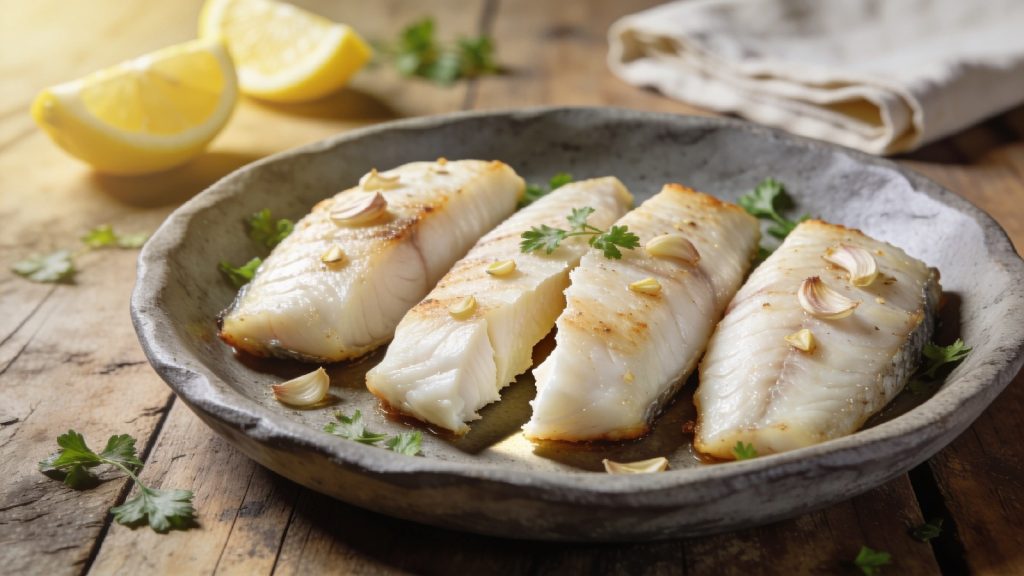
Bake uncovered, then check
Bake uncovered. Take the first reading at 10 minutes for 2.5 cm (1-inch) fillets — at 5 minutes for 1.3 cm (1/2 inch) and at 15 minutes for 4 cm (1 1/2 inches). Push an instant-read thermometer in from the side of the fillet into its thickest part.
6 Take it out at 63°C (145°F)
The cod is done at 63°C (145°F), or when the flesh is no longer translucent and separates easily with a fork. If it is not there yet, return the dish to the oven for 2 minutes and check again.
Finish and serve
7 Finish and serve
Scatter the 2 tablespoons of chopped parsley over the fillets, spoon the lemon-garlic juices from the dish over the top, and serve right away with the lemon wedges.
Servings 4
Serving Size 1 of 4 fillets
- Amount Per Serving
- % Daily Value *
- Total Fat 8g11%
- Saturated Fat 1g5%
- Cholesterol 73mg25%
- Sodium 384mg17%
- Potassium 728mg16%
- Total Carbohydrate 1g1%
- Protein 31g62%
- Vitamin A 26 mcg RAE
- Vitamin C 7 mg
- Calcium 36 mg
- Iron 1 mg
* Percent Daily Values are based on a 2,000 calorie diet. Your daily value may be higher or lower depending on your calorie needs.
Note
- Measure the fillet, not the clock. The first check is set by thickness: 5 minutes for 1.3 cm (1/2 inch), 10 minutes for 2.5 cm (1 inch), 15 minutes for 4 cm (1 1/2 inches), then every 2 minutes after that. It is the old rule of 10 minutes per inch, and both Clemson Cooperative Extension and NC Sea Grant give it for a 230°C (450°F) oven. At 200°C (400°F) the fish should not be done any sooner, so treat those minutes as the moment to start checking, not the moment to stop.
- The finish line is 63°C (145°F). FoodSafety.gov lists cod by name: 145°F (63°C), or cook until the flesh is no longer translucent and separates easily with a fork. Some chef guides pull cod at 54–57°C (130–135°F) for a softer center; that sits below the official target, and this recipe is written to 63°C (145°F).
- Cod loin or fillet: UK shops often sell cod as loin, the thick center cut, rather than as fillet. It bakes the same way — measure it, because a thicker piece gets its first check later.
- From frozen: the FDA’s advice is to thaw seafood in the refrigerator overnight, or sealed in a plastic bag in cold water when you are short on time. If you bake straight from frozen, Clemson Cooperative Extension doubles the time for unthawed fish (20 minutes per inch at 230°C / 450°F), so double your first check, pat off any surface ice before seasoning, and let the thermometer decide.
- Swaps: haddock, Pacific cod, and Alaska pollock bake the same way by thickness. They are not equal on iodine: per 4 oz (110 g) raw, the USDA, FDA and ODS-NIH iodine database lists haddock at 250 mcg, Pacific cod at 144 mcg, Atlantic cod at 125 mcg, and Alaska pollock at 48 mcg — each from only 3 to 8 samples, so read them as rough averages.
- Butter version: replace 15 ml (1 tablespoon) of the olive oil with 15 g (1 tablespoon) melted butter. The recipe is then no longer dairy-free, and the nutrition card, which is calculated with olive oil only, will run slightly different.
- How the nutrition was calculated: from one USDA FoodData Central SR Legacy record per ingredient — Atlantic cod, raw 171955, olive oil 171413, garlic 169230, lemon juice 167747, lemon peel 167749, parsley 170416, black pepper 170931 and table salt 173468 — adjusted with USDA Release 6 retention factors for baking (row 2302, lean fish baked with its juices, for the cod; 3771 for the garlic and pepper; 0270 for the lemon juice and zest; the parsley goes on raw), then divided by four servings. The lemon wedges served alongside are not counted. Iodine is not on the card because USDA’s standard records do not carry it; the iodine figures in the article come from the separate USDA, FDA and ODS-NIH Database for the Iodine Content of Common Foods (Release 4, 2024).
Keywords:
Baked Cod, Lemon Garlic Baked Cod, Cod Fillets, Baked Cod Internal Temperature, Cod Loin, Healthy Seafood Dinner, Iodine
Did you make this recipe?