



Eating oatmeal every day may lower LDL cholesterol, steady blood sugar, keep you full longer, and feed your gut bacteria. Here’s how strong the evidence actually is for each one — including an honest read on the two-day trial behind January’s headlines.
The plainest bowl on the breakfast table may be the best-studied. Oatmeal (porridge, to UK readers) carries decades of cholesterol research — and in January 2026, a German trial grabbed headlines with a 10% LDL drop in two days. The fine print tells a better story.
So what are the benefits of eating oatmeal every day? Here are six, each backed by published research — plus ways to build a better bowl.
What the evidence says
Strongest · Lower LDL cholesterol. 17 randomized trials in 1,731 people, moderate certainty.
Strong, but observational · Whole grains and a longer life. 45 cohort studies — association, not proof of cause.
Limited · Steadier blood sugar and longer-lasting fullness. 4 trials in 350 people; one crossover trial in 48 adults.
Weakest · The viral two-day cholesterol drop. 32 people — and calories were cut to 1,100–1,200 a day at the same time.
1. It May Help Lower LDL Cholesterol
Oats are rich in beta-glucan, a soluble fiber that gels in the gut and escorts cholesterol-laden bile acids out; to replace them, the liver pulls LDL from the blood.
A 2024 review in Food & Function pooled 17 randomized trials in 1,731 people with unhealthy blood lipids: four-plus weeks of oat products lowered LDL by 0.24 mmol/L (about 9 mg/dL) and total cholesterol by 0.32 mmol/L (about 12 mg/dL), with moderate certainty — though the authors flag a high risk of bias in many trials.
Harvard’s Nutrition Source puts the dose at 3 g of beta-glucan a day from whole oats — the threshold for the FDA-permitted heart-health claim — linked to a modest drop of roughly 12 points.
2. A New 2026 Trial Shows Why the Details Matter
In Nature Communications on January 14, 2026, University of Bonn researchers published a two-part oat trial in adults with metabolic syndrome. Part one (32 finishers — 17 on oats, 15 controls) was extreme: two days at 1,100–1,200 calories, the oat group eating 300 g (10.5 oz) of oats daily as three oatmeal meals.
LDL fell about 16 mg/dL (0.42 mmol/L) more than in the control group — roughly 10%. Cholesterol then tended to stay below where it started through a six-week, oat-free follow-up — the authors put it no more strongly than that. With a dose that large and calories that low, oats can’t take sole credit.
Part two mirrored real life — 34 adults, 80 g (about 1 cup) of oats a day replacing one meal, six weeks, calories unchanged — and LDL didn’t differ significantly between groups.
The cleanest finding is the mechanism: oats multiplied gut bacteria that make phenolic compounds — ferulic and dihydroferulic acid — which appear to act on cholesterol metabolism. The authors, noting small samples prone to baseline imbalances and an uneven sex split, call for a larger multicenter trial. For tomorrow’s breakfast, the four-plus-week evidence above is the better guide.
3. It May Help Steady Blood Sugar
The same gel slows how quickly carbohydrates leave the stomach and may flatten post-meal glucose spikes.
In a 2016 Nutrients meta-analysis — four trials, 350 patients with type 2 diabetes — 2.5–3.5 g of oat beta-glucan daily for three to eight weeks lowered fasting glucose by 0.52 mmol/L (about 9 mg/dL) and HbA1c, a three-month blood sugar average, by 0.21%. Fasting insulin didn’t budge, and the authors admit the evidence is thin — four studies, little long-term data.
4. It May Keep You Full Longer
In a 2014 crossover trial in Nutrition Journal, 48 adults ate three 218-calorie breakfasts: instant oatmeal, rolled (old-fashioned) oatmeal, or a boxed ready-to-eat cereal. Over the next four hours, the instant oatmeal beat the cereal on all three counts: fullness, desire to eat, and how much people planned to eat next. The rolled oats won on that last measure alone. The authors still judged both oatmeals better than the cereal for appetite control.
Viscosity explains it: beta-glucan thickens the meal in the stomach, and oatmeal carried more than the cereal.
5. It Feeds the Bacteria in Your Gut
Beta-glucan also moonlights as a prebiotic. As gut microbes ferment this fiber, Harvard’s Nutrition Source notes, gut microbiome diversity appears to increase — and the Bonn trial hints those microbes return the favor. Oats pack insoluble fiber, phosphorus, thiamin, magnesium, and zinc, too.
That prebiotic pull is partly why oats got a passing mention on our list of 9 powerful anti-inflammatory foods.
6. As a Whole Grain, It’s Linked to a Longer, Healthier Life
A 2016 dose-response meta-analysis in The BMJ, spanning 45 prospective studies, linked every 90 g of whole grains a day (three servings, oatmeal included) to 19% lower coronary heart disease risk, 22% lower cardiovascular risk, 17% lower all-cause mortality, and 15% lower cancer mortality.
The caveat: observational studies show association, not causation — and this covers whole grains as a group, not oats alone.
How to Use Oatmeal in Your Kitchen
Which oats to buy comes down to processing: chewy, nutty steel-cut oats digest slowest, for the lowest glycemic index; rolled (old-fashioned) oats are steamed flat; instant cook fastest and often hide added sugar — read the label. All three are whole grains.
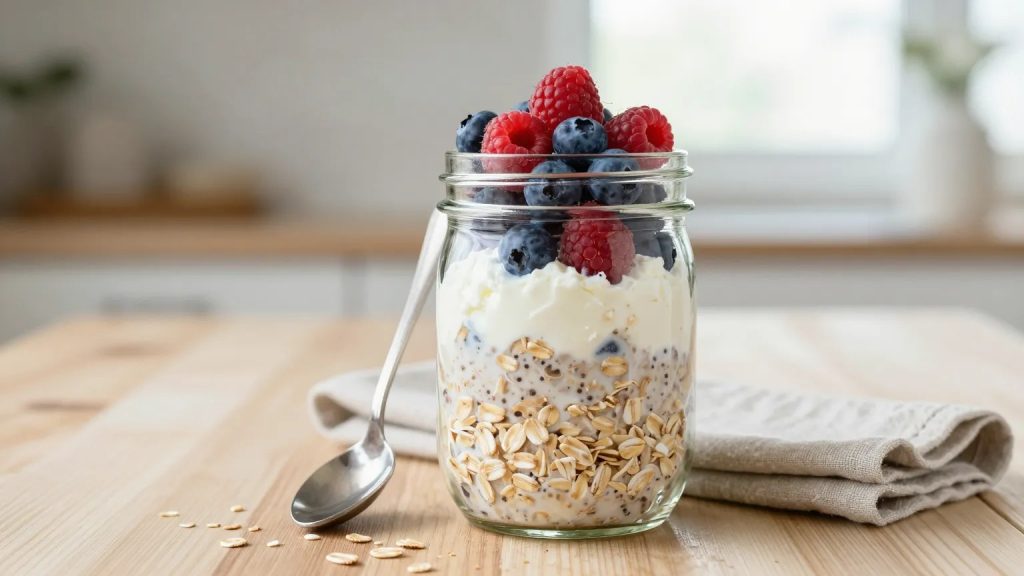
Aim for roughly 60–80 g (3/4 to 1 cup) of dry oats a day to reach that 3 g of beta-glucan (the Bonn trial’s six-week arm packed 3.5 g into its 80 g daily dose); overnight oats — rolled oats soaked in milk in the fridge — get there with zero cooking.
For high-protein oatmeal, stir in a spoonful of cottage cheese — the same ingredient behind our 10-Minute Creamy Avocado & Cottage Cheese Toast. Top with fruit, nuts, or cinnamon instead of syrup, so added sugar doesn’t undo the fiber’s work.
Oatmeal Nutrition Facts
Frequently Asked Questions
How much oatmeal should you eat per day?
A typical serving is 40–50 g (about 1/2 cup) of dry oats; 60–80 g (3/4 to 1 cup) reaches the 3 g beta-glucan fiber mark. Go gradually — trial side effects were mostly digestive, like gas and nausea.
Is oatmeal good for weight loss?
It may help indirectly: at identical calories, both oatmeals beat the cereal for appetite control in the trial above. No single food drives weight loss — portions and toppings still decide.
What’s the difference between steel-cut, rolled, and instant oats?
Processing. Steel-cut oats are chopped whole groats; rolled are steamed and flattened; instant are rolled thinner and precooked — fastest to digest, highest glycemic index. All three still count as whole grains.
Are overnight oats healthy?
They’re the same rolled oats, just softened in liquid overnight instead of cooked. Milk or plain yogurt and fruit keep the jar balanced, while sugary add-ins turn breakfast into dessert.
The Bottom Line: Benefits of Eating Oatmeal Every Day
A daily bowl of oatmeal earns its reputation: trials link it to lower LDL cholesterol and steadier blood sugar, it appears to hold appetite in check longer than ready-to-eat cereal, and whole-grain eaters show lower mortality in large cohorts. The 2026 trial’s real lesson: dose, calories, and time frame decide what oats can do. If you take cholesterol or diabetes medication, talk to your doctor first. Keep it simple — oats, milk, blueberries — and see what happened when a doctor ate them every day for a week.
Sources
- Food & Function, 2024 — “Efficacy of oats in dyslipidemia: a systematic review and meta-analysis.” https://pubmed.ncbi.nlm.nih.gov/38441173/
- Nature Communications, January 14, 2026 — Klümpen L, et al. “Cholesterol-lowering effects of oats induced by microbially produced phenolic metabolites in metabolic syndrome: a randomized controlled trial” (University of Bonn). Nat Commun. 2026;17(1):598. https://www.nature.com/articles/s41467-026-68303-9
- Nutrients, 2016 — “Effect of Oat β-Glucan Intake on Glycaemic Control and Insulin Sensitivity of Diabetic Patients: A Meta-Analysis of Randomized Controlled Trials.” https://pubmed.ncbi.nlm.nih.gov/26771637/
- Nutrition Journal, 2014 — “The role of meal viscosity and oat β-glucan characteristics in human appetite control: a randomized crossover trial.” https://pubmed.ncbi.nlm.nih.gov/24884934/
- Harvard T.H. Chan School of Public Health — The Nutrition Source, “Oats.” https://nutritionsource.hsph.harvard.edu/food-features/oats/
- The BMJ, 2016 — “Whole grain consumption and risk of cardiovascular disease, cancer, and all cause and cause specific mortality: systematic review and dose-response meta-analysis of prospective studies.” https://pmc.ncbi.nlm.nih.gov/articles/PMC4908315/