



Eating blueberries every day is worth doing, but a week tells you nothing. A cup is 84 calories, 24% of the Daily Value for vitamin K and 22% for manganese. The one trial that ran long enough found a real effect at a cup a day — and none at half a cup.
The version of this page that used to sit here followed a family physician who ate blueberries for seven days and reported feeling more energetic, with brighter skin and better digestion. That is one person, one week, and no measurement — the kind of evidence that cannot separate a fruit from the attention paid to eating well while you are watching yourself.
The interesting thing is that the real trial exists, it is much longer, and it comes with a dose. Figures below are USDA values per 100 g (about 3.5 oz); a cup of blueberries is 148 g.
What the evidence says
Solid · A cup a day improved blood-vessel function over six months. Curtis and colleagues randomized 115 adults with metabolic syndrome, double-blind, for 6 months: 150 g of blueberries a day raised flow-mediated dilatation by 1.45 percentage points and reduced arterial stiffness (AJCN, 2019).
Solid · Half a cup did nothing measurable. The same trial tested 75 g against matched placebo and found no significant effect. The dose is the finding, and it is the part that gets left out.
Weakest · “I ate blueberries for a week and felt better.” One person, seven days, self-reported energy, skin and digestion, with no control and no measurement. It is a story, not a result — and it was the entire basis of the article this replaces.
The catch · Washing them in lemon juice does nothing extra. The FDA is explicit: rub produce under plain running water; there is no need for soap or a produce wash, and the effectiveness of such washes “has not been tested”.
1. A Cup a Day May Improve Blood-Vessel Function
This is the claim with a proper trial behind it. Curtis and colleagues gave 115 adults with metabolic syndrome either 150 g of blueberries a day, 75 g, or a matched placebo powder, double-blind, for six months. At the full cup, flow-mediated dilatation — how well an artery widens when blood flow rises — improved by 1.45 percentage points, and arterial stiffness fell.
At half a cup, nothing. That is the sentence most coverage drops, and it is the useful one: the effect is real but dose-dependent, and a few berries on your porridge is not the intervention that was tested.
2. It Delivers Vitamin K and Manganese, Not Much Else
A cup gives 24% of the Daily Value for vitamin K and 22% for manganese, plus 16% for vitamin C and 13% for fiber, at 84 calories. That is a genuinely good return for a snack. There is one use for a cup of blueberries that has nothing to do with what is inside them: simmered down and strained, that juice is the color in our lilac buttercream flower cake, which gets its shade without a drop of FD&C Red No. 40 or Blue No. 1 — and the 84 calories come along for the ride.
Beyond that the picture thins fast: 2% of the Daily Value for potassium, 2% for iron, and — despite the reputation berries carry — essentially no vitamin A, at 3 µg RAE per 100 g. Blueberries are not a multivitamin.
3. The Color Is the Active Part
Anthocyanins, the pigments that make blueberries blue, are what the cardiovascular work is chasing — not the vitamin content. They are water-soluble and heat-sensitive, which is why the trial used fresh and freeze-dried berries rather than baked ones.
That does not make a blueberry muffin pointless, but it does mean the version with the evidence behind it is the raw one.
4. Frozen Counts, and Costs Less
Blueberries are picked ripe and frozen within hours, and freezing does not meaningfully degrade anthocyanins — ice crystals rupture the cell walls, which if anything makes the pigments easier to release. For a cup a day, all year, frozen is the practical answer.
How to Use Blueberries in Your Kitchen
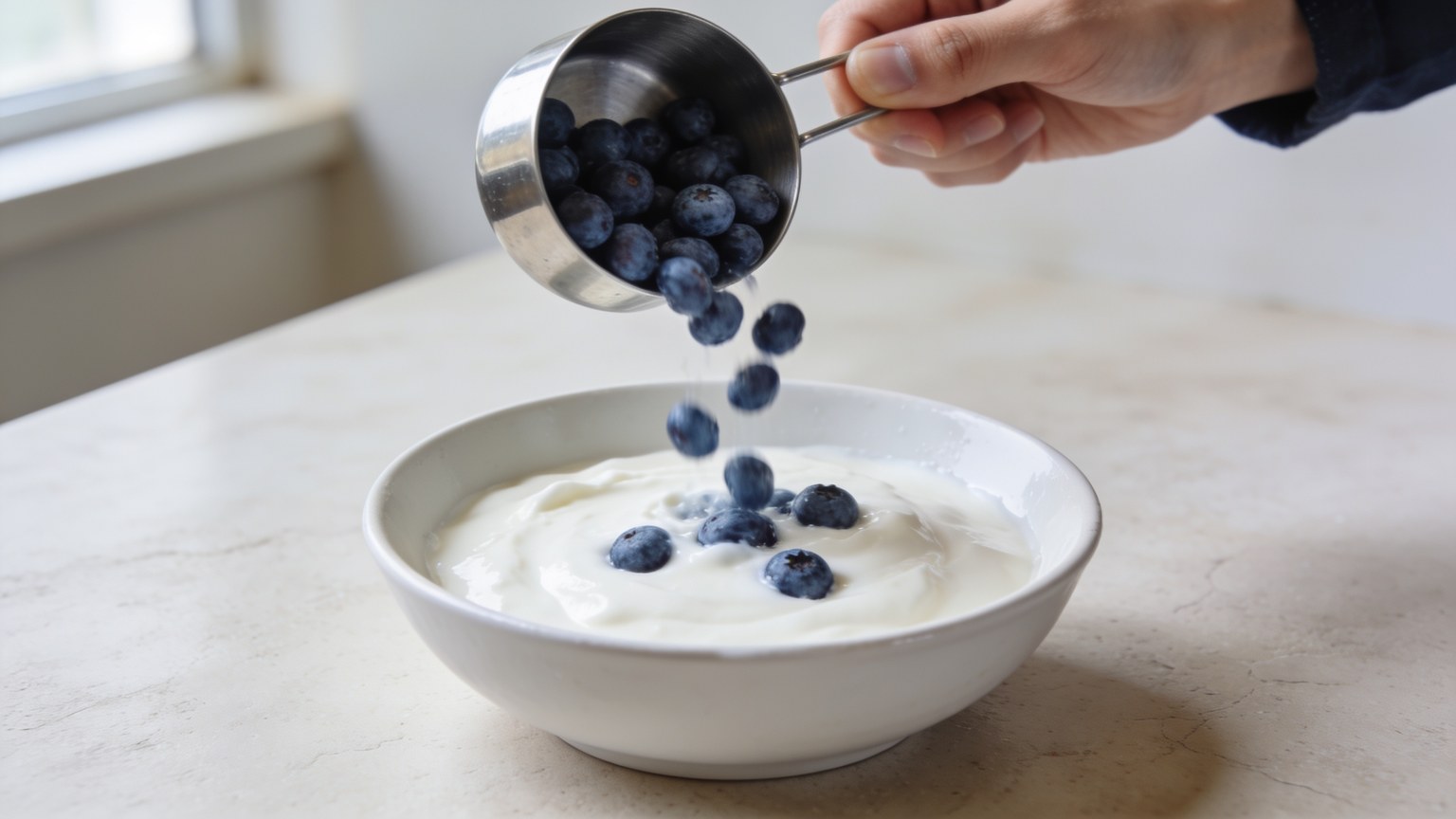
- Measure the cup once. 148 g is more than most people pour by eye, and the dose is the whole point.
- Wash under plain running water, and only just before eating. No lemon, no soap, no produce wash — the FDA advises against all three. Washing before storage traps moisture and brings on mold.
- Keep them raw where you can. Yogurt, oats, a handful on their own — heat costs you the anthocyanins the research is about.
- Frozen straight from the bag into porridge or a smoothie; no need to thaw, and they stop the porridge scalding your mouth.
- Store unwashed in the refrigerator, in the punnet or a loosely covered box, up to a week.
Blueberry Nutrition Facts
Frequently Asked Questions
How many blueberries should I eat a day?
The only long trial with a clear result used one cup, 148 g, a day for six months. The same trial tested half that and found no significant effect. If you are eating them for the cardiovascular evidence rather than the taste, the cup is the number.
Are frozen blueberries as good as fresh?
For anthocyanins, yes — berries are frozen soon after picking, and ice crystals rupture the cells, which makes the pigments easier to release rather than harder. Frozen is also what makes a cup a day affordable outside the season.
Should I wash blueberries in vinegar or lemon juice?
No. The FDA says to rub produce under plain running water and that there is no need for soap or a commercial produce wash, whose effectiveness “has not been tested”. Wash them just before eating — washing before storage leaves moisture on the skins and brings on mold.
The Bottom Line
Blueberries earn their place, but for a narrower reason than the usual list: a cup a day, for months rather than a week, measurably improved blood-vessel function in people with metabolic syndrome — and half a cup did not. Everything else is an 84-calorie snack with good vitamin K and manganese. Eat them raw, buy them frozen, and measure the cup once so you know what one looks like. Our profile of eating oatmeal every day covers the bowl most of them end up in, and holds its claims to the same standard.
Sources
- Curtis P.J. et al., Blueberries improve biomarkers of cardiometabolic function in participants with metabolic syndrome — results from a 6-month, double-blind, randomized controlled trial, American Journal of Clinical Nutrition, 2019;109(6):1535–1545 — 115 participants; 150 g/day raised flow-mediated dilatation 1.45 percentage points and reduced arterial stiffness, 75 g/day did not — https://pubmed.ncbi.nlm.nih.gov/31136659/
- USDA FoodData Central — “Blueberries, raw”, FDC ID 171711 — every per-100-g figure here — https://fdc.nal.usda.gov/food-details/171711/nutrients
- U.S. Food and Drug Administration, 7 Tips for Cleaning Fruits, Vegetables — rub produce under plain running water; no need for soap or produce wash, and the safety and effectiveness of commercial washes is not established — https://www.fda.gov/consumers/consumer-updates/7-tips-cleaning-fruits-vegetables
- U.S. Food and Drug Administration, Daily Value and Percent Daily Value — the reference values behind every percentage — https://www.fda.gov/files/food/published/DV-Percent-DV-Nutrition-Facts-Label_09072023.pdf