



Chickpeas simmered in a spiced tomato-coconut sauce: one pot, about 40 minutes, and 11 g of fiber in every bowl — with the chickpea dose that lowered LDL cholesterol in 26 randomized trials. The honest part most recipes skip: the coconut milk that makes it creamy also carries nearly a day’s saturated fat. Both numbers are below.
This creamy coconut chickpea curry is the weeknight dish that meal-prep dreams are made of: everything from cans and the spice rack, one pot, better tomorrow than today. The onion and spices do their work in the first ten minutes; after that it’s a gentle simmer while the rice cooks.
One correction from our earlier version, which called coconut milk a stand-in “instead of cream or yogurt.” Coconut milk isn’t a substitute in this kind of cooking — it’s the original. Across South Indian and Sri Lankan coastal kitchens, coconut milk is the everyday base of curries and always has been; the cream-and-yogurt style belongs to a different, northern family of dishes. This bowl descends from the coconut branch, honestly and deliciously.
Why This Coconut Chickpea Curry Works
- Bloomed spices. Cumin, turmeric, and garam masala hit hot oil for 30 to 60 seconds before any liquid — their flavors are fat-soluble, and this one step is the difference between a curry and stew-with-spices.
- Canned chickpeas hold their shape. They’re already cooked, so 15 minutes of simmering warms them through and tightens the sauce without turning them to mush.
- Acid at the end. Lime juice goes in off the heat, so its brightness — and its vitamin C — survive to the bowl.
- Dietary note: vegan, dairy-free, and gluten-free as written (check your garam masala’s label if celiac disease is in the picture; serve with rice rather than naan).
Why This Coconut Chickpea Curry Is Good for You (and What the Coconut Costs)
What the evidence says
Solid · A daily serving of pulses — beans, chickpeas, lentils — lowered LDL cholesterol across 26 randomized trials. 1,037 participants; the median trial dose was 130 g a day. This bowl carries 120 g of chickpeas.
Strong, but observational · Moderate curry eaters lived longer in 11.6 years of Singapore data — with the benefit sitting at moderate, not maximal, consumption. 4,551 adults; association, not causation.
The catch · Full-fat coconut milk gives one bowl 19 g of saturated fat — nearly the full FDA daily value. Gram for gram, canned coconut milk carries about four-fifths as much saturated fat as heavy cream. Light coconut milk cuts it sharply.
Start with what the chickpeas earn. A bowl delivers 11 g of fiber — more than a third of the daily value — and 12 g of plant protein. The cholesterol evidence here is unusually direct: a systematic review of 26 randomized trials found that a daily serving of dietary pulses lowered LDL cholesterol by 0.17 mmol/L, at a median dose of 130 g a day (CMAJ, 2014). That’s not a supplement dose or a stretch — it’s almost exactly the 120 g of chickpeas in one serving of this curry. The same can does the job cold: our chickpea avocado toast smashes it onto sourdough for 10 g of fiber and 11 g of plant protein a slice.
The iron story is better than most people expect from a vegan pot: 6.4 mg per bowl — over a third of the daily value — from the chickpeas, the coconut milk, and, surprisingly, the spice rack; cumin and turmeric are concentrated iron sources by weight. Plant iron absorbs poorly on its own, which is one more job for that finishing lime: vitamin C taken in the same meal helps convert it into the form your body takes up.
Turmeric earns a sober sentence rather than a sermon. The trials that moved arthritis pain scores used concentrated curcumin supplements at doses no dinner reaches, and the Singapore cohort data that links curry dishes with longer life is observational, with the benefit at moderate intake — our breakdown of that data has the honest numbers. A weekly curry fits what the evidence rewards; nightly vats do not.
Now the coconut. Full-fat coconut milk is why this sauce is silky — and why one bowl carries 19 g of saturated fat, nearly the full FDA daily value of 20 g. The comparison worth knowing: per 100 g, canned coconut milk holds 18.9 g of saturated fat against heavy cream’s 23 (USDA). “Dairy-free” and “light” are different claims, and this dish is only one of them. If saturated fat is a number you watch, the light-coconut-milk swap in the Note cuts it sharply and costs you a little body, nothing more. The sodium is honest too: 865 mg a bowl, most of it from the canned chickpeas, tomatoes, and the ¾ teaspoon of salt — low-sodium cans bring it down fast.
Coconut Chickpea Curry FAQ
Can I use light coconut milk in chickpea curry?
Yes — it swaps 1:1 and cuts the saturated fat sharply, which is this dish’s one heavy number. The sauce comes out thinner, so simmer about 5 minutes longer, or mash a few chickpeas against the pan to thicken it.
Do I need to cook dried chickpeas first?
No — canned chickpeas are fully cooked and hold their shape through the simmer. If you prefer dried, soak and cook about 180 g (1 cup) until tender first; you’ll need roughly 480 g cooked for this recipe.
How do I make the curry thicker?
Simmer it uncovered a few minutes longer, or press a spoonful of chickpeas against the side of the pan and stir — their starch tightens the sauce naturally. Skip flour or cornstarch; this sauce doesn’t need them.
Why add the lime juice at the end?
Acid brightens a rich coconut sauce, and it fades if it simmers. Stirring it in off the heat keeps the lift — and the vitamin C it brings helps your body absorb the iron from the chickpeas and spices.
Serving and Storage
Basmati rice is the classic bed; warm naan is the classic regret-nothing addition. Either way, finish each bowl with cilantro and a last squeeze of lime. If you’re building a chickpea rotation, our spicy chickpea and quinoa bowl is the cold-weather cousin from the same pantry. For a cold, no-cook take on a plant-based Asian sauce, see our gluten-free peanut noodles. Coconut milk is what makes this curry rich, and also what makes its saturated fat the number to watch; a bowl built on lentils and tahini instead — our sweet potato Buddha bowl with red lentils — lands at 4.1 g of saturated fat a serving.
This curry is a genuine meal-prep dish: it deepens overnight, keeps 4 days refrigerated, and freezes up to 3 months. Coconut sauces can separate on thawing — reheat gently and stir hard, and the sauce comes back together. Coconut milk is what makes this curry rich, and also where its saturated fat comes from; when we wanted the same creaminess without it, we blended silken tofu instead — 2.7 g of fat per 100 g against 21.33 g — in our vegan mushroom stroganoff.
Sources
- CMAJ, 2014 — “Effect of dietary pulse intake on established therapeutic lipid targets for cardiovascular risk reduction: a systematic review and meta-analysis of randomized controlled trials.” CMAJ. 2014;186(8):E252-E262. PMID 24710915. https://pubmed.ncbi.nlm.nih.gov/24710915/
- GeroScience, 2024 — Ng TP, Nyunt SZ, Gao Q, Gwee X, Chua DQL, Yap KB. “Curcumin-rich curry consumption and life expectancy: Singapore longitudinal ageing study.” GeroScience. 2024;46(1):969-980. PMID 37306893. https://pubmed.ncbi.nlm.nih.gov/37306893/
- USDA FoodData Central, SR Legacy — “Chickpeas, canned, drained solids” (173800), “Tomatoes, red, ripe, canned, packed in tomato juice” (170051), “Nuts, coconut milk, canned” (170173), “Cream, fluid, heavy whipping” (170859, for the comparison), plus the remaining listed ingredients. https://fdc.nal.usda.gov/
- US FDA — Daily Values for Nutrition and Supplement Facts Labels (saturated fat 20 g; fiber 28 g; iron 18 mg). https://www.fda.gov/food/nutrition-facts-label/daily-value-nutrition-and-supplement-facts-labels
Recipe Details
Recipe Card
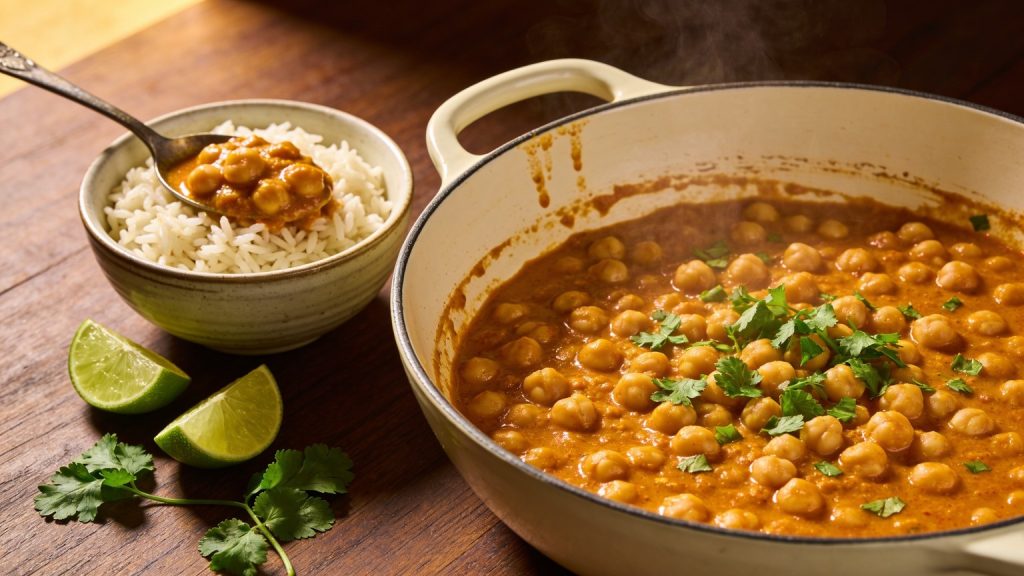

Creamy Coconut Chickpea Curry: 11 g of Fiber a Bowl — and an Honest Word About the Coconut
Description
Chickpeas simmered in a spiced tomato-coconut sauce — a one-pot vegan curry ready in about 40 minutes, with 11 g of fiber a bowl. Creamy comes from full-fat coconut milk; the honest cost of that is in the article.
Ingredients
For the base
For the spices
For the curry
For serving (optional, not in the nutrition card)
Instructions
Build the base
-
Soften the onion
Warm 15 ml (1 tablespoon) of olive oil in a deep skillet or pot over medium heat. Add the diced onion with a pinch of the salt and cook, stirring now and then, for 5 to 7 minutes until soft and golden at the edges.
-
Add garlic and ginger
Stir in the minced garlic and grated ginger and cook for 1 minute, just until fragrant — they burn faster than onion, so keep them moving.
-
Bloom the spices
Add the cumin, coriander, turmeric, garam masala, and chili flakes. Stir constantly for 30 to 60 seconds until the spices smell toasty and coat the onion — blooming them in the oil wakes up their fat-soluble flavors.
Simmer the curry
-
Cook down the tomatoes
Pour in the 400 g can of diced tomatoes with their juice, scraping up anything stuck to the pan. Simmer for 5 minutes, stirring occasionally, until slightly thickened and darker.
-
Add chickpeas and coconut milk
Stir in the drained chickpeas (480 g) and the full can of coconut milk. Bring to a gentle simmer — small lazy bubbles, not a boil — and cook uncovered for 12 to 15 minutes, stirring occasionally, until the sauce coats a spoon.
-
Season and finish
Off the heat, stir in 3/4 teaspoon of fine salt and the lime juice (30 ml / 2 tablespoons). Taste — it should be creamy, gently spiced, and bright at the end. Scatter the chopped cilantro (coriander) over the top and serve over rice or with naan.
Nutrition Facts
Servings 4
Serving Size 1 of 4 bowls
- Amount Per Serving
- Calories 437kcal
- % Daily Value *
- Total Fat 28g36%
- Saturated Fat 19g95%
- Sodium 865mg38%
- Potassium 703mg15%
- Total Carbohydrate 40g15%
- Dietary Fiber 11g40%
- Sugars 9.3g
- Protein 12g24%
- Vitamin A 35 mcg RAE
- Vitamin C 16 mg
- Calcium 136 mg
- Iron 6.4 mg
* Percent Daily Values are based on a 2,000 calorie diet. Your daily value may be higher or lower depending on your calorie needs.
Note
- Lighter version: light coconut milk works 1:1 and cuts the saturated fat sharply — the sauce will be thinner, so simmer 5 extra minutes. Check your can; brands vary widely.
- Rinse the chickpeas. Rinsing and draining sheds the metallic-tasting canning brine; the card’s sodium is computed for drained chickpeas plus the listed salt.
- Bloom, don’t dump: the 30-to-60-second fry in step 3 is where the curry’s depth comes from — turmeric and cumin flavors are fat-soluble and open up in oil, not in liquid.
- Better tomorrow: like most curries this one deepens overnight — it keeps 4 days refrigerated and is a genuine meal-prep dish.
- Freezes well, with one move: up to 3 months. Coconut sauces can separate on thawing — reheat gently and stir hard, and it comes back together.
- Add-ins that work: two handfuls of spinach wilted in at the end, or frozen peas in the last 3 minutes. Sweet potato needs pre-cooking — it won’t soften in 15 minutes of simmering.
- Nutrition method: the card is computed per serving from USDA FoodData Central records for each listed ingredient (chickpeas 173800, tomatoes 170051, coconut milk 170173, and the rest), with cooking-retention factors applied to simmered vegetables’ vitamin C. Garam masala has no USDA record, so the closest record (curry powder, 170924) stands in for its 1 teaspoon.