



Mushrooms browned hard, then folded into a sauce blended from silken tofu rather than cashews or coconut milk — vegan mushroom stroganoff at 430 calories and 20 g of protein a plate. The odd step costs nothing: fifteen minutes with the sliced mushrooms out in the sun before they ever meet the pan.
The sun does its work on the mushrooms, not on the sauce. USDA FoodData Central lists cremini mushrooms (chestnut mushrooms) at 0.1 µg of vitamin D per 100 g raw (FDC 168434), and the very same mushroom after exposure to ultraviolet light at 31.9 µg (FDC 168557). Same 22 calories, same 448 mg of potassium, same 26 µg of selenium. One row of the table moves, and it moves by a factor of more than three hundred.
Stroganoff in its classic form is beef, mustard and sour cream (soured cream). Take the meat out and mushrooms step in easily; take the cream out and the trouble starts. Almost every version on the first page of a search solves it the same two ways — canned coconut milk or a blended cashew cream — and readers keep typing “without cream” anyway.
This one uses a whole 349 g (12.3 oz) carton of silken tofu blended smooth with vegetable broth. It pours like heavy cream (double cream), it is nut-free, and it leaves the mushrooms tasting like mushrooms. Total time is about 55 minutes, fifteen of them spent doing nothing while a tray sits outside.
Why This Vegan Mushroom Stroganoff Works
- The cream is a carton of tofu. No cashews to soak, no coconut to taste, no dairy — 2.7 g of fat per 100 g against 21.33 g for canned coconut milk (USDA FDC 172461 and 170173).
- Fifteen free minutes of sun. Sliced mushrooms laid out in direct sunlight are the only part of this recipe you cannot buy — and the dish cooks the same without it.
- Browning is the seasoning. Six hundred grams (1 lb 5 oz) of mushrooms stay in a wide skillet (frying pan) until it is dry again — that is where the meaty note comes from.
- Sodium kept on a short leash. Two teaspoons of tamari instead of a tablespoon, and a quarter teaspoon of added salt, because the broth and the pasta water bring plenty of their own.
- Vegan and dairy-free as written, and gluten-free with a ribbon pasta swap and cornstarch (cornflour) in place of the flour.
Why This Mushroom Stroganoff Is Good for You
One of four plates comes to 430 calories with 20 g of protein, 11.1 g of fat, 1.7 g of saturated fat, 64 g of carbohydrate and 5.4 g of fiber. The protein is two fifths of the daily value, the iron (4.5 mg) a quarter of it, the potassium (1,067 mg) close to a quarter, the fiber close to a fifth. The number to watch is sodium: 810 mg, more than a third of a day. Every figure comes from USDA FoodData Central adjusted with the USDA Table of Nutrient Retention Factors (Release 6), divided by four.
What the evidence says
Strongest · Ultraviolet light moves the vitamin D line of a mushroom’s nutrition and leaves the rest of the plate where it was. USDA SR Legacy puts raw cremini at 0.1 µg of vitamin D per 100 g (FDC 168434) and UV-exposed cremini at 31.9 µg (FDC 168557), with calories, potassium and selenium identical in both records. White button mushrooms sit in the same pair: 0.2 against 26.2 µg (FDC 169251 and 169376).
Single study · Fifteen minutes of sunlight is what was actually measured, once. Urbain and Jakobsen laid sliced Agaricus bisporus in the sun and tracked the UV-B dose with a spectroradiometer: after 15 minutes and a dose of 0.13 J/cm², vitamin D2 rose from 0.1 to 2.2 ± 0.5 µg per gram of dry weight (P < 0.0001), which they put at 17.6 µg (704 IU) per 100 g of fresh mushrooms (Journal of Agricultural and Food Chemistry, 2015). One dose-response experiment, on one day, in one place — other latitudes and seasons were not tested.
Moderate · Whether it reaches your blood depends on who is eating, and two trials disagree. Urbain, Singler, Ihorst, Biesalski and Bertz split 26 young adults with serum 25-hydroxyvitamin D at or below 50 nmol/L into three groups for five weeks in winter — soup made from irradiated mushrooms, a D2 supplement, or placebo — so about nine people carried each arm; 25OHD rose 3.9 nmol/L a week (95% CI 2.9–4.8) against 4.7 (95% CI 3.8–5.7) on a supplement (European Journal of Clinical Nutrition, 2011). Mehrotra, Calvo, Beelman, Levy, Siuty, Kalaras and Uribarri fed 43 prediabetic, vitamin-D-deficient adults with a BMI above 25 a daily entrée of 100 g of cooked mushrooms for 16 weeks and saw “modest or no increases” (same journal, 2014). Their comparison group turned out to be a strong one: the D3 capsules those subjects took measured about 1,242 and 7,320 IU a day, higher than their labels said. Both used a laboratory dose, not sunlight; the 2011 mushrooms took 1.5 J/cm², about eleven and a half times the sunlight dose above.
Solid · Silken tofu is the lightest of the three usual stand-ins for cream. Per 100 g, USDA lists silken firm tofu at 6.9 g of protein, 2.7 g of fat and 0.406 g of saturated fat (FDC 172461); canned coconut milk at 2.02 g, 21.33 g and 18.92 g (FDC 170173); raw cashews at 18.22 g, 43.85 g and 7.78 g (FDC 170162). The tofu record is a branded one (MORI-NU) because SR Legacy has no generic silken entry, so another carton will read a little differently.
The catch · Cooking takes some of the vitamin D back, and the plate carries 810 mg of sodium. The 2014 trial reported that the D2 dose was significantly lower after cooking and named that loss as one likely reason its results were flat. On sodium, 196 of the 810 mg come from boiling the pasta in salted water and 227 mg from the broth (USDA FDC 169751 and 171180) — both are yours to change. If you are being treated for low vitamin D, talk to your doctor first; this is dinner, not a dose.
Mushrooms carry ergosterol, and ultraviolet light converts it into vitamin D2 (ergocalciferol) — the same kind of reaction, on a tray, that sunlight sets off in skin. That is why the two USDA records exist at all, and why the gap between them is so lopsided.
| Same mushroom, 100 g raw | Cremini, ordinary FDC 168434 |
Cremini, UV-exposed FDC 168557 |
|---|---|---|
| Vitamin D (D2 + D3) | 0.1 µg (3 IU) | 31.9 µg (1,276 IU) |
| Share of the 20 µg Daily Value | 0.5% | 160% |
| Calories | 22 | 22 |
| Potassium | 448 mg | 448 mg |
| Selenium | 26 µg | 26 µg |
| Protein | 2.5 g | 2.5 g |
Source: USDA FoodData Central, SR Legacy records 168434 and 168557, both published April 1, 2019. Percent Daily Values use the FDA reference value of 20 µg for vitamin D.
Read that table in both directions. The ordinary mushroom loses the vitamin D row — calories, potassium, selenium and protein all read the same, and folate is 25 µg against 28 µg — and it is the record the nutrition card below is calculated on — a number you can count on beats a number that depends on the weather. The UV mushroom’s advantage is real, one row wide, and smaller by the time it leaves the pan.
Selenium is the quiet figure here. A plate carries at least 81 µg against an FDA Daily Value of 55 µg — about half again a day’s worth — arriving almost evenly from the mushrooms (26 µg per 100 g) and the enriched pasta. The recipe card leaves that field blank, as it does on every recipe here. Treat 81 as a floor rather than a total: two ingredients have no selenium value on file and went into the sum as zero.
The sauce is where most vegan versions gain their calories, and this is the trade: silken tofu brings no flavor of its own, while coconut milk brings richness and 18.92 g of saturated fat per 100 g, and cashews bring more protein than either but 43.85 g of fat with it. We ran the coconut side of the argument on the creamy coconut chickpea curry and its saturated-fat count.
Sodium deserves the last word. Of the 810 mg, the broth accounts for 227, the salted pasta water 196, the tamari 168 and the added salt 145. Boil the pasta unsalted and close to 200 mg comes off without touching the sauce; a low-sodium broth takes a good part of the rest. It is the same swap we counted out on the peanut noodle bowl, where tamari moved the number the other way. Elsewhere in the produce aisle, see what bell peppers carry in vitamin C and where mushrooms sit among the anti-inflammatory foods we looked at.
Vegan Stroganoff FAQ
Can I make vegan mushroom stroganoff without cream?
Yes — this one has no cream in it at all, dairy or otherwise. One 349 g (12.3 oz) carton of silken tofu blended with 150 ml (2/3 cup) of vegetable broth pours like heavy cream (double cream) and behaves like it in the pan, and USDA puts silken firm tofu at 2.7 g of fat per 100 g against 21.33 g for canned coconut milk. The one rule: keep the finished sauce at a bare simmer, because a tofu sauce turns grainy at a rolling boil.
How long to leave mushrooms in the sun for vitamin D?
Fifteen minutes was enough in the only published sunlight trial. Urbain and Jakobsen (Journal of Agricultural and Food Chemistry, 2015) measured a UV-B dose of 0.13 J/cm² over those 15 minutes and saw vitamin D2 in sliced white button mushrooms rise to 2.2 ± 0.5 µg per gram of dry weight, which they put at 17.6 µg (704 IU) per 100 g fresh. Content rose in a straight line for the first hour, then flattened, and two extra hours brought a significant decline — so longer is not better. Slice the mushrooms first and lay them cut side up. The catch: 15 minutes is how long that dose took on that day, and the study did not test other seasons or latitudes.
Does cooking mushrooms destroy vitamin D?
Some of it, and in one trial enough to matter. Mehrotra and colleagues (European Journal of Clinical Nutrition, 2014) had 43 prediabetic adults eat 100 g of cooked mushrooms a day for 16 weeks — two of the four groups got UVB-treated mushrooms, the other two got untreated ones with a vitamin D3 capsule — and reported that the D2 dose was significantly lower after cooking; serum 25-hydroxyvitamin D showed “modest or no increases”, and the authors named that unanticipated cooking loss as one likely reason. How much is lost depends on the method and the time, which that trial did not set out to map. Treat the sun step as a free extra rather than as a measured dose.
What’s the secret to a flavorful stroganoff?
Browning the mushrooms properly, and then keeping the sauce below a boil. Six hundred grams of mushrooms release their water in the first five minutes; the flavor arrives in the 10 minutes after that, once the pan is dry and the edges brown. Everything else is timing at the end: paprika stirred into hot fat for 30 seconds before any liquid goes in, and the mustard, tamari and lemon juice added off the boil so they stay sharp.
Serving and Storage
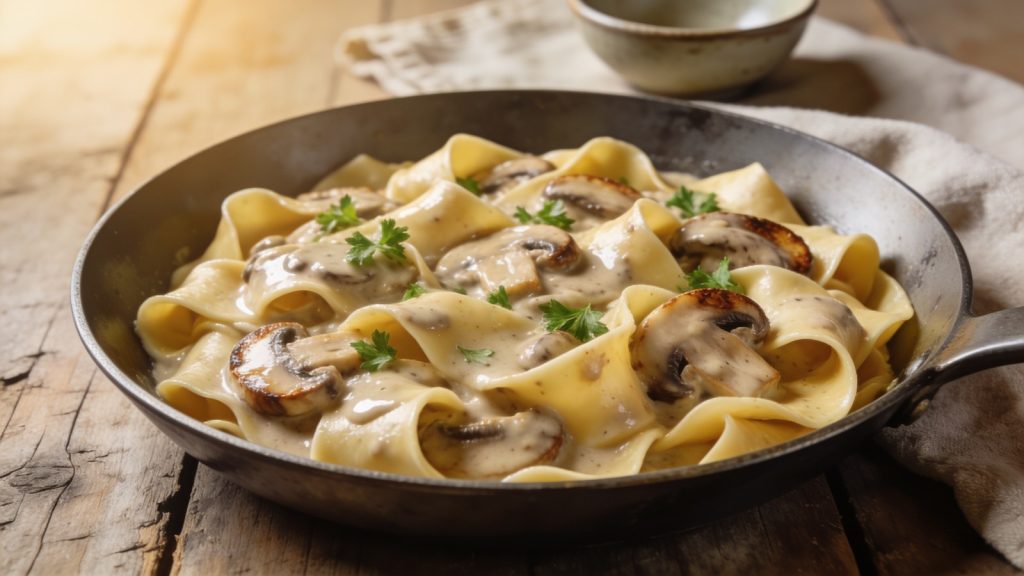
Serve it straight from the skillet, parsley scattered at the table rather than stirred in, with a lemon wedge for anyone who wants the sour-cream note pushed further. A green salad with a sharp dressing is the right partner. Wide ribbons matter more than they sound — pappardelle and tagliatelle hold this sauce, thin strands slide out of it.
To store: the sauce keeps covered in the refrigerator for 3 days and thickens as it sits. To reheat: loosen it with a splash of broth over low heat, held at a bare simmer so it stays smooth. To freeze: skip it — dressed pappardelle softens fast, so boil the pasta fresh each time.
For more plant-based dinners that suit the cold half of the year, try the lentil shepherd’s pie that, strictly speaking, isn’t one or the unstuffed cabbage roll soup and its vitamin K count.
Sources
- Urbain P., Jakobsen J., Dose-Response Effect of Sunlight on Vitamin D2 Production in Agaricus bisporus Mushrooms, Journal of Agricultural and Food Chemistry, 2015;63(37):8156–8161 (sliced mushrooms, real-time UV-B measured by spectroradiometer; a single dose-response experiment, no other latitudes or seasons tested) — https://pubmed.ncbi.nlm.nih.gov/26314311/
- Urbain P., Singler F., Ihorst G., Biesalski H.K., Bertz H., Bioavailability of vitamin D2 from UV-B-irradiated button mushrooms in healthy adults deficient in serum 25-hydroxyvitamin D: a randomized controlled trial, European Journal of Clinical Nutrition, 2011;65(8):965–971 (n = 26, 5 weeks, single-blinded, placebo-controlled; mushrooms irradiated at 1.5 J/cm², not sunlight) — https://pubmed.ncbi.nlm.nih.gov/21540874/
- Mehrotra A., Calvo M.S., Beelman R.B., Levy E., Siuty J., Kalaras M.D., Uribarri J., Bioavailability of vitamin D2 from enriched mushrooms in prediabetic adults: a randomized controlled trial, European Journal of Clinical Nutrition, 2014;68(10):1154–1160 (n = 43, BMI > 25, 16 weeks; D2 dose significantly lower after cooking; no dose or source modified type 2 diabetes risk factors) — https://pubmed.ncbi.nlm.nih.gov/25117997/
- U.S. Food and Drug Administration, Daily Value on the Nutrition and Supplement Facts Labels (vitamin D 20 µg, selenium 55 µg, sodium 2,300 mg, potassium 4,700 mg, protein 50 g, dietary fiber 28 g, iron 18 mg) — https://www.fda.gov/food/nutrition-facts-label/daily-value-nutrition-and-supplement-facts-labels
- USDA FoodData Central, SR Legacy records used for the nutrition and the comparisons: cremini mushrooms raw 168434, cremini exposed to ultraviolet light 168557, white mushrooms raw 169251, white mushrooms exposed to ultraviolet light 169376, silken firm tofu 172461, canned coconut milk 170173, raw cashews 170162, olive oil 171413, salt 173468, onion 170000, garlic 169230, paprika 171329, all-purpose flour 168936, vegetable broth 171180, tamari 174278, prepared mustard 172234, lemon juice 167747, black pepper 170931, parsley 170416, pasta cooked with added salt 169751 — https://fdc.nal.usda.gov/
- USDA Agricultural Research Service, USDA Table of Nutrient Retention Factors, Release 6 (2007) — retention codes 3780 (other vegetables, fried), 3460 (roots and similar, sauteed), 0305 (flour and meal, sauteed), 3776 (other vegetables, boiled, water used) and 0270 (citrus fruits, cooked) — https://www.ars.usda.gov/ARSUserFiles/80400525/Data/retn/retn06.pdf
Recipe Details
Recipe Card

Vegan Mushroom Stroganoff: 15 Minutes of Sun Before the Pan
Description
Sliced mushrooms browned hard, then folded into a sauce built on blended silken tofu instead of cashews or coconut milk — vegan mushroom stroganoff over wide pasta ribbons, about 55 minutes with a 15-minute stop in the sun along the way. Per 100 g, USDA puts silken firm tofu at 6.9 g of protein and 2.7 g of fat against 2.02 g and 21.33 g for canned coconut milk, and that is what keeps this sauce light enough to still taste of mushroom.
Ingredients
For the mushrooms
For the sauce
To serve
Instructions
Fifteen minutes of sun
-
Slice the mushrooms and set them out
Slice the 600 g (1 lb 5 oz) of mushrooms about 5 mm (1/4 inch) thick and spread them in one layer on a tray, cut faces up. Set the tray outside in direct sun for 15 minutes, then bring it in. If there is no sun today, go straight to the pan — the dish cooks exactly the same either way.
Brown the mushrooms
-
Get the pan hot first
Heat 15 ml (1 tablespoon) of the olive oil in a 30 cm (12-inch) skillet (frying pan) over medium-high heat. Add the mushrooms — they will heap above the rim, and that is fine. If your pan is smaller than 30 cm, brown them in two batches instead.
-
Cook the water off, then brown
Cook for 12 to 15 minutes, stirring every couple of minutes. The mushrooms give up their water in the first five minutes and then sit in it; keep the heat up until the pan is dry again and the edges have gone brown. Add the 1/4 teaspoon of salt only now, at the end.
-
Tip them into a bowl
Scrape the mushrooms and any juices into a bowl and set the pan back on the heat. They go back in at the very end, so they keep the browning they just earned.
Blend the cream
-
Blend the tofu with half the broth
Blend the whole 349 g (12.3 oz) carton of silken tofu with 150 ml (2/3 cup) of the vegetable broth for 30 to 60 seconds, until it pours off the spatula in a smooth ribbon with no grain left in it. This is the sauce that replaces heavy cream (double cream).
Sauce and pasta together
-
Start the pasta
Bring a large pot of water to a boil, add the tablespoon of salt, and cook the 250 g (9 oz) of pappardelle to the time on the packet. Scoop out 120 ml (1/2 cup) of the cooking water before you drain it.
-
Soften the onion, wake up the paprika
Add the remaining 15 ml (1 tablespoon) olive oil to the skillet with the chopped onion and cook over medium heat for 5 minutes, until soft and translucent. Stir in the garlic, the 2 teaspoons sweet paprika and the 1 teaspoon smoked paprika and keep stirring for 30 seconds, until the pan smells toasted.
-
Flour, then the rest of the broth
Scatter the 2 tablespoons of flour over the onion and stir for 1 minute. Pour in the remaining 150 ml (2/3 cup) broth a splash at a time, scraping the brown film off the bottom of the pan, and let it thicken to a loose paste.
-
Finish the sauce below a boil
Turn the heat to low and stir in the blended tofu, the tamari, the Dijon and the lemon juice. Hold it at a bare simmer — a rolling boil turns a tofu sauce grainy. Return the mushrooms with their juices, grind in the pepper, and warm through for 3 to 4 minutes.
Serve
-
Turn the pasta through the sauce
Add the drained pasta to the pan and turn it through the sauce, loosening with the reserved cooking water a spoonful at a time until the sauce coats every ribbon rather than pooling under it. Scatter the parsley over the top and serve straight from the pan.
Nutrition Facts
Servings 4
Serving Size 1 of 4 plates
- Amount Per Serving
- Calories 430kcal
- % Daily Value *
- Total Fat 11.1g15%
- Saturated Fat 1.7g9%
- Sodium 810mg36%
- Potassium 1067mg23%
- Total Carbohydrate 64g24%
- Dietary Fiber 5.4g20%
- Sugars 7g
- Protein 20g40%
- Vitamin A 62 mcg RAE
- Vitamin C 9 mg
- Calcium 93 mg
- Iron 4.5 mg
* Percent Daily Values are based on a 2,000 calorie diet. Your daily value may be higher or lower depending on your calorie needs.
Note
- Fifteen minutes of sun — what was actually measured. Urbain and Jakobsen, writing in the Journal of Agricultural and Food Chemistry in 2015, laid sliced Agaricus bisporus out in sunlight and tracked the real-time UV-B dose with a spectroradiometer. After just 15 minutes and a UV-B dose of 0.13 J/cm², vitamin D2 rose from 0.1 to 2.2 ± 0.5 µg per gram of dry weight (P < 0.0001) — which the authors put at 17.6 µg (704 IU) per 100 g of fresh mushrooms, comparable to the levels they cite for fatty fish like Atlantic salmon. The content climbed in a straight line through the first hour, then flattened; two further hours of exposure brought a significant decline. The limit worth knowing: 15 minutes is how long that dose took under that day’s sun. The trial did not test other latitudes or seasons, so an October afternoon may need longer, or may not get there at all. Slice the mushrooms first — that is what the study did, and slices turn far more surface toward the sky than whole caps.
- Whether it reaches your blood is a different question, and two trials answer it differently. Neither is a test of this step: the 2011 mushrooms were irradiated at 1.5 J/cm², about eleven and a half times the sunlight dose above, and the 2014 trial reported its dose as 600 or 4,000 IU of D2 per serving before cooking. Urbain, Singler, Ihorst, Biesalski and Bertz (European Journal of Clinical Nutrition, 2011) split 26 young adults with serum 25-hydroxyvitamin D at or below 50 nmol/L into three groups for five weeks in winter — a soup made from irradiated mushrooms, a D2 supplement, or placebo, about nine people to an arm; their 25OHD rose by 3.9 nmol/L a week (95% CI 2.9–4.8), against 4.7 nmol/L a week (95% CI 3.8–5.7) on a D2 supplement. Mehrotra, Calvo, Beelman, Levy, Siuty, Kalaras and Uribarri, in the same journal in 2014, fed 43 prediabetic, vitamin-D-deficient adults with a BMI above 25 a daily entrée of 100 g of cooked mushrooms for 16 weeks and saw “modest or no increases” in 25OHD; they pointed to unanticipated D2 loss during cooking and probably lower absorption in that group, and no dose or source shifted type 2 diabetes risk factors. Read together: sunlight does something real to the mushroom, and how much of it reaches you depends on the dose, on the cooking and on who is eating. If you are being treated for low vitamin D, talk to your doctor first — this is dinner, not a dose.
- Why silken tofu instead of cashews or coconut milk. Per 100 g, USDA lists silken firm tofu at 6.9 g of protein, 2.7 g of fat and 0.406 g of saturated fat (FDC 172461); canned coconut milk at 2.02 g, 21.33 g and 18.92 g (FDC 170173); raw cashews at 18.22 g, 43.85 g and 7.78 g (FDC 170162). Blended silken tofu carries roughly three and a half times the protein of coconut milk for about an eighth of the fat, which is why the mushrooms still lead the plate instead of the sauce. It is also nut-free, and a cashew cream is not. One honest caveat: USDA has no generic silken tofu record — every silken entry in SR Legacy belongs to a brand (MORI-NU, Vitasoy), and the nutrition here is calculated on MORI-NU silken firm. Another carton will read a little differently.
- The browning is most of the flavor. Six hundred grams of mushrooms hold a lot of water, and for the first five minutes the pan looks like a mistake. Keep the heat at medium-high and wait: once the liquid boils away the mushrooms start to fry rather than stew, and that is where the meaty note comes from. Two things help. Use a pan at least 30 cm (12 inches) wide, or work in two batches, because a crowded pan traps steam. And salt at the end rather than the start, since salt draws more water out just when you are trying to drive it off.
- Sodium hides in the liquids — and in the pasta water. Per USDA: one tablespoon of tamari carries 1,005 mg of sodium (FDC 174278, 5,586 mg per 100 g, 1 tbsp = 18 g), vegetable broth 303 mg per 100 g (FDC 171180), and prepared mustard 1,104 mg per 100 g (FDC 172234). That is why this recipe uses two teaspoons of tamari rather than a tablespoon, and only 1/4 teaspoon of added salt. The pasta water is the other half of the story, and it is easy to miss: USDA puts pasta cooked in salted water at 131 mg of sodium per 100 g against 1 mg cooked unsalted (FDC 169751 and 169737), which is about 196 mg a plate here. To go lower: boil the pasta unsalted, use a low-sodium broth, and add a second squeeze of lemon at the end, which replaces sharpness without replacing salt.
- Gluten-free, and made ahead. For gluten-free, serve the sauce over a gluten-free ribbon pasta or over mashed potato, use a tamari whose bottle says gluten-free, and replace the flour with 1 1/2 teaspoons of cornstarch (cornflour) slaked in a little cold broth and stirred in with the tofu. Ahead of time: the sauce keeps covered in the fridge for 3 days and thickens as it sits. Loosen it with a splash of broth over low heat, hold it at a bare simmer so it stays smooth, and boil the pasta fresh — dressed pappardelle softens fast.
- How the nutrition was calculated: from USDA FoodData Central SR Legacy records — cremini mushrooms 168434, olive oil 171413, salt 173468, onion 170000, garlic 169230, paprika 171329, all-purpose flour 168936, vegetable broth 171180, silken firm tofu 172461, tamari 174278, prepared mustard 172234, lemon juice 167747, black pepper 170931, parsley 170416, and pasta 169751 — adjusted with USDA Release 6 retention factors for the sautéed and simmered parts, then divided by four. The pasta is counted cooked, not dry: boiling in salted water and draining takes minerals out and puts sodium in, and 169751 (pasta, cooked, enriched, with added salt) is the USDA record that measures both. That is where 196 of the 810 mg of sodium on a plate comes from; boil the pasta unsalted and take roughly that much off. The card is calculated on ordinary cremini mushrooms (FDC 168434), not on the UV-exposed record (FDC 168557): the sun step is optional and its result depends on the day, so the number printed here is the one you can count on whatever the weather.