



Cooking broccoli does not destroy sulforaphane, because whole broccoli holds only its precursor — heat hits the enzyme that turns one into the other. Steaming for 1 to 3 minutes raised sulforaphane yield in three of four cultivars; boiling cost 41% of the aliphatic glucosinolates behind it. Here is every method, measured.
Broccoli carries sulforaphane the way a matchbox carries fire: as two parts kept apart. So does cooking broccoli destroy sulforaphane? The pot decides, and the window is narrower than most kitchens assume.
Five household methods have been measured against raw Brassica oleracea var. italica. Here is what each one costs, and where two labs flatly disagree.
What the evidence says
Solid · Steaming keeps the most. Steaming 1.0–3.0 min raised sulforaphane in 3 of 4 cultivars (2012); a second lab found aliphatic glucosinolates almost unchanged (2009).
Moderate · Boiling costs the most sulforaphane. Two labs agree on direction: boiling “prevented the formation of any significant levels” (2013), and cost 41% of aliphatic glucosinolates and 33% of vitamin C (2009).
Single study · Frozen broccoli needs outside help. Thawing for 9 hours made none; 0.25% daikon radish restored formation (2013). One lab, processing-line conditions.
The catch · The microwave findings do not agree. One lab measured a 62% glucoraphanin loss; another measured microwaving above both raw broccoli and the pot it was compared with — three samples per point, broccoli immersed in water, heat stopped at a set temperature.
1. Does Cooking Broccoli Destroy Sulforaphane? What Heat Hits First
Heat does not attack sulforaphane. It attacks myrosinase, the enzyme that makes it. Raw broccoli stores glucoraphanin — a glucosinolate — in one compartment and myrosinase in another; chopping or chewing breaks the wall between them, and only then does sulforaphane form.
A second protein complicates it. Wang, Farnham and Jeffery (University of Illinois, Journal of Agricultural and Food Chemistry, 2012) found that in unheated broccoli 52% to 91% of the hydrolysis products came out as sulforaphane nitrile, an inactive dead end, depending on cultivar (Pinnacle > Marathon > Patriot > Brigadier). The cofactor steering the reaction that way — the epithiospecifier protein — is more heat-sensitive than myrosinase in their data, which is the whole opening.
In the same trial, boiling and microwaving produced a brief rise in sulforaphane followed by its loss, all within 1 minute. Steaming raised sulforaphane yield between 1.0 and 3.0 minutes in every cultivar but Brigadier. The authors call that “proof of concept”: four cultivars, one lab.
2. How to Cook Broccoli to Keep Nutrients: Five Methods, Measured
Steaming keeps the most; microwaving and stir-frying cost the most. The table below is from one study — Yuan, Sun, Yuan and Wang, Journal of Zhejiang University Science B, 2009 — which cooked a single cultivar, Youxiu, five ways, three replicate samples per point.
| Method | Aliphatic glucosinolates | Vitamin C | Note |
|---|---|---|---|
| Steaming | almost unchanged | no significant loss | still cost 36.8% of indole glucosinolates |
| Boiling | −41% | −33% | water-soluble losses leach into the pot |
| Microwaving | −60% | −16% | largest glucoraphanin loss of the five, 62% |
| Stir-frying | −55% | −24% | the paper’s Discussion gives 16% for vitamin C |
| Stir-frying, then boiling | −54% | −38% | worst vitamin C result of the five |
All figures are losses against raw broccoli, cultivar Youxiu. Source: Yuan GF, Sun B, Yuan J, Wang QM, Journal of Zhejiang University Science B, 2009;10(8):580–588.
Two cautions. That study measured glucosinolates, the precursor — not sulforaphane itself; a floret can hold its glucoraphanin and still produce nothing if myrosinase is already gone. And the paper contradicts itself on one figure: the Results put stir-frying’s vitamin C loss at 24%, the Discussion at 16%. We print the Results number and flag the gap.
3. Does Frozen Broccoli Have Sulforaphane?
Usually very little, and blanching is why. Dosz and Jeffery (Journal of Food Science, 2013) found that blanching at 86 °C (187 °F) or above inactivates peroxidase, lipoxygenase and myrosinase together. The enzyme you need goes out with the spoilage enzymes the processor is actually targeting.
Their workaround cuts both ways. Blanching at 76 °C (169 °F) still knocked out 92% of lipoxygenase activity while costing only 18% of myrosinase-dependent sulforaphane formation. Thawing frozen broccoli for 9 hours produced none at all unless an outside source of the enzyme was added. Daikon radish root (mooli, in UK shops) still supported some formation after 10 minutes at 125 °C (257 °F), and 0.25% daikon stirred into the frozen broccoli before it thawed restored formation without changing how it looked. By the time a bag reaches your freezer, that decision is already made.
4. The Microwave Is Where Two Labs Disagree
Yuan’s group measured the microwave as the worst of the five for glucoraphanin, a 62% loss. Lu, Pang and Yang (Food Science & Nutrition, 2020) measured microwaving as the best method they tested. Both papers are real; the difference is what they did.
Lu’s team immersed the broccoli in water and stopped the heat at a set temperature. At 60 °C (140 °F), high-power microwaving at 950 W gave 2.45 µmol/g dry weight of sulforaphane against 1.42 µmol/g at 475 W. At 70 °C (158 °F) the level fell back to statistically no different from raw. Three samples per point.
That’s a temperature-controlled lab run, not three minutes on full power in a covered bowl. A domestic cycle sails past the enzyme’s denaturation point in well under a minute.
How to Use Broccoli in Your Kitchen
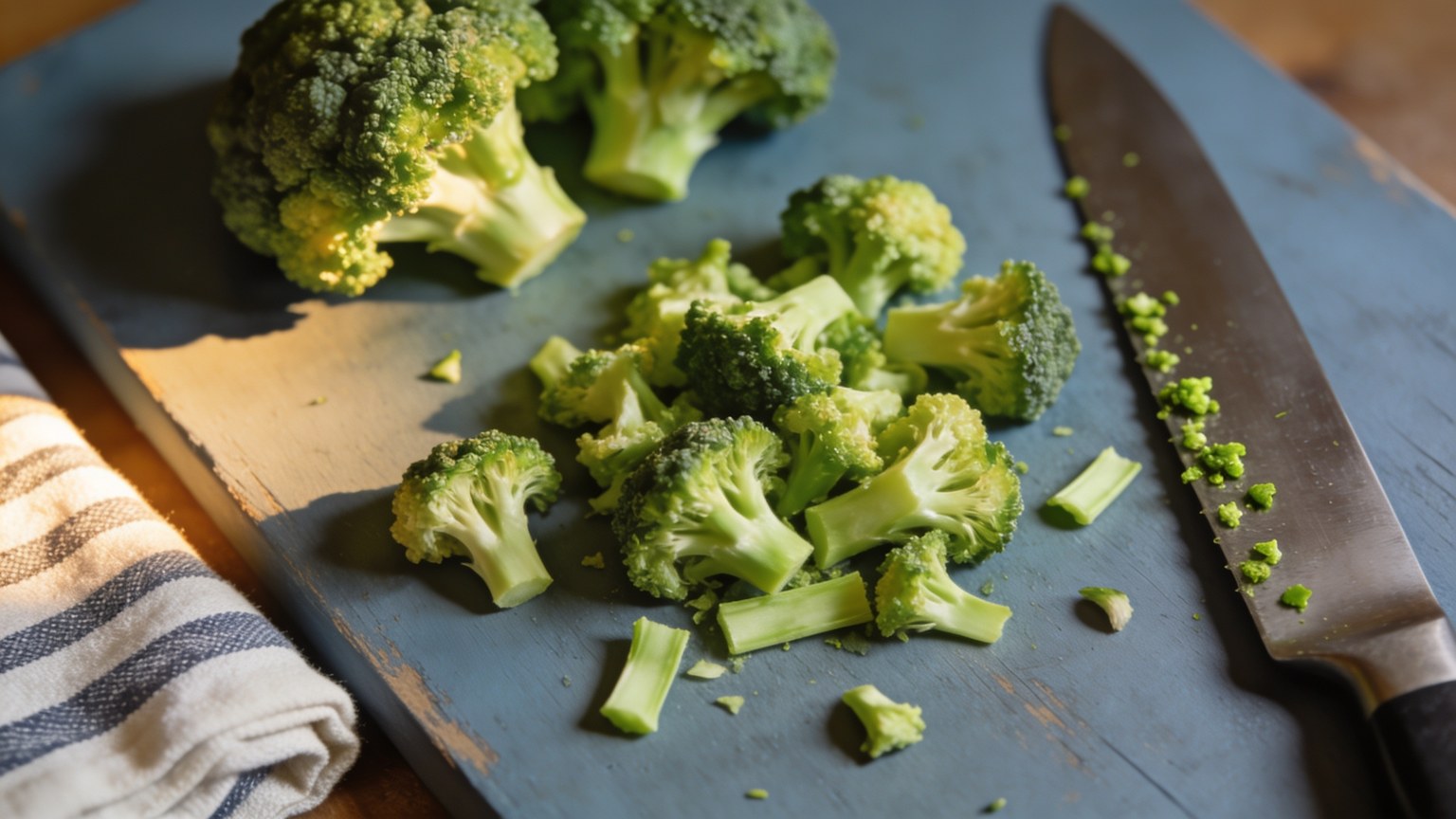
Chop, wait, then steam. Cutting ruptures the cells that keep the two halves of the reaction apart, so give the board a few minutes before anything gets hot — cooks call it chop-and-wait. Then steam the florets 1 to 3 minutes and pull them while they still squeak against the tooth.
Rescue what the pot took. Ghawi, Methven and Niranjan at the University of Reading (Food Chemistry, 2013) found boiling “prevented the formation of any significant levels of sulforaphane” — but stirring powdered white mustard seed (Sinapis alba) into the cooked broccoli significantly increased it, because mustard carries a tougher form of the same enzyme. The paper puts no number on the increase, so neither do we.
Buy for the crown. Lu’s team could barely detect glucoraphanin or sulforaphane in the stalks, and a 1:1 mix of florets and stalks carried under 52% of the florets’ glucoraphanin. The stalk (stem, to UK readers) is still good food, just not where this chemistry lives. Roasting appears in none of these trials — treat it like the dry heat in our sheet pan salmon with zucchini and tomatoes.
Broccoli Nutrition Facts
One cup of chopped raw broccoli (91 g, about 3.2 oz) carries 31 calories, 2.4 g of fiber, 81 mg of vitamin C and 92 µg of vitamin K — roughly 90% and 77% of the respective Daily Values. Boiling cuts that vitamin C by a third; for scale, a medium raw red bell pepper carries 152 mg of vitamin C, 169% of the Daily Value.
Sulforaphane cannot be in that table: USDA does not carry it, and the amount depends on what you just did to the floret. Cooking does not always subtract, though — in tomatoes, heat raises the lycopene, the way we keep zucchini’s lutein number separate from its claims.
Frequently Asked Questions
How do you cook broccoli without destroying sulforaphane?
Chop the florets, let them sit a few minutes, then steam 1 to 3 minutes — the window that raised sulforaphane yield in three of four cultivars in the 2012 University of Illinois trial. Boiling is the method two labs agree costs the most.
Does cooked broccoli still have sulforaphane?
It depends on the method. Briefly steamed broccoli can carry more than raw, because heat first knocks out the protein that diverts the reaction into inactive sulforaphane nitrile. Boiled broccoli formed no significant levels in the 2013 Reading study.
What is the healthiest way to cook broccoli?
On the published numbers, steaming. It was the only method in the 2009 five-way comparison that left aliphatic glucosinolates almost unchanged with no significant vitamin C loss — though it still cost 36.8% of the indole glucosinolates.
Does frozen broccoli have sulforaphane?
Often very little. Commercial blanching at 86 °C (187 °F) or above inactivates myrosinase along with the spoilage enzymes, and thawing alone did not restore formation over 9 hours. The fix Dosz and Jeffery tested on frozen broccoli was 0.25% daikon radish stirred in before thawing; the mustard-powder trick comes from a separate study on fresh boiled broccoli.
The Bottom Line: Steam It 1 to 3 Minutes
Heat isn’t the enemy here; the wrong heat is. A short steam appears to buy more sulforaphane than eating broccoli raw, boiling appears to cost the most, and the microwave is unsettled between two labs. Every number above comes from small laboratory studies on a handful of cultivars — direction, not dosage.
If you take medication that interacts with vitamin K, talk to your doctor first: 100 g of broccoli carries 85% of the Daily Value. Then put the crowns to work in our unstuffed cabbage roll soup, which runs on the same brassica chemistry, or on our list of anti-inflammatory foods for joint pain.
Sources
- Journal of Agricultural and Food Chemistry, 2012 — Wang GC, Farnham M, Jeffery EH. “Impact of thermal processing on sulforaphane yield from broccoli (Brassica oleracea L. ssp. italica).” J Agric Food Chem. 2012;60(27):6743–8. https://pubmed.ncbi.nlm.nih.gov/22471240/
- Journal of Zhejiang University Science B, 2009 — Yuan GF, Sun B, Yuan J, Wang QM. “Effects of different cooking methods on health-promoting compounds of broccoli.” J Zhejiang Univ Sci B. 2009;10(8):580–8. https://pmc.ncbi.nlm.nih.gov/articles/PMC2722699/
- Journal of Food Science, 2013 — Dosz EB, Jeffery EH. “Modifying the processing and handling of frozen broccoli for increased sulforaphane formation.” J Food Sci. 2013;78(9):H1459–63. https://pubmed.ncbi.nlm.nih.gov/23915112/
- Food Chemistry, 2013 — Ghawi SK, Methven L, Niranjan K. “The potential to intensify sulforaphane formation in cooked broccoli (Brassica oleracea var. italica) using mustard seeds (Sinapis alba).” Food Chem. 2013;138(2–3):1734–41. https://pubmed.ncbi.nlm.nih.gov/23411305/
- Food Science & Nutrition, 2020 — Lu Y, Pang X, Yang T. “Microwave cooking increases sulforaphane level in broccoli.” Food Sci Nutr. 2020;8(4):2052–2058. https://pmc.ncbi.nlm.nih.gov/articles/PMC7174218/
- USDA FoodData Central — “Broccoli, raw,” SR Legacy, FDC ID 170379. https://fdc.nal.usda.gov/food-details/170379/nutrients