



Fresh homemade goat cheese — chèvre — takes one pot, four everyday ingredients, and a thermometer: heat goat milk to 85°C (185°F), curdle it with lemon juice, drain to the texture you like. You get about 225 g of creamy, tangy cheese with 5.2 g of protein per ounce — three times what cream cheese manages.
Recipe Card
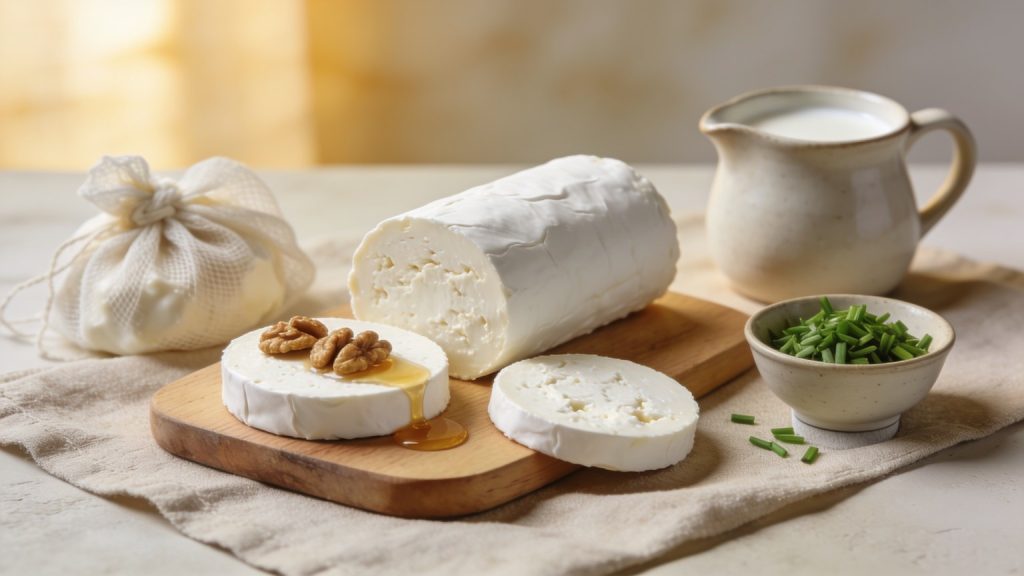

Homemade Goat Cheese (Chèvre): One Pot, Four Ingredients, and a Thermometer
Description
Fresh homemade goat cheese — chèvre — from one pot, four everyday ingredients, and a thermometer: goat milk heated to 85°C (185°F), curdled with lemon juice, drained to the texture you like. About 225 g (8 oz) of creamy, tangy spread, no rennet needed.
Ingredients
For the cheese
For flavoring (optional, not in the nutrition card)
Instructions
Heat and curdle
-
Heat the milk to 85°C (185°F)
Pour 1 liter of goat milk into a heavy saucepan and set it over medium heat. Stir gently and often, and clip on a thermometer: you’re going to 85°C (185°F) — hot enough to curdle cleanly, below a boil. This takes about 10 to 12 minutes; don’t rush it.
-
Add the lemon juice off the heat
Take the pan off the heat and pour in the lemon juice (60 ml / 1/4 cup). Give it two or three slow stirs — no more — and watch the milk separate into white curds and thin, yellowish whey. If nothing happens within a minute, stir in the vinegar a teaspoon at a time until it does.
-
Let the curds settle
Cover the pan with a clean towel and leave it completely undisturbed for 10 minutes. The curds will finish forming and sink into a soft raft.
Drain, season, shape
-
Drain to the texture you like
Line a colander with fine cheesecloth (or a clean, thin tea towel) set over a bowl, and pour in the curds and whey. Let it drain 30 minutes for a spreadable cheese, 60 to 90 for a firmer one you can shape. Keep the whey — see Note.
-
Season and shape
Turn the drained curds into a bowl, add 1/2 teaspoon of fine salt, and stir gently. Fold in herbs if you’re using them. Shape into a log on parchment or press into a small ramekin.
-
Chill to set
Wrap and refrigerate at least 1 hour before serving — the texture settles and the tang rounds out. Keeps 5 to 7 days in an airtight container.
Nutrition Facts
Servings 8
Serving Size 1 of 8 servings
- Amount Per Serving
- Calories 74kcal
- % Daily Value *
- Total Fat 5.9g8%
- Saturated Fat 4.1g21%
- Cholesterol 13mg5%
- Sodium 129mg6%
- Potassium 7mg1%
- Protein 5.2g11%
- Vitamin A 81 mcg RAE
- Calcium 39 mg
- Iron 0.5 mg
* Percent Daily Values are based on a 2,000 calorie diet. Your daily value may be higher or lower depending on your calorie needs.
Note
- Pasteurized yes, ultra-pasteurized no: UHT milk’s proteins are altered by the high-heat process and curdle poorly — the number-one reason this recipe “doesn’t work.” The carton will say.
- Skip raw milk. The FDA advises against raw (unpasteurized) milk — it can carry Listeria, Salmonella, and E. coli, and fresh soft cheese is exactly where that risk lives.
- The thermometer is the recipe: 85°C (185°F) sets the curd cleanly. Boiled milk turns grainy; underheated milk gives a weak, milky curdle.
- Drain time is your texture dial: 30 minutes = spreadable, 90 = sliceable log. There’s no wrong answer, only preference.
- Don’t pour out the whey: it’s mildly tangy and protein-flecked — use it in smoothies, bread dough, or to water acid-loving plants.
- Flavor directions: chives and cracked pepper; herbes de Provence rolled on the log; or the sweet route — a drizzle of honey and walnuts over a slice.
- Nutrition method: fresh acid-set cheese splits its milk’s nutrients between curd and whey, so the card uses USDA FoodData Central’s record for soft goat cheese (FDC 173435) per 28 g (1 oz) serving — the closest complete match for the finished chèvre. The listed salt lands in the same range as that record’s sodium; the acids mostly drain off with the whey.
Cheesemaking sounds like a discipline; fresh chèvre is barely a recipe. There’s no rennet, no cultures, no aging cave — just milk, acid, heat, and a half hour of draining. Goat’s-milk cheesemaking is ancient, and this acid-set style is its simplest branch: the version a farmhouse could make the same afternoon the milk came in. Every dairy culture keeps a version of it; the French one simply got the best name.
The word chèvre is simply French for “goat,” and the French treat the fresh kind as an everyday staple rather than a delicacy. Homemade, it costs a fraction of the boutique log and lets you set the salt, the tang, and the herbs yourself.
A 1-liter carton becomes roughly 225 g of finished cheese, and you control every variable that matters: the salt, the tang, the texture, and what lands on the outside — cracked pepper, herbs, or nothing at all. The whole active effort is maybe fifteen minutes; the colander does the rest.
Why This Homemade Goat Cheese Works
- The thermometer is the recipe. 85°C (185°F) is hot enough for the lemon juice to set a clean curd and comfortably below a boil, which would turn it grainy.
- Acid off the heat, stirred barely. Two or three slow turns and patience — overstirring breaks the curd into mush that slips through the cloth.
- Drain time is the texture dial. Thirty minutes gives a spreadable cheese, ninety a firm, sliceable log. One recipe, two cheeses.
- Dietary note: vegetarian by construction — acid does the curdling, so no rennet is involved. Gluten-free as written.
Why This Goat Cheese Is Good for You (and Its Two Honest Numbers)
Ounce for ounce, fresh goat cheese is the protein play among the spreadable cheeses: 5.2 g per 28 g serving, alongside 39 mg of calcium and a genuinely useful 81 µg of vitamin A — goat’s milk converts carotenes efficiently, which is also why the cheese is porcelain-white (USDA). Here’s how it stacks against the tub most fridges already hold:
| Per 28 g (1 oz) | Fresh goat cheese | Cream cheese |
|---|---|---|
| Calories | 74 | 98 |
| Protein | 5.2 g | 1.7 g |
| Total fat | 5.9 g | 9.6 g |
| Saturated fat | 4.1 g | 5.7 g |
| Sodium | 129 mg | 88 mg |
| Calcium | 39 mg | 27 mg |
USDA FoodData Central, per 28 g: “Cheese, goat, soft type” (173435) and “Cheese, cream” (173418). The comparison cuts both ways — chèvre triples the protein at a quarter fewer calories, while cream cheese carries less sodium.
Two details behind those numbers: fresh chèvre is essentially concentrated goat-milk protein — casein set by acid — which is why an ounce quietly outperforms cream cheese, a product built mostly on cream. The phosphorus rides along too, about 72 mg per ounce, working the same bone-mineral shift as the calcium. It pairs well with something that brings what dairy cannot: our tomato nutrition profile puts a raw tomato at 2,573 µg of lycopene per 100 g, and cooking concentrates it further.
The two honest numbers: this is still a full-fat dairy product, so each ounce brings 4.1 g of saturated fat — about a fifth of the daily limit — and it inherits goat dairy’s quiet gap, the one we documented in our goat milk vs cow milk breakdown: B12 barely registers here, a trace 0.05 µg per ounce. Spread it for pleasure and protein; look elsewhere in the day for B12. And one safety line that matters for fresh soft cheese: make it with pasteurized milk — the FDA advises against raw milk precisely because fresh, unaged cheese is where Listeria and friends thrive.
Homemade Goat Cheese FAQ
Why didn’t my goat milk curdle?
Almost always the milk: ultra-pasteurized (UHT) milk curdles poorly because the high-heat treatment changes its proteins. Use regular pasteurized goat milk, make sure you hit 85°C (185°F), and if the curds are still shy, add the backup vinegar a teaspoon at a time.
Can I make this with cow’s milk instead?
Yes — the same method with cow’s milk gives you a ricotta-style fresh cheese, milder and sweeter. Goat milk is what makes it chèvre: the tang and the slight earthiness are the goat’s contribution.
How long does homemade goat cheese last?
Five to seven days in an airtight container in the fridge. It has no preservatives and a fresh cheese’s high moisture, so treat it like milk, not like aged cheese — and freeze a shaped log up to a month if you need longer.
What can I do with the leftover whey?
Plenty. It’s mildly tangy with a little protein: swap it for water in bread or pancake batter, add it to smoothies, or feed it to acid-loving garden plants. Refrigerated, it keeps about a week.
Serving and Storage
Serve it barely chilled: on warm toast with cracked pepper, crumbled over roasted beets or a tomato salad, folded through hot pasta where it melts into an instant sauce, or the sweet way — honey and walnuts over a thick slice. If high-protein toast is your breakfast beat, it slots straight into the formula from our cottage cheese and avocado toast. Fresh cheese carries dessert too: the cream in our authentic tiramisu recipe is mascarpone, egg yolks and sugar — no cream, no liqueur, no whipped whites.
One texture note for cooks: fresh chèvre doesn’t melt into strings the way aged cheese does — it softens and creams. That’s a feature. Whisked with a splash of pasta water it becomes an instant sauce; dabbed onto pizza after baking it stays in soft pockets; folded into scrambled eggs off the heat it turns them silky. Crumbled over hot roasted vegetables it does the same thing — the zucchini and split cherry tomatoes from our sheet pan salmon and zucchini are the easiest excuse.
Keep the log wrapped in parchment inside an airtight box, 5 to 7 days. The flavor sharpens slightly by day three — many people’s favorite window. Frozen (up to a month), it thaws best overnight in the fridge and goes crumbly-then-creamy with a quick stir.
Sources
- USDA FoodData Central, SR Legacy — “Cheese, goat, soft type” (FDC ID 173435) and “Cheese, cream” (FDC ID 173418). https://fdc.nal.usda.gov/food-details/173435/nutrients
- US FDA — “The Dangers of Raw Milk: Unpasteurized Milk Can Pose a Serious Health Risk.” https://www.fda.gov/food/buy-store-serve-safe-food/dangers-raw-milk-unpasteurized-milk-can-pose-serious-health-risk
- US FDA — Daily Values for Nutrition and Supplement Facts Labels (saturated fat 20 g; vitamin B12 2.4 µg). https://www.fda.gov/food/nutrition-facts-label/daily-value-nutrition-and-supplement-facts-labels

There’s nothing quite like fresh homemade goat cheese — the flavor is so much brighter than store-bought. Can’t wait to try this!
love how this ties back to centuries of tradition. Making chèvre at home sounds both fun and rewarding.
This is exactly the kind of recipe that turns a simple meal into something special. Thanks for sharing such a beautiful culinary tradition.