


Fall Salad With Roasted Vegetables Recipe: Fat-Free Dressing Absorbed Almost Nothing
Description
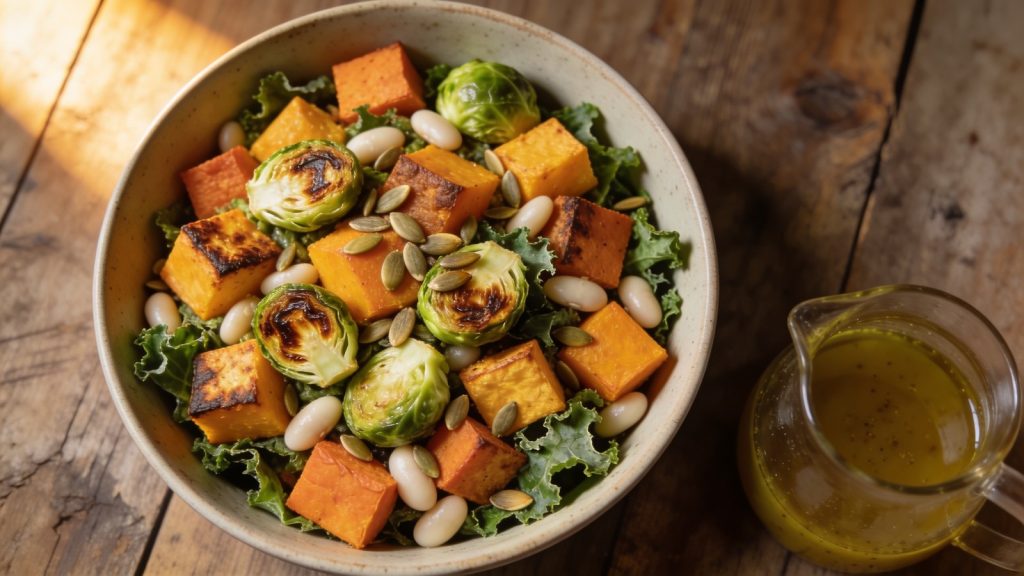
A fall salad with roasted vegetables that is meant to be eaten warm, not chilled — butternut squash, sweet potato and Brussels sprouts roasted at 200°C (400°F), tipped straight onto raw kale, and dressed with a full-fat cider vinaigrette. The oil is not decoration: in a 2004 Iowa State University trial, seven adults ate the same salad with a fat-free dressing and the carotenoids showing up in their blood were, in the authors’ word, negligible.
Ingredients
For the roasted vegetables
For the cider vinaigrette
To finish
Instructions
Roast the vegetables
-
Heat the oven
Set two racks in the upper and lower thirds of the oven and heat it to 200°C (400°F). Line two large rimmed sheet pans (baking trays), about 33 x 45 cm (13 x 18 inches), with parchment paper.
-
Cut everything to one size
Peel and seed the butternut squash and cut it into 2 cm (3/4-inch) cubes, about 600 g. Scrub the sweet potato, leave the skin on, and cut it the same size (400 g). Trim the Brussels sprouts and halve them through the root, and cut the red onion into eight wedges.
-
Oil and season
Toss all of it in a large bowl with 45 ml (3 tablespoons) olive oil, 3/4 teaspoon (4.5 g) fine sea salt, 1 teaspoon dried thyme and 1/2 teaspoon black pepper, until every piece looks slick. Spread the vegetables over the two pans in a single layer with space between the pieces, and turn every sprout half cut side down.
-
Roast 30 to 35 minutes
Roast for 30 to 35 minutes, swapping the pans between the two racks at 20 minutes. Do not stir: the sprouts stay cut side down the whole time, and that browned cut face is the point. They are done when a knife tip slides through a squash cube with no resistance and the sprout faces are deep brown.
Vinaigrette and seeds, while the oven works
-
Shake the vinaigrette
Put 45 ml (3 tablespoons) olive oil, 30 ml (2 tablespoons) apple cider vinegar (cider vinegar), 2 teaspoons Dijon mustard, 1 tablespoon maple syrup, the grated garlic clove, 1/4 teaspoon (1.5 g) salt and a pinch of pepper in a jar. Seal it and shake for 20 seconds, until it thickens slightly and stops separating in the jar.
-
Toast the pumpkin seeds
Toast 40 g (1/3 cup) pumpkin seeds (pepitas) in a dry pan over medium heat for 2 to 3 minutes, shaking often, until they start to pop and smell nutty. Tip them onto a plate straight away — they keep browning in a hot pan.
Build it warm
-
Tear the kale into the serving bowl
Strip the stems from 120 g (4 oz) kale and tear the leaves into bite-size pieces, about 6 packed cups, straight into a wide serving bowl. Add the 260 g (1 cup) drained and rinsed white beans.
-
Tip the hot vegetables on top
Scrape the vegetables from both pans over the kale and beans while they are still hot and turn everything over twice. The heat wilts the kale in about two minutes, which is why it goes in raw and never needs massaging.
-
Dress it, then finish
Shake the vinaigrette again, pour it over and toss until every leaf is coated. Scatter the toasted pumpkin seeds and the 75 g (1/2 cup) crumbled feta, if you are using it, and serve while the vegetables are still warm.
Nutrition Facts
Servings 4
Serving Size 1 of 4 bowls
- Amount Per Serving
- Calories 590kcal
- % Daily Value *
- Total Fat 30g39%
- Saturated Fat 6g30%
- Cholesterol 17mg6%
- Sodium 1144mg50%
- Potassium 1731mg37%
- Total Carbohydrate 69g26%
- Dietary Fiber 15g54%
- Sugars 14g
- Protein 17g34%
- Vitamin A 1520 mcg RAE
- Vitamin C 114 mg
- Calcium 379 mg
- Iron 7 mg
* Percent Daily Values are based on a 2,000 calorie diet. Your daily value may be higher or lower depending on your calorie needs.
Note
- The dressing is where the fat has to be. In a 2004 trial at Iowa State University (Brown MJ, Ferruzzi MG, Nguyen ML, Cooper DA, Eldridge AL, Schwartz SJ, White WS; Am J Clin Nutr 2004;80(2):396–403), seven adults ate the same salad three times with dressings holding 0, 6 or 28 g of canola oil. With the fat-free dressing the appearance of alpha-carotene, beta-carotene and lycopene in blood chylomicrons was, in the authors’ word, negligible; it rose with the reduced-fat dressing (P < 0.04) and rose again with the full-fat one (P < 0.02). Seven people, three salads each in random order, canola rather than olive oil, and what was measured was carotenoids appearing in the blood over 12 hours — not a health outcome. It is still the reason the 45 ml (3 tablespoons) of olive oil in the vinaigrette stays in.
- Why the oven sits at 200°C (400°F) and not higher. Hotter is not automatically better. He S, He S, Niu L, Sun C, Zeng Z and Xiao J roasted orange-fleshed sweet potato three ways — 180°C/70 min, 210°C/50 min and 240°C/30 min — and measured beta-carotene bioaccessibility after simulated digestion (Food Chem X 2025;25:102201). The order came out 180 > 210 > 240, and the authors call 210°C the best compromise between sweetness, aroma and carotenoid retention. That is one study, in vitro rather than in people, on sweet potato only. Read it as a reason not to crank the oven, not as a rule.
- What roasting costs, and what it keeps. Per 100 g, USDA lists raw butternut squash at 21.0 mg of vitamin C and baked butternut at 15.1 mg (FDC 169295 and 169296) — roughly a quarter of it gone. Raw Brussels sprouts carry 85.0 mg; boiled and drained, 62.0 mg (FDC 170383 and 169971). Beta-carotene shows no such fall: 4,570 µg in the baked butternut record against 4,226 µg in the raw one. Those are two separate analyses of two separate samples rather than one squash measured before and after — the baked record even holds more water, 87.80 g against 86.41 g — so read them as no loss, not as a gain.
- Two pans, one layer. Piled vegetables trap their own steam and stew instead of roasting. Keep them in a single layer with space between the pieces, use both pans even though it feels like one would do, and swap the pans between racks once rather than stirring. If your oven runs cool, give the pans the last five minutes on the upper rack.
- Where the sodium actually is. A serving carries 1,144 mg, and the salt cellar is the largest single source: the 6 g of salt in the recipe accounts for 581 mg of it, the canned beans for 221 mg and the feta for 214 mg. Leaving the feta out takes a serving to 931 mg and removes all of its cholesterol, and makes the salad vegan; halving the salt takes it to 854 mg; doing both leaves 640 mg. Draining and rinsing the beans under cold running water sends some of their sodium down the sink, but USDA has no record for rinsed beans (FDC 175204 is 340 mg per 100 g unrinsed), so the card figure is a ceiling.
- Swaps. Acorn squash or pumpkin replace the butternut 1:1; chickpeas replace the white beans; toasted walnuts or pecans replace the pepitas; honey replaces the maple syrup, though the salad is then no longer vegan. Baby spinach can stand in for the kale, but it collapses much faster — add it after the vegetables have sat for a minute, not straight out of the oven. The recipe is gluten-free as written: no bread, no couscous, no soy sauce.
- How the nutrition was calculated. Every figure in the card is summed from one USDA FoodData Central SR Legacy record per ingredient — butternut squash 169295, sweet potato 168482, Brussels sprouts 170383, onion 170000, olive oil 171413, kale 168421, canned white beans 175204, pumpkin seed kernels 170557, feta 173420, cider vinegar 173469, maple syrup 169661, prepared mustard 172234, garlic 169230, dried thyme 170938, black pepper 170931 and table salt 173468 — and then adjusted with the USDA retention factors published for the method actually used (Table of Nutrient Retention Factors, Release 6: vegetables baked for the squash, sprouts and onion; sweet potatoes baked in skin for the sweet potato). The kale, beans, seeds, feta and the whole vinaigrette never see the oven, so no factor is applied to them. Nothing is boiled and drained here, so the minerals stay at 100 percent. The total is divided by four. The feta is counted in; the salt is counted in full; the oil is counted in full even though some of it stays on the pan, and the canned beans are counted unrinsed, so the sodium figure is a ceiling rather than a best case.