



A 25-year study of 25,749 people links sugary drinks and blood pressure: a twice-a-day sugary-drink habit was tied to 52% higher hypertension risk, daily fruit juice to 35% — while total fructose showed no link at all. Here’s what the data shows, and what observational research can’t prove.
Pour the same fructose into a can of soda (a fizzy drink, to UK readers), a glass of juice, and an apple, and your blood pressure may treat each one differently. That’s the message of a new study in Circulation, published August 18, 2026, which followed 25,749 people from an average age of 12 to 36. The fructose didn’t track with who developed hypertension. The container did.
What the evidence says
Strong, but observational · Two or more sugary drinks a day was linked to 52% higher hypertension risk. HR 1.52 (95% CI 1.27–1.83) across 25,749 people and up to 25 years.
Moderate · Daily fruit juice pointed the same way, more weakly. HR 1.35 (95% CI 1.06–1.71) at 1.5 or more servings a day.
Single study · Neither total fructose (HR 1.07) nor whole fruit (HR 0.79, not statistically significant) was linked to risk. A striking null, from one cohort so far.
The catch · Observational data — association, not causation. Diets and all 1,625 hypertension diagnoses were self-reported.
What Did the Study Find About Sugary Drinks and Blood Pressure?
The Growing Up Today Study (GUTS) followed two waves — 16,875 participants enrolled from 1996, another 10,918 from 2004, 55% female — through 2021. Diet came from validated food-frequency questionnaires every one to four years — memory-based, a real limitation, though 25 years of repeats steadies the picture. By the end, 1,625 participants (6.3%) had reported a hypertension diagnosis.
Sugar-sweetened beverages carried the clearest signal: two or more servings a day was tied to 52% higher risk than fewer than three a week (HR 1.52, 95% CI 1.27–1.83), with risk climbing as intake rose (P for trend < 0.001). Fruit juice echoed it: 1.5 or more daily servings was linked to 35% higher risk than under one a week (HR 1.35, 95% CI 1.06–1.71).
Total fructose, meanwhile, showed no significant association (HR 1.07, 95% CI 0.92–1.25, top versus bottom fifth). Whole fruit wasn’t linked to risk either — its estimate leaned lower (HR 0.79, 95% CI 0.59–1.05) but didn’t reach significance. And the beverage links held independent of diet quality, physical activity, and other factors.
As a cohort study, this shows association, not causation — nobody was assigned a drink — and hypertension was self-reported rather than measured in a clinic (Circulation, 2026).
Why Would Juice Behave Like Soda?
The study didn’t test why, so this part is explanation, not finding. An apple’s fructose comes packaged in fiber and intact cell walls, which may slow how quickly sugar reaches the blood. Juice the apple and that scaffolding is gone: the same fructose lands as a quick liquid dose, easy to overdo.
One note from the disclosures: co-author Dr. Sievenpiper reports research support from, among others, the European Fruit Juice Association, while Dr. Malik has consulted for the City and County of San Francisco in litigation over sugary-drink health warnings. If anything, juice-industry support behind a paper that flags juice strengthens the finding.
What Happens If You Swap One Drink?
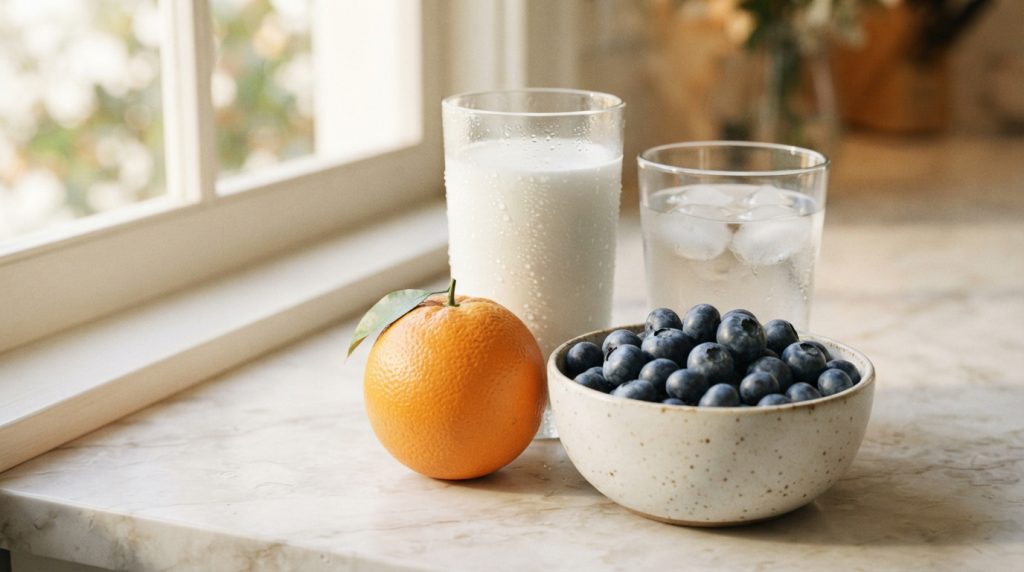
The team also modeled swaps — statistical substitutions, not a trial, so read them as estimates. Replacing one daily sugary drink with whole fruit was associated with 22% lower hypertension risk (95% CI 11–31%); milk came in at 13% lower (5–20%), plain water at 9% (3–15%).
Swapping a daily glass of juice for whole fruit tracked with a 19% lower risk (95% CI 3–32%). On a plate, that’s one cup of mango standing in for the morning glass — same fruit, fiber still attached.
Why These Findings Matter
For Parents
GUTS enrolled participants at an average age of 12, and the authors read the results as support for limiting sugary drinks and fruit juice starting in childhood, not in midlife. The practical version: water or milk as the default glass, juice as an occasional pour.
For Anyone Reading a Label
Grams of fructose on a label didn’t separate safer from riskier here — the form did. Juice behaved more like soda, while whole fruit sat at neutral. If breakfast is where your juice glass lives, a bowl of oatmeal with fruit on top comes closer to what these numbers reward.
None of this convicts a single glass of juice; observational data can’t deliver that verdict. It does support one concrete move: replace the sugary drink or juice you pour most days with whole fruit, the swap tied to the largest risk difference. For that habit in practice, see what happened when a doctor ate blueberries every day for a week.
Sources
- Circulation, August 18, 2026 (published online June 22, 2026) — Nguyen M, AlEssa HB, Glenn AJ, Tobias DK, Chavarro JE, Willett WC, Hu FB, Hanley AJ, Birken CS, Sievenpiper JL, Malik VS. “Consumption of Fructose-Containing Food and Beverage Sources in Childhood Through to Adulthood and Risk of Hypertension: A Prospective Cohort Study.” Circulation. 2026;154(7):612-623. doi:10.1161/CIRCULATIONAHA.125.077666. PMID 42324999. https://pubmed.ncbi.nlm.nih.gov/42324999/