



All the sweet-and-sour comfort of stuffed cabbage rolls — beef, rice, tomatoes, tender cabbage — in one pot, with none of the leaf-rolling. Dinner is on the table in about an hour.
Cabbage rolls are a Sunday project. You blanch the leaves, trim the thick ribs, roll each one around a scoop of filling, tuck them into a pot, and wait two hours. This unstuffed cabbage roll soup keeps every flavor in that dish and throws out the fussy part: the cabbage gets chopped, the filling becomes the soup, and the rice cooks right in the broth.
Versions of stuffed cabbage show up across Central and Eastern Europe and the Balkans — golabki in Poland, holubtsi in Ukraine, sarma from Bosnia to Turkey — and nearly all of them balance tomato, meat, and a little sweet-sour tang. That tang is what most weeknight cabbage soups miss. A tablespoon of brown sugar and a splash of apple cider vinegar at the end do the work that hours of slow braising used to.
The timing lands well in early fall, when cabbage is cheap and heavy in both the US and the UK and a whole head keeps for weeks in the fridge. Pinterest named cabbage its food trend of 2026 — searches for golumpki soup were up 95% when the forecast was published — so if the vegetable seems to be everywhere lately, that’s why.
Why This Cabbage Roll Soup Works
- One pot, 15 minutes of prep. Brown, chop, simmer. No blanching, no rolling, no baking dish.
- The rice cooks in the broth. It absorbs the tomato and beef flavor instead of arriving as a bland filler.
- Sweet-and-sour balance. Brown sugar plus cider vinegar rebuilds the flavor of long-braised cabbage rolls in under an hour.
- Feeds six for the price of a takeout side. A head of cabbage, a pound of ground beef (UK: beef mince), and pantry tomatoes.
- Adapts to your equipment and your diet. Stovetop, slow cooker, or Instant Pot; ground turkey for a leaner pot; skip the rice for a low-carb bowl.
What Goes Into Unstuffed Cabbage Rolls in Soup Form
Green cabbage (UK: white cabbage) is the backbone. One medium head, about 900 g (2 lb), looks absurd in the pot for the first two minutes and then collapses to almost nothing — don’t be tempted to halve it. The meat is 85% lean ground beef: anything leaner turns dry and grainy in a long simmer, anything fattier leaves a slick you’ll have to skim.
Crushed tomatoes plus tomato paste (UK: tomato purée) give the broth body that plain diced tomatoes never do, and Worcestershire sauce adds savory depth a quick soup otherwise takes hours to build. Use low-sodium beef broth (UK: beef stock) so you control the salt.
Long-grain white rice cooks in about 25 minutes right in the pot, the same window the cabbage needs to turn silky. Sweet paprika, oregano, and a half teaspoon of lightly crushed caraway seeds are what make this taste specifically like cabbage rolls rather than generic beef-and-tomato soup. Caraway is optional, but it’s the flavor most people can’t name and immediately recognize.
How to Make Cabbage Roll Soup (Stovetop, Slow Cooker, or Instant Pot)
On the stovetop, brown the beef in a 6-quart (6 L) Dutch oven, soften the onion and carrots, bloom the spices and tomato paste for a minute, then add the liquids, the cabbage, and the rice. Twenty-five to thirty minutes of gentle simmering does the rest.
In a slow cooker, brown the beef and aromatics in a skillet (UK: frying pan) first — that step is where the flavor comes from, and slow cooking won’t replace it. Transfer everything except the rice, cook 6 to 7 hours on low, then stir the rice in for the last 45 minutes on high.
In an Instant Pot, use Sauté to brown, add everything else, then pressure cook on high for 5 minutes with a 10-minute natural release. Rice and cabbage both finish in that window.
Is Cabbage Roll Soup Healthy?
For a bowl of comfort food, this one carries real nutrition — roughly 360 calories, 19 g of protein, and 7 g of fiber per serving.
Cabbage does most of that work. A cup of shredded raw cabbage has about 22 calories while supplying 85% of the daily value for vitamin K and 54% for vitamin C, along with more than 2 g of fiber, according to the Cleveland Clinic. Registered dietitian Julia Zumpano puts it plainly there: cabbage has more nutritional value than people expect. Roughly 40% of its fiber is soluble, the type that binds cholesterol in the gut, and cabbage also contains phytosterols, plant compounds that compete with cholesterol for absorption.
Cabbage is a cruciferous vegetable, the family that includes broccoli, cauliflower, and Brussels sprouts. Those vegetables contain glucosinolates — sulfur compounds that break down during chopping and digestion into isothiocyanates such as sulforaphane. The National Cancer Institute’s fact sheet notes that indoles and isothiocyanates have inhibited cancer development in several organs in rats and mice, and that laboratory work points to mechanisms like protecting cells from DNA damage and inactivating carcinogens. The honest caveat: human studies have been inconsistent, so this is a reason to eat more cruciferous vegetables, not a treatment.
Cooking doesn’t cancel out the tomatoes, either — it helps them. In a 2002 study in the Journal of Agricultural and Food Chemistry, Cornell researchers heated tomatoes to 88°C (190°F) and found trans-lycopene rose from about 2.0 to 5.4 mg per gram after 15 minutes, with total antioxidant activity climbing alongside it. Heat breaks down cell walls and frees the pigment for absorption, which is why a simmered tomato broth may deliver more usable lycopene than the raw fruit. We covered what lycopene may do for skin and heart health in our Tomato Power guide.
The beef adds heme iron, zinc, and vitamin B12, all harder to absorb from plants, and the carrots bring beta-carotene. Sodium is the one number to watch: low-sodium broth and no-salt-added tomatoes keep a serving near 620 mg instead of well past 1,000 mg. And if you take a blood thinner such as warfarin, cabbage’s vitamin K affects your dose — keep your intake steady and talk to your doctor first.
Cabbage Roll Soup FAQ
Is cabbage roll soup healthy?
It holds up well for comfort food: about 360 calories per serving with 19 g of protein and 7 g of fiber, and the cabbage brings vitamin C, vitamin K, and cruciferous compounds. To lighten it further, use 93% lean beef or ground turkey and low-sodium broth. To cut carbs, skip the rice.
Can you freeze cabbage roll soup?
Yes, with one caveat — the rice keeps drinking the broth and turns soft. To freeze: cool completely, then freeze in airtight containers for up to 3 months, ideally leaving the rice out and adding it fresh later. To reheat: thaw overnight in the refrigerator and warm over medium-low heat, adding 120 to 240 ml (1/2 to 1 cup) of broth to loosen it.
What do you serve with cabbage roll soup?
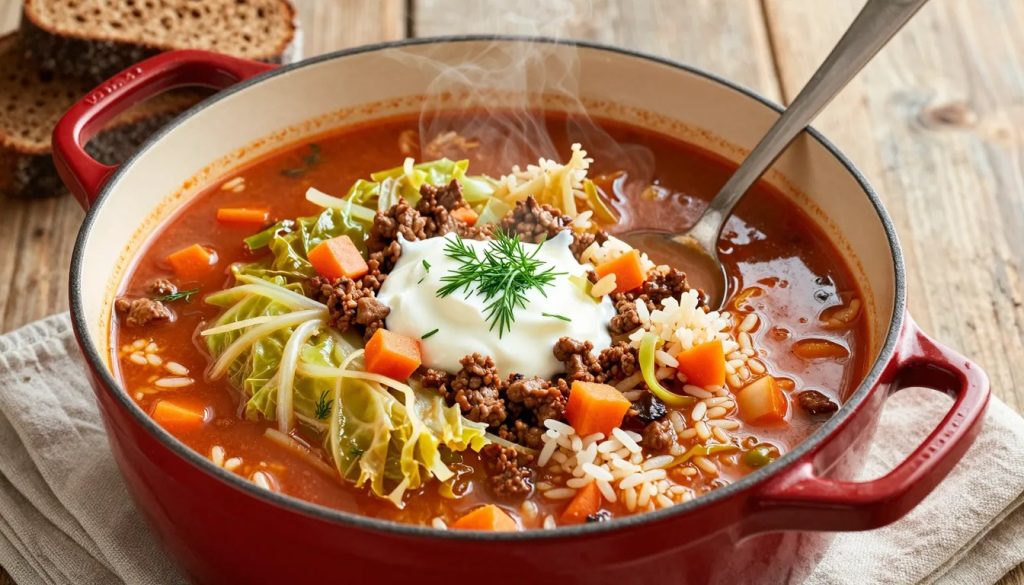
Crusty rye or sourdough for dipping, a dollop of sour cream (UK: soured cream), and chopped dill. A simple cucumber salad cuts the richness. It’s a full meal on its own — meat, vegetable, and grain in one bowl.
Can I make cabbage roll soup without rice?
Yes. Leave it out and the soup becomes low-carb and thinner, more of a proper soup than a stew. For the same body without the grain, add 400 g (14 oz) of diced potatoes with the broth, or stir in 300 g (10 oz) of cauliflower rice during the last 10 minutes.
Can I use ground turkey instead of beef?
Yes. Ground turkey (UK: turkey mince) makes a leaner pot — add an extra tablespoon of oil, since there’s little fat to render, and be a bit heavier on the paprika and Worcestershire to keep the savory depth.
Can I make it in a slow cooker or an Instant Pot?
Both work. Slow cooker: brown the beef and aromatics first, then 6 to 7 hours on low, stirring the rice in for the final 45 minutes on high. Instant Pot: sauté, then 5 minutes at high pressure with a 10-minute natural release.
How long does cabbage take to cook in soup?
Chopped into 2.5 cm (1-inch) pieces, cabbage turns tender in 25 to 30 minutes of gentle simmering — the same time the rice needs. Longer is fine; cabbage rolls simmer for hours, and the cabbage only gets sweeter.
Serving and Storage
Ladle into bowls, add a spoonful of sour cream and a scatter of dill, and put the vinegar bottle on the table — a few extra drops brighten the whole bowl.
To store: refrigerate for up to 4 days in an airtight container. The rice will absorb liquid overnight, so add a splash of broth or water when reheating. To make ahead: the soup base actually improves on day two; if you plan to keep it, cook the rice separately and add it to each bowl.
For more one-pot dinners in this vein, see our Bosnian pot stew, the Vietnamese bo kho beef stew, or a lighter weeknight option, sheet pan salmon with corn, zucchini and tomatoes.
Sources
- Cleveland Clinic Health Essentials, 8 Health Benefits of Cabbage (nutrition per cup, fiber, phytosterols; comments from registered dietitian Julia Zumpano) — https://health.clevelandclinic.org/benefits-of-cabbage
- National Cancer Institute, Cruciferous Vegetables and Cancer Prevention fact sheet (glucosinolates, indoles, isothiocyanates, sulforaphane; animal and laboratory evidence) — https://www.cancer.gov/about-cancer/causes-prevention/risk/diet/cruciferous-vegetables-fact-sheet
- Dewanto V., Wu X., Adom K.K., Liu R.H., Thermal Processing Enhances the Nutritional Value of Tomatoes by Increasing Total Antioxidant Activity, Journal of Agricultural and Food Chemistry, 2002 — https://pubs.acs.org/doi/10.1021/jf0115589
- Healthline, 9 Impressive Health Benefits of Cabbage (soluble fiber share, vitamin K) — https://www.healthline.com/nutrition/benefits-of-cabbage
- Quadram Institute, The nutrition and health benefits of cabbage — https://quadram.ac.uk/blogs/the-nutrition-and-health-benefits-of-cabbage/
- Pinterest Predicts 2026, Cabbage Crush (search growth figures) — https://business.pinterest.com/pinterest-predicts/2026/cabbage-crush/
Recipe Details
Recipe Card

Unstuffed Cabbage Roll Soup with Beef and Rice
Description
All the sweet-and-sour comfort of stuffed cabbage rolls — beef, rice, tomatoes, and tender cabbage — in one pot, with none of the leaf-rolling. A hearty fall dinner that feeds six in about an hour.
Ingredients
For the beef base
For the broth
For the cabbage and rice
To serve (optional)
Instructions
Build the base
-
Brown the beef
Heat 1 tbsp (15 ml) olive oil in a 6-quart (6 L) Dutch oven or heavy pot over medium-high heat. Add 450 g (1 lb) ground beef and cook 5 to 6 minutes, breaking it into small pieces, until no pink remains. Drain off the fat if there is more than about a tablespoon in the pot.
-
Soften the vegetables
Add the diced onion and carrots and cook 5 minutes, stirring now and then, until the onion is translucent and the carrots have lost their raw edge.
-
Bloom the spices and tomato paste
Stir in the garlic, 1 tbsp sweet paprika, 1 tsp oregano, and the crushed caraway seeds and cook 1 minute, until fragrant. Add 2 tbsp tomato paste and cook 1 minute more, stirring constantly, until it darkens slightly — this is where the depth of flavor comes from.
Simmer the soup
-
Add the liquids
Pour in the crushed tomatoes, 1.5 L (6 cups) beef broth, Worcestershire sauce, brown sugar, and vinegar, and drop in the bay leaf. Scrape the bottom of the pot to lift the browned bits.
-
Add the cabbage
Add the chopped cabbage in two or three additions, stirring after each until it wilts enough to make room for the next. It will look like far too much and will cook down to fit. Bring the pot to a boil.
-
Stir in the rice and simmer
Stir in 130 g (2/3 cup) rice, 1 1/4 tsp salt, and 1/2 tsp pepper. Reduce the heat to low, cover partially, and simmer 25 to 30 minutes, stirring every 10 minutes so the rice does not stick, until the rice is tender and the cabbage is silky.
Finish and serve
-
Taste and adjust
Remove the bay leaf. Taste and adjust: another splash of vinegar if it needs brightness, a pinch of sugar if the tomatoes are sharp, more salt and pepper as needed.
-
Serve
Ladle into bowls and top each with a spoonful of sour cream and a scatter of fresh dill. Serve with rye or sourdough bread for dipping.
Nutrition Facts
Servings 6
- Amount Per Serving
- Calories 360kcal
- % Daily Value *
- Total Fat 12g19%
- Saturated Fat 4g20%
- Cholesterol 55mg19%
- Sodium 620mg26%
- Potassium 1100mg32%
- Total Carbohydrate 43g15%
- Dietary Fiber 7g29%
- Sugars 14g
- Protein 19g38%
- Vitamin A 3600 IU
- Vitamin C 30 mg
- Calcium 120 mg
- Iron 3 mg
- Magnesium 55 mg
- Zinc 3 mg
* Percent Daily Values are based on a 2,000 calorie diet. Your daily value may be higher or lower depending on your calorie needs.
Note
- The rice keeps drinking. Leftovers thicken overnight as the rice absorbs broth. Add 120–240 ml (1/2–1 cup) of broth or water when reheating, or cook the rice separately and add it per bowl if you want leftovers to stay soupy.
- Slow cooker: brown the beef and aromatics in a skillet first, transfer everything except the rice to the slow cooker, and cook 6–7 hours on low or 3–4 hours on high. Stir the rice in for the last 45 minutes on high.
- Instant Pot: brown on Sauté, add everything else, then pressure cook on high for 5 minutes with a 10-minute natural release before venting.
- Sauerkraut version: for a sharper, more traditional pot, swap about 150 g (1 cup) of drained sauerkraut for a quarter of the fresh cabbage and cut the vinegar in half.
- Leaner or low-carb: ground turkey works with 1 extra tbsp of oil. To skip the rice, leave it out and add 400 g (14 oz) diced potatoes with the broth, or stir in 300 g (10 oz) cauliflower rice during the last 10 minutes.
- Food safety: ground beef is safe at 71°C (160°F) internal temperature; browned and then simmered for 30 minutes, this soup passes that easily. Refrigerate leftovers within 2 hours.