



Zucchini health benefits come down to fullness for almost no calories and a big dose of lutein: 100 g (about 3.5 oz) has 17 calories, nearly 95% water, and 2.1 mg of the carotenoids your eyes depend on. Here’s how strong the evidence really is — myths included.
Every August, gardeners leave zucchini (courgette, to UK readers) on neighbors’ porches — the plant won’t quit. The squash is 94.79% water, per USDA, and that’s its best feature: a full plate for 17 calories, plus more lutein — the eye-protective carotenoid — than flashier vegetables.
It also drags two myths around: “high in fiber” (USDA says 1.0 g per 100 g) and “manganese for libido” (the Linus Pauling Institute’s manganese reference doesn’t support it). Here are four zucchini health benefits that hold up.
What the evidence says
Solid · Vitamin C for collagen and antioxidant defense. 17.9 mg per 100 g — 20% of the Daily Value; settled biochemistry.
Moderate · Lutein and cataracts. One randomized trial, 4,203 people: supplements didn’t help overall, but cut cataract-surgery risk 32% in the fifth eating the least lutein.
Single study · Water-rich foods and weight. 97 women, one year: 1.5 kg (3.3 lb) more lost, with less hunger.
The catch · Fiber is modest — 1.0 g per 100 g — and the Linus Pauling Institute’s manganese page mentions libido zero times..
1. It May Help Protect Your Eyes
Zucchini’s standout USDA number: 2,125 µg (2.1 mg) of lutein and zeaxanthin per 100 g — the carotenoids the eye stockpiles in retina and lens. For scale, green bell peppers carry 341 µg — and red ones only 51 µg.
The toughest test is AREDS2 (JAMA Ophthalmology, 2013), a randomized, double-blind trial: 4,203 adults aged 50 to 85, at risk for advanced macular degeneration, took 10 mg lutein plus 2 mg zeaxanthin daily — or none — for a median 4.7 years. Overall, cataract-surgery rates didn’t significantly differ (hazard ratio 0.96, P = 0.54).
The useful part hid in the subgroup: the fifth eating the least lutein saw 32% lower cataract-surgery risk when supplementing (hazard ratio 0.68, P = 0.03). Pills added nothing for those already eating enough — an argument for the produce aisle, not the supplement shelf.
Scale check: 100 g of zucchini covers about a sixth of that dose — a contribution, not a therapy.
2. It Fills You Up for Almost No Calories
At 94.79 g of water per 100 g, zucchini sits near the bottom of the energy-density scale (calories per gram). Volume without calories appears to matter for appetite.
A year-long 2007 trial in the American Journal of Clinical Nutrition randomized 97 women with obesity to two diets with no calorie targets — one cut fat; the other also added water-rich foods, mostly fruits and vegetables. The water-rich group lost 7.9 kg (17.4 lb) versus 6.4 kg (14.1 lb) (P = 0.002) — and reported less hunger (P = 0.003) while eating a greater weight of food.
The limits: only women with obesity, 71 of 97 finished — and it tested an eating pattern, not zucchini alone.
3. It Delivers Vitamin C for Very Few Calories
Those 17 calories buy 17.9 mg of vitamin C — about 20% of the Daily Value.
Per the Linus Pauling Institute, vitamin C is a required cofactor for building collagen — the protein holding skin, tendons, and blood-vessel walls together — and a potent antioxidant. Cohort studies also link higher vitamin C status to lower hypertension risk, though that’s association, not cause.
4. It’s an Easy Way to Add Potassium
A 100 g serving adds 261 mg of potassium — about 6% of the 4,700 mg Daily Value — plus small amounts of magnesium, vitamin B6, and folate. A whole 200 g (7 oz) squash tops 500 mg.
We found no trial testing zucchini’s potassium against a health outcome, so we won’t claim one. Potassium is what the U.S. Dietary Guidelines call a “nutrient of public health concern” — most Americans fall short — and a 17-calorie vegetable is an easy way to get some.
How to Use Zucchini in Your Kitchen
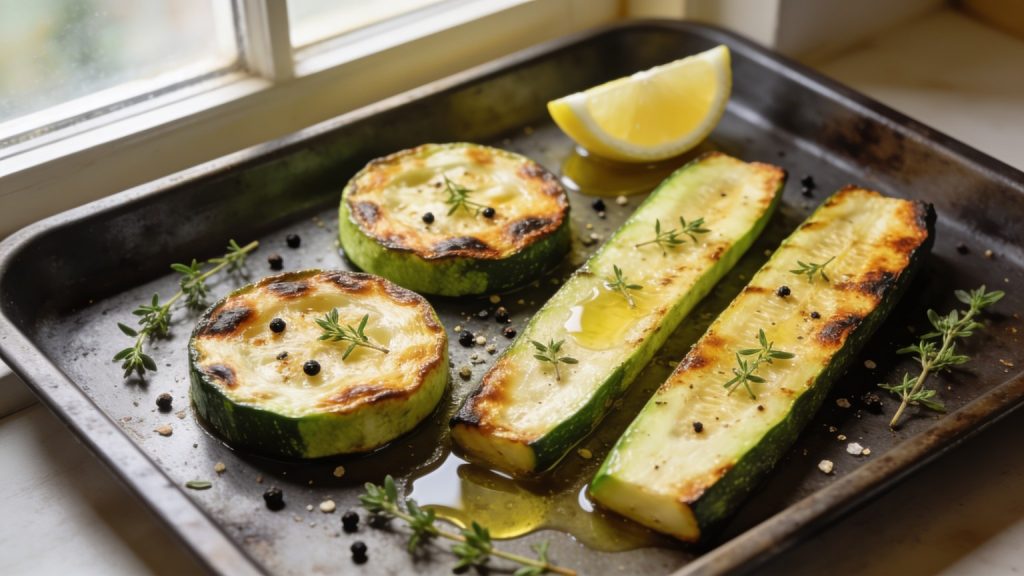
Buy small to medium — 15–20 cm (6–8 inches). Smaller zucchini are firmer and sweeter, with fewer watery seeds than late-August giants. Unwashed, loosely bagged in the crisper drawer, they keep about a week.
Don’t peel. The USDA figures describe zucchini with skin on — and carotenoids like lutein are pigments, sitting in and just under that deep-green surface.
Manage the water: salt sliced or shredded zucchini, wait 10–15 minutes, squeeze dry. Favor dry heat — a grill or a 200°C (400°F) oven concentrates flavor; boiling waterlogs the squash and sends some water-soluble vitamin C into the pot. Our sheet-pan salmon with corn, zucchini, and tomatoes does it on one tray. Water is what makes zucchini forgiving in a hot pan; broccoli is the opposite, and a rolling pot costs it 41% of its aliphatic glucosinolates — the five methods are measured side by side in does cooking broccoli destroy sulforaphane.
Zucchini Nutrition Facts
Frequently Asked Questions
Is zucchini good for weight loss?
It fits the winning pattern from the year-long trial above: that group lost 1.5 kg (3.3 lb) more without counting calories. The pattern, not any single vegetable, does the work.
Should you peel zucchini?
No. The skin is tender raw or cooked, and the USDA numbers here — the 2.1 mg of lutein included — were measured skin on.
Is zucchini a fruit or a vegetable?
Botanically a fruit — it grows from the flower and holds the seeds. In the kitchen and in dietary guidance, it’s a vegetable.
Can you eat zucchini raw?
Yes — shaved into ribbons, sliced into salads, grated into slaws — and raw spares its vitamin C. One rule: a harshly bitter zucchini gets thrown out, not powered through.
The Bottom Line: Zucchini Health Benefits
Zucchini earns its spot with arithmetic: 17 calories per 100 g, nearly 95% water, 20% of your daily vitamin C, and 2.1 mg of lutein — its best-supported benefit. The strongest trial suggests lutein-rich food matters most for those eating the least of it. Skip the fiber and libido claims — the data doesn’t back them. For a carotenoid-rich plate, tomatoes and their lycopene belong beside it.
Sources
- USDA FoodData Central — “Squash, summer, zucchini, includes skin, raw” (SR Legacy, FDC ID 169291). https://fdc.nal.usda.gov/food-details/169291/nutrients
- JAMA Ophthalmology, 2013 — Age-Related Eye Disease Study 2 (AREDS2) Research Group. “Lutein/zeaxanthin for the treatment of age-related cataract: AREDS2 randomized trial report no. 4.” 2013;131(7):843-850. https://pubmed.ncbi.nlm.nih.gov/23645227/
- American Journal of Clinical Nutrition, 2007 — Ello-Martin JA, Roe LS, Ledikwe JH, Beach AM, Rolls BJ. “Dietary energy density in the treatment of obesity: a year-long trial comparing 2 weight-loss diets.” 2007;85(6):1465-1477. https://pubmed.ncbi.nlm.nih.gov/17556681/
- Linus Pauling Institute, Oregon State University — Micronutrient Information Center, “Manganese.” https://lpi.oregonstate.edu/mic/minerals/manganese
- Linus Pauling Institute, Oregon State University — Micronutrient Information Center, “Vitamin C.” https://lpi.oregonstate.edu/mic/vitamins/vitamin-C
- Linus Pauling Institute, Oregon State University — Micronutrient Information Center, “Potassium” (documents the Dietary Guidelines’ “nutrient of public health concern” designation and average U.S. intakes below the recommended level). https://lpi.oregonstate.edu/mic/minerals/potassium

I love how versatile zucchini is — from grilling to spiralizing into noodles. Great to see it’s also packed with so many essential nutrients!
Had no clue zucchini could actually support libido and hormone balance. Makes me appreciate this humble veggie even more.
Fun fact: zucchini also contains cucurbitacins, compounds that have been studied for their potential anti-cancer properties. Just another reason to keep enjoying this amazing vegetable!