



How much black pepper with turmeric? About a fifth of a teaspoon of ground pepper carries the 20 mg of piperine used in the 1998 study everyone quotes. The turmeric side is the problem: that same study gave 2 g of curcumin, which is roughly 21 teaspoons of ground turmeric.
The paper is real, and so is the 2,000%. Piperine, the compound that makes black pepper (Piper nigrum) hot, raised curcumin in human blood by that much in a 1998 trial out of St. John’s Medical College in Bangalore. What almost nobody does is weigh what those volunteers swallowed.
So we weighed it. Five things decide whether the pairing means anything at your stove: the pepper dose, the curcumin in a teaspoon of turmeric, the ratio question, the daily ceiling, and the supplement trials.
What the evidence says
Solid · The arithmetic on both jars. USDA gram weights times two published assays: in an HPLC survey of 28 turmeric and curry powders, pure turmeric powder held the most curcumin, averaging 3.14% by weight, and black pepper runs 2–7.4% piperine.
Single study · The 2,000% figure. One 1998 trial in healthy volunteers, a single dose, blood sampled 0.25–1 h later. BfR reports a second human study at 5 mg of piperine that found only about a twofold rise.
Moderate · Turmeric-plus-piperine supplements and blood lipids. A 2025 meta-analysis pooled three randomized trials, n ≈ 250: LDL-C fell 17.0 mg/dL, GRADE certainty moderate, and the author asks for larger and longer trials.
The catch · The jar and the capsule are not the same intervention. The study’s 2 g of curcumin is about 64 g (2.2 oz) of turmeric powder. BfR says the liver case reports cluster on preparations with improved bioavailability, often with piperine added, mostly above the ADI but some below it — and that no causal link can be drawn from the data so far.
1. Does Black Pepper Help Turmeric Absorption?
In one human study it did, by a lot — on a single dose, and at a size nothing since has repeated.
The paper is Shoba G, Joy D, Joseph T, Majeed M, Rajendran R and Srinivas PS, Planta Medica, May 1998. Healthy volunteers given 2 g of curcumin alone had serum levels that were, in the authors’ words, “either undetectable or very low.” Adding 20 mg of piperine produced much higher concentrations between 0.25 and 1 hour after the dose, and the bioavailability increase was put at 2,000%. In rats, at 2 g/kg of curcumin with 20 mg/kg of piperine, the same measure rose 154%.
The mechanism is named in the paper: piperine is, in the authors’ words, “a known inhibitor of hepatic and intestinal glucuronidation” — the liver-and-gut process that tags curcumin for disposal before much of it reaches the blood.
Three limits travel with that figure. One dose, not a diet; healthy volunteers; and an abstract that never says how many people were in the human arm, so we will not invent one.
Germany’s Federal Institute for Risk Assessment (BfR) calls that result roughly a twentyfold rise in its 2021 opinion, then sets a second human study beside it: Anand and colleagues, 2007, same 2 g of curcumin with 5 mg of piperine, about a twofold rise. Its verdict is the honest one — the boost “can be subject to significant fluctuations.”
2. How Much Curcumin Is in a Teaspoon of Turmeric?
About 94 mg, in a level teaspoon of pure ground turmeric — the dried rhizome of Curcuma longa. That number decides everything else here.
Tayyem RF, Heath DD, Al-Delaimy WK and Rock CL ran high-performance liquid chromatography on 28 spice products for Nutrition and Cancer in 2006. Pure turmeric powder held the most curcumin, averaging 3.14% by weight. Curry powders, with one exception, carried “relatively small amounts” and varied widely — which is why the Singapore data on curry is a story about a whole blend, not about curcumin.
USDA FoodData Central weighs a teaspoon of ground turmeric at 3.0 g, a tablespoon at 9.4 g. Multiply 3.0 g by 3.14% — our arithmetic, not a published figure — and a level teaspoon holds about 94 mg of curcumin. The 2 g those volunteers took would be 21 teaspoons: 64 g, or 2.2 oz. No amount of pepper changes that.
3. What Is the Turmeric to Black Pepper Ratio for Absorption?
There is no tested ratio. The 1998 study used one fixed pair of doses — 2 g of curcumin and 20 mg of piperine, which happens to be 100:1 by weight — and no trial has since varied that proportion in people to see what it does.
Two ways to copy it, two very different pinches. Black pepper contains 2–7.4% piperine, per a 2021 review by Haq IU, Imran M, Nadeem M, Tufail T, Gondal TA and Mubarak MS in Phytotherapy Research; USDA weighs a teaspoon of the ground spice at 2.3 g and a dash at 0.1 g.
- Copy the piperine dose. Twenty milligrams of piperine is 270 mg to 1 g of ground pepper depending on the batch — an eighth of a teaspoon to just under half a teaspoon, and about a fifth of a teaspoon at the midpoint of that published range.
- Copy the 100:1 weight ratio instead. A teaspoon of turmeric carries 94 mg of curcumin, so the matching piperine is 0.94 mg — roughly 20 mg of ground pepper, about a fifth of a dash.
- Either way, a teaspoon of pepper overshoots. One teaspoon of the ground spice carries 46–170 mg of piperine, two to eight times what the volunteers were given.
Those readings differ more than twentyfold, and nothing published settles which to follow — the absolute dose is the one with a trial behind it, but that is our inference. The mismatch itself is not in doubt: the pepper side fits on a teaspoon, the turmeric side does not fit in a meal.
4. How Much Turmeric and Black Pepper Is Safe Per Day?
For curcumin there is a figure: 3 mg per kg of body weight a day, which is 210 mg for a 154-lb (70-kg) adult and works out near 2¼ teaspoons of ground turmeric. For black pepper as a spice there is no equivalent: the only piperine figure on the books is written for supplements.
The chain behind that 3 mg is short. The Joint FAO/WHO Expert Committee on Food Additives (JECFA) derived an acceptable daily intake of 0–3 mg/kg body weight in 2004, dividing a no-observed-effect level of 250–320 mg/kg from a two-generation rat study by 100. EFSA’s ANS Panel confirmed 3 mg/kg in its 2010 re-evaluation of curcumin as the food color E 100. BfR applies it to everything combined.
Ordinary eating sits inside that. EFSA’s 2014 refined exposure assessment, which covers curcumin as the additive, put adult intakes below the ADI at the mean and the 95th percentile; only for toddlers and children did the high-level estimate reach it. The additive alone gives adults a mean of 0.2–0.6 mg/kg a day, BfR reports — 14 to 42 mg for that 154-lb adult before the jar is opened. A daily teaspoon adds 94 mg. It is the same arithmetic we ran on how much cinnamon is safe per day, with a friendlier answer.
Piperine is where the caution belongs. BfR puts the ceiling at 2 mg of piperine a day for a 70-kg adult when it arrives isolated or concentrated and swallowed in one go — a figure written for supplements rather than pepper ground over food, and one the study’s 20 mg is ten times over. BfR also lists altered drug bioavailability among piperine’s effects. If you take medication, or are weighing capsules rather than the spice, talk to your doctor first.
5. Can You Take Turmeric Without Black Pepper?
In the kitchen, yes. Pepper is not a switch that turns turmeric on, and a curry without it is not a wasted curry. In supplement trials the picture differs, and that difference is the part worth knowing.
Epelde F, of Parc Taulí Hospital Universitari and the Universitat Autònoma de Barcelona, published a systematic review and meta-analysis in Pharmaceutics on December 15, 2025, using PRISMA 2020, Cochrane RoB 2 and GRADE. Three randomized trials (n ≈ 250) in adults with cardiometabolic risk were pooled: triglycerides fell 25.5 mg/dL (95% CI −32.5 to −18.4), LDL-C fell 17.0 mg/dL (95% CI −25.2 to −8.8), HDL-C rose 5.7 mg/dL. In subgroup analysis, turmeric with piperine dropped LDL-C 29.6 mg/dL against 16.2 for turmeric alone.
Read that subgroup carefully: it compares separate trials, not people randomized head to head, so it suggests rather than shows. GRADE certainty was moderate for triglycerides and LDL-C, low for HDL-C, and the author asks for larger, longer trials. All three used supplements — the gap we flagged on the anti-inflammatory list, and the reason one large trial settles more than a dozen small ones, as the 21,442-person COSMOS trial did for cocoa flavanols.
How to Use It in Your Kitchen
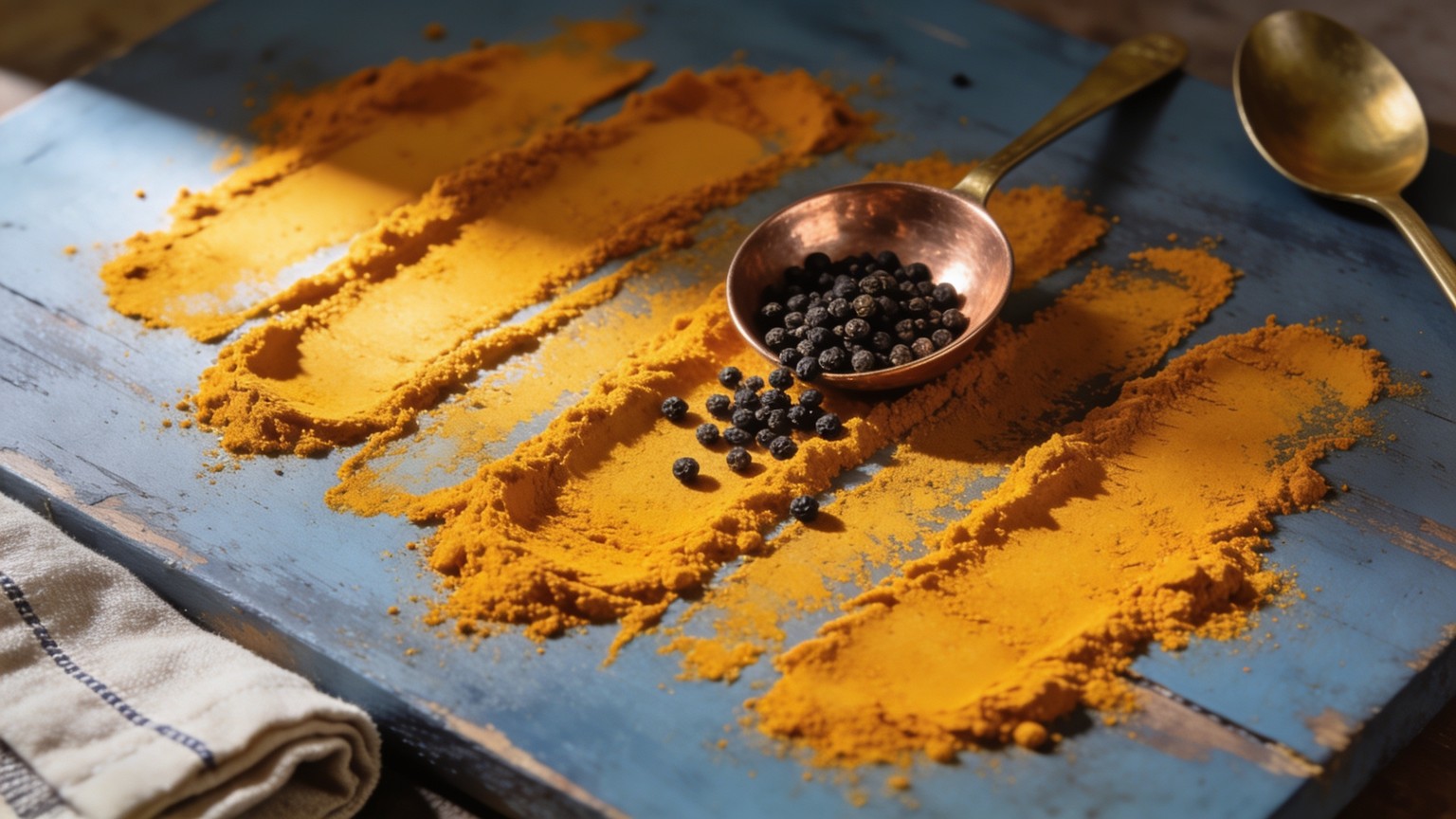
Grind the pepper over the finished dish and keep the mill turning. It takes an eighth to just under half a teaspoon of ground pepper to reach the study’s 20 mg of piperine, so a real grind gets there and a single dash does not — a dash is 0.1 g, which carries 2 to 7.4 mg. Grinding late also keeps the aroma the pre-ground jar in the pantry (store cupboard) has mostly lost. USDA weighs whole peppercorns at 2.9 g per teaspoon against 2.3 g ground.
Buy plain turmeric rather than curry powder when curcumin is the point; the 2006 assay found blends carried far less, and inconsistently. Our spicy chickpea and quinoa bowl uses both honestly — turmeric simmered into the grain, black pepper stirred through the roasted chickpeas off the heat.
One thing to know before buying a “high-absorption” blend: BfR notes that formulation can move curcumin much further than piperine does, with micellar preparations appearing to raise bioavailability more than a hundredfold. That is a supplement question, not a spice question, and it is where the liver case reports cluster.
Turmeric Nutrition Facts
Frequently Asked Questions
How much black pepper do you need with turmeric?
About a fifth of a teaspoon of ground pepper matches the 20 mg of piperine used in the 1998 study — an eighth to just under half a teaspoon, depending on the batch. That is a real grind rather than a dash: a dash is 0.1 g and carries 2 to 7.4 mg, while a full teaspoon carries 46–170 mg.
Does turmeric need black pepper for absorption?
No, not for turmeric to be worth eating. Piperine appears to slow the disposal of curcumin, and one human study measured a large rise — but a second, at a lower piperine dose, found only about a doubling. Turmeric without pepper is not an error.
Why do you need black pepper to activate turmeric?
“Activate” is the wrong verb. Piperine does not change curcumin; it inhibits the glucuronidation that clears curcumin, so more stays in circulation for an hour or so. That is pharmacokinetics, not a switch.
The Bottom Line: How Much Black Pepper With Turmeric
A fifth of a teaspoon of ground pepper is the honest answer, and the least interesting half of the question. That pinch came paired with 2 g of curcumin — about 21 teaspoons of turmeric — so a normally seasoned meal matches the pepper and misses the turmeric by a factor of twenty. Season for flavor, treat capsules as a separate conversation with your doctor, and cook something yellow, like our creamy coconut chickpea curry.
Sources
- Planta Medica, May 1998 — Shoba G, Joy D, Joseph T, Majeed M, Rajendran R, Srinivas PS. “Influence of piperine on the pharmacokinetics of curcumin in animals and human volunteers.” 1998;64(4):353–6 (2 g curcumin alone “either undetectable or very low”; 20 mg piperine, concentrations higher from 0.25 to 1 h, bioavailability up 2,000%; rats 2 g/kg plus 20 mg/kg, up 154%; piperine described as an inhibitor of hepatic and intestinal glucuronidation). https://pubmed.ncbi.nlm.nih.gov/9619120/
- Nutrition and Cancer, 2006 — Tayyem RF, Heath DD, Al-Delaimy WK, Rock CL. “Curcumin content of turmeric and curry powders.” 2006;55(2):126–31 (HPLC on 28 spice products; pure turmeric powder highest, averaging 3.14% curcumin by weight; curry powders “relatively small amounts” with great variability). https://pubmed.ncbi.nlm.nih.gov/17044766/
- Phytotherapy Research, February 2021 — Haq IU, Imran M, Nadeem M, Tufail T, Gondal TA, Mubarak MS. “Piperine: A review of its biological effects.” 2021;35(2):680–700 (“Black pepper contains 2–7.4% of piperine”). https://pubmed.ncbi.nlm.nih.gov/32929825/
- Pharmaceutics, December 15, 2025 — Epelde F. “Effects of Turmeric and Turmeric Plus Piperine Supplementation on Lipid Profiles in Adults with Cardiometabolic Risk Conditions: A Systematic Review and Meta-Analysis of Randomized Controlled Trials Following PRISMA Guidelines.” 2025;17(12):1609 (three RCTs, n ≈ 250; TG −25.5, TC −14.1, LDL-C −17.0, HDL-C +5.7 mg/dL; subgroup turmeric plus piperine −29.6 vs turmeric alone −16.2 mg/dL LDL-C; GRADE moderate for TG, TC and LDL-C, low for HDL-C). https://pubmed.ncbi.nlm.nih.gov/41471123/
- The American Journal of Clinical Nutrition, June 2022 — Sesso HD, Manson JE, Aragaki AK, Rist PM, Johnson LG, Friedenberg G, Copeland T, Clar A, Mora S, Moorthy MV, Sarkissian A, Carrick WR, Anderson GL; COSMOS Research Group. “Effect of cocoa flavanol supplementation for the prevention of cardiovascular disease events: the COcoa Supplement and Multivitamin Outcomes Study (COSMOS) randomized clinical trial.” 2022;115(6):1490–1500 (21,442 US adults; 500 mg cocoa flavanols daily; median follow-up 3.6 years; total cardiovascular events HR 0.90, 95% CI 0.78–1.02). https://pubmed.ncbi.nlm.nih.gov/35294962/
- German Federal Institute for Risk Assessment (BfR), Opinion No 040/2021, December 14, 2021 — “Curcumin in food supplements: Acceptable daily intake may be exceeded” (JECFA 2004 ADI of 0–3 mg/kg bw/day from a NOEL of 250–320 mg/kg bw/day with a factor of 100; EFSA’s 2010 re-evaluation of E 100 confirming 3 mg/kg bw/day; total intake from all sources; EFSA 2014 mean adult intake of 0.2–0.6 mg/kg bw/day from the additive; Shoba 1998 described as about a twentyfold rise and Anand et al. 2007 at 5 mg piperine as about twofold; 2 mg/day of isolated or enriched piperine as a bolus for a 70-kg adult; micellar formulations raising bioavailability more than a hundredfold; liver case reports clustered on high-dose preparations with improved bioavailability). https://www.bfr.bund.de/cm/349/curcumin-in-food-supplements-acceptable-daily-intake-may-be-exceeded.pdf
- European Food Safety Authority, EFSA Journal 2014;12(10):3876 — “Refined exposure assessment for curcumin (E 100)” (ADI of 3 mg/kg body weight per day from the 2010 ANS Panel re-evaluation; exposure for adolescents, adults and the elderly below the ADI at the mean and the 95th percentile; high-level estimates at the level of the ADI for toddlers and children, with exceedance in one survey each). https://pmc.ncbi.nlm.nih.gov/articles/PMC13136989/
- USDA FoodData Central — “Spices, turmeric, ground” (SR Legacy, FDC ID 172231): 3.0 g per teaspoon, 9.4 g per tablespoon, and the per-100 g values behind the table above. https://fdc.nal.usda.gov/food-details/172231/nutrients
- USDA FoodData Central — “Spices, pepper, black” (SR Legacy, FDC ID 170931): 2.3 g per teaspoon ground, 2.9 g per teaspoon whole, 6.9 g per tablespoon, 0.1 g per dash. https://fdc.nal.usda.gov/food-details/170931/nutrients