



The chocolate-and-heart story finally got its big randomized test. In COSMOS, 21,442 older adults took 500 mg of cocoa flavanols daily for a median 3.6 years: total cardiovascular events were not significantly reduced — but cardiovascular deaths fell 27%. Here’s what that settles, what it doesn’t, and two numbers we’re correcting from our earlier version.
Cocoa flavanols are the plant compounds that gave chocolate its scientific reputation — and for two decades the evidence for them was observational: people who ate chocolate had healthier hearts, which proves less than it suggests. The COcoa Supplement and Multivitamin Outcomes Study (COSMOS) was designed to end the ambiguity.
What the evidence says
Solid · In the largest flavanol trial ever run, the primary endpoint — all cardiovascular events — was not significantly reduced. HR 0.90 (95% CI 0.78–1.02), 21,442 adults, randomized and placebo-controlled.
Moderate · The same trial’s secondary endpoints leaned positive: cardiovascular death down 27%, and adherent participants did better. Secondary findings generate hypotheses, not verdicts.
Strong, but observational · People eating the most chocolate had 37% less cardiovascular disease and 29% fewer strokes than those eating the least. 114,009 people across seven studies — none of them randomized.
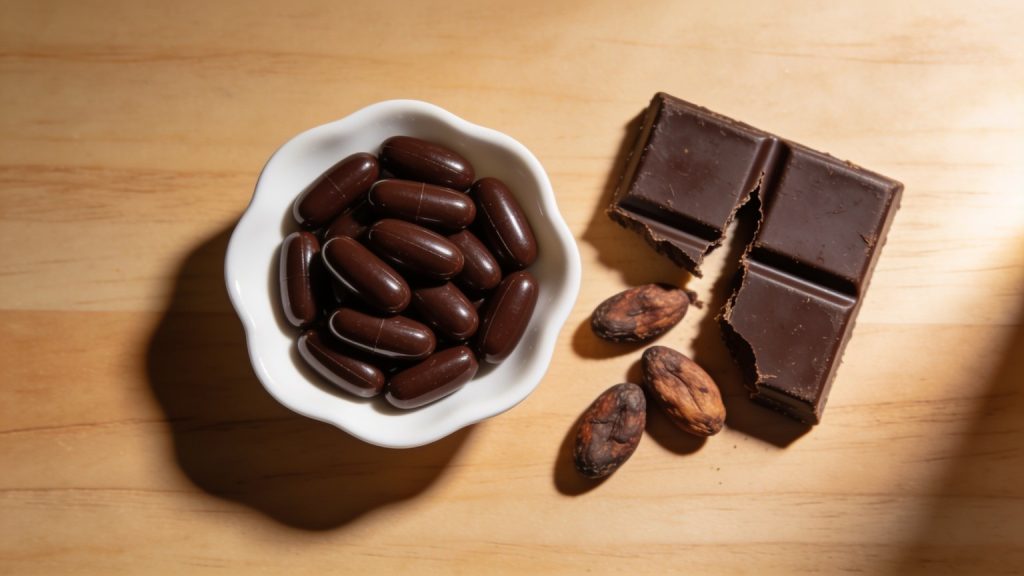
The catch · COSMOS tested a purified extract in capsules, not chocolate. 500 mg of flavanols a day is more than typical bars deliver, and bars don’t state their flavanol content at all.
What Did COSMOS Actually Test?
COSMOS randomized 21,442 US adults — women 65 and over, men 60 and over — to a daily cocoa-extract supplement standardized to 500 mg of flavanols, or placebo, and followed them for a median of 3.6 years. On the primary endpoint, total cardiovascular events, the result missed statistical significance: 410 events with the extract versus 456 with placebo (American Journal of Clinical Nutrition, 2022). Five hundred milligrams a day is a capsule figure, and the kitchen version of it is blunt: one square of our fudgy cocoa powder brownies carries about 186 mg of flavanols before it goes into the oven, so matching the COSMOS dose would take roughly three brownies a day — sugar, butter and all.
The secondary results are why the trial didn’t close the book. Cardiovascular death fell 27% (HR 0.73), all-cause mortality trended lower, and among participants who actually took their capsules consistently, the overall event reduction strengthened. The investigators’ own conclusion holds both halves: no significant reduction in total events, a real signal on cardiovascular death, and a case for more research rather than a victory lap.
Where Does the 37% Number Come From?
From observation, not experiment. A BMJ meta-analysis pooled seven studies covering 114,009 people and found the highest chocolate consumers had a 37% lower risk of cardiovascular disease and 29% lower risk of stroke than the lowest — with the authors stressing that not one of those studies was randomized (BMJ, 2011).
Two corrections to our earlier version, for the record: it credited that BMJ analysis with “more than 336,000 participants” — the correct figure is 114,009, and the larger number belongs to a different, later meta-analysis. It also cited a “2020 study from the University of L’Aquila”; the work in question is a 2017 review by University of L’Aquila researchers. Both are fixed here.
Do Cocoa Flavanols Sharpen the Brain?
The cognitive story is younger and smaller. A review by University of L’Aquila researchers gathered the trials of cocoa flavanols and cognition: several report gains in processing speed, working memory, and attention — most consistently in older adults and after weeks, not years, of intake (Frontiers in Nutrition, 2017). The samples are small and the tests short, so “may help” is as far as the evidence stretches. Flavanols appear to work partly by improving blood flow, including to the brain — the same mechanism behind the vascular findings.
Why These Findings Matter
For Your Heart
The honest summary: flavanols probably do something real for the cardiovascular system — the death signal in a 21,442-person trial is hard to wave away — but the definitive benefit, on all events, wasn’t proven. No capsule replaces the things with mountains of evidence: not smoking, movement, and a diet built on plants. Pomegranate raises the same capsule-versus-food question, since two of the four blood pressure reviews were not limited to juice, which is why we kept them apart in how much pomegranate juice per day.
For Your Chocolate Habit
A supplement trial is not a license for candy — but eating dark chocolate has randomized evidence of its own, at doses of one to three squares: see what dark chocolate actually changed in trials. And flavanols have close cousins, anthocyanins, with their own case — blueberries carry that story. Cocoa is not the only pantry staple where one number decides the story: the same kind of arithmetic settles how much cinnamon is safe per day, and there the answer turns on which bark ended up in your jar. Most cocoa at home ends up in a mug rather than a capsule, and in our healthy hot chocolate we went through the two small trials of cocoa made with milk or water, which only partly agree on whether the milk costs you flavanols.
Sources
- American Journal of Clinical Nutrition, 2022 — “Effect of cocoa flavanol supplementation for the prevention of cardiovascular disease events: the COcoa Supplement and Multivitamin Outcomes Study (COSMOS) randomized clinical trial.” Am J Clin Nutr. 2022;115(6):1490-1500. PMID 35294962. https://pubmed.ncbi.nlm.nih.gov/35294962/
- BMJ, 2011 — Buitrago-Lopez A, Sanderson J, Johnson L, Warnakula S, Wood A, Di Angelantonio E, Franco OH. “Chocolate consumption and cardiometabolic disorders: systematic review and meta-analysis.” BMJ. 2011;343:d4488. PMID 21875885. https://pubmed.ncbi.nlm.nih.gov/21875885/
- Frontiers in Nutrition, 2017 — Socci V, Tempesta D, Desideri G, De Gennaro L, Ferrara M. “Enhancing Human Cognition with Cocoa Flavonoids.” Front Nutr. 2017;4:19. PMID 28560212. https://pubmed.ncbi.nlm.nih.gov/28560212/