



Dark chocolate benefits come with trial numbers attached: measurably better blood-vessel function, lower insulin resistance, and a real effect on mood — including a drop in depression scores among menopausal women eating 12 g a day. The fine print is the dose: every one of these trials used a square or three, not a bar.
Chocolate’s health halo usually leans on population studies of people who happen to eat it. The more interesting shelf is the randomized trials — where researchers hand out dark chocolate (70–85% cocoa) and measure what changes. An earlier version of this article mixed both kinds of evidence together; this one keeps them separate.
What the evidence says
Solid · Across 42 randomized trials, chocolate and cocoa improved blood-vessel dilation and insulin resistance. 1,297 participants: FMD +1.34% with regular intake, HOMA-IR −0.67.
Single study · In menopausal women, 12 g of 78% dark chocolate a day lowered depression scores versus milk chocolate. 60 women, triple-blind, 8 weeks: −2.3 points; sleep didn’t change.
Single study · In healthy adults, 30 g of 85% chocolate reduced negative mood — and 70% didn’t. 48 adults, 3 weeks; gut-microbiome shifts tracked the mood change.
Limited · In type 2 diabetes, 30 g of 84% chocolate alongside lifestyle advice lowered fasting glucose, HbA1c, LDL, and inflammation markers. 44 completers, not blinded.
The catch · The doses were 12–30 g — one to three squares. A full 100-g bar of 70–85% chocolate carries 598 calories and undoes the arithmetic.
What Moved in the Vessel and Insulin Trials?
The broadest randomized evidence is a meta-analysis of 42 trials with 1,297 participants. Flow-mediated dilation — how readily an artery widens — improved both after a single serving (+3.19%) and with regular intake over weeks (+1.34%). Insulin resistance fell (HOMA-IR −0.67), driven by lower insulin, and diastolic blood pressure eased by about 1.6 mm Hg (American Journal of Clinical Nutrition, 2012). The authors’ caveat is standard but worth repeating: trials were short — 18 weeks at most — and many were industry-funded.
Can a Square a Day Lift Mood?
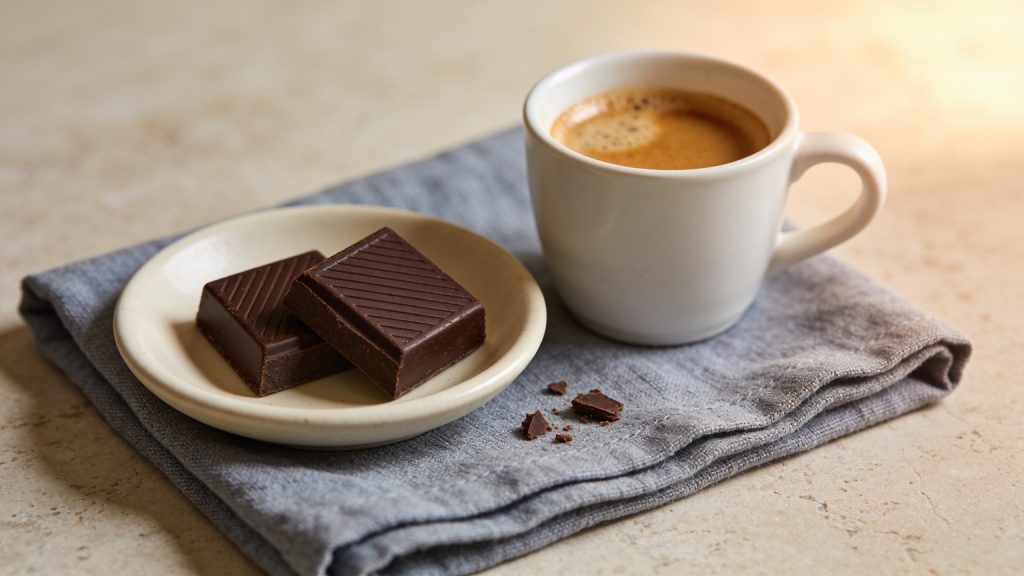
Two recent randomized trials suggest it can — with conditions. In a triple-blind Iranian trial, 60 menopausal women ate 12 g a day of either 78% dark or milk chocolate for eight weeks; the dark-chocolate group’s depression scores fell by 2.3 points more, a moderate effect size, while sleep quality and body measurements didn’t budge (Scientific Reports, 2024).
A Korean trial fed 48 healthy adults 30 g a day of 85% chocolate, 70% chocolate, or none for three weeks. Negative mood improved only in the 85% group — and stool sequencing showed their gut microbiomes shifted, with the mood change tracking the microbial one (Journal of Nutritional Biochemistry, 2022). Small samples, short trials; but they’re the right kind of evidence, and they agree on direction.
What About Type 2 Diabetes?
The most cited trial gave 30 g of 84% dark chocolate daily, on top of lifestyle guidance, to adults with type 2 diabetes for eight weeks. Compared with lifestyle guidance alone, fasting glucose, HbA1c, LDL, and triglycerides fell, along with inflammatory markers TNF-α, IL-6, and hs-CRP (International Journal of Preventive Medicine, 2018). Read it as encouraging, not settled: 44 people finished, and everyone knew who was eating chocolate. If you take diabetes medication, changes like this belong in a conversation with your doctor first.
Why These Findings Matter
The Dose Is a Square, Not a Bar
Every result above came from 12–30 g a day. Dark chocolate at 70–85% cocoa runs 598 calories per 100 g (USDA), so the serving that matched the trials is one to three squares — eaten instead of another sweet, not on top of it.
The Percentage Did the Work
Where trials compared strengths, higher cocoa won: 85% moved mood where 70% didn’t, and the diabetes and menopause trials sat at 84% and 78%. Higher percentage also means less sugar riding along — a reasonable default is the darkest bar you genuinely enjoy. A bar is not the only place where the label decides the dose: the tin behind our fudgy cocoa powder brownies averages 34.6 mg of flavanols per gram if it is natural and 3.9 mg if it has been heavily Dutch-processed, which is the same question asked in a cheaper aisle.
For the days chocolate is dessert rather than a data point, do it properly: our Black Forest gateau is built on real dark chocolate and honest about being cake. And for what the compound behind these effects did in a 21,442-person trial, see our companion piece on cocoa flavanols.
Sources
- American Journal of Clinical Nutrition, 2012 — Hooper L, Kay C, Abdelhamid A, Kroon PA, Cohn JS, Rimm EB, Cassidy A. “Effects of chocolate, cocoa, and flavan-3-ols on cardiovascular health: a systematic review and meta-analysis of randomized trials.” Am J Clin Nutr. 2012;95(3):740-751. PMID 22301923. https://pubmed.ncbi.nlm.nih.gov/22301923/
- Scientific Reports, 2024 — Abdoli E, Rezaie E, Mirghafourvand M, Payahoo L, Naseri E, Ghanbari-Homaie S. “A clinical trial of the effects of cocoa rich chocolate on depression and sleep quality in menopausal women.” Sci Rep. 2024;14:23971. PMID 39397049. https://pubmed.ncbi.nlm.nih.gov/39397049/
- Journal of Nutritional Biochemistry, 2022 — Shin JH, Kim CS, Cha J, Kim S, Lee S, Chae S, Chun WY, Shin DM. “Consumption of 85% cocoa dark chocolate improves mood in association with gut microbial changes in healthy adults: a randomized controlled trial.” J Nutr Biochem. 2022;99:108854. PMID 34530112. https://pubmed.ncbi.nlm.nih.gov/34530112/
- International Journal of Preventive Medicine, 2018 — Jafarirad S, Ayoobi N, Karandish M, Jalali MT, Haghighizadeh MH, Jahanshahi A. “Dark Chocolate Effect on Serum Adiponectin, Biochemical and Inflammatory Parameters in Diabetic Patients: A Randomized Clinical Trial.” Int J Prev Med. 2018;9:86. PMID 30450169. https://pubmed.ncbi.nlm.nih.gov/30450169/
- USDA FoodData Central — “Chocolate, dark, 70-85% cacao solids” (FDC ID 170273, SR Legacy). https://fdc.nal.usda.gov/food-details/170273/nutrients