


Fudgy Cocoa Powder Brownies: Natural Cocoa Has Nearly Nine Times the Flavanols
Description
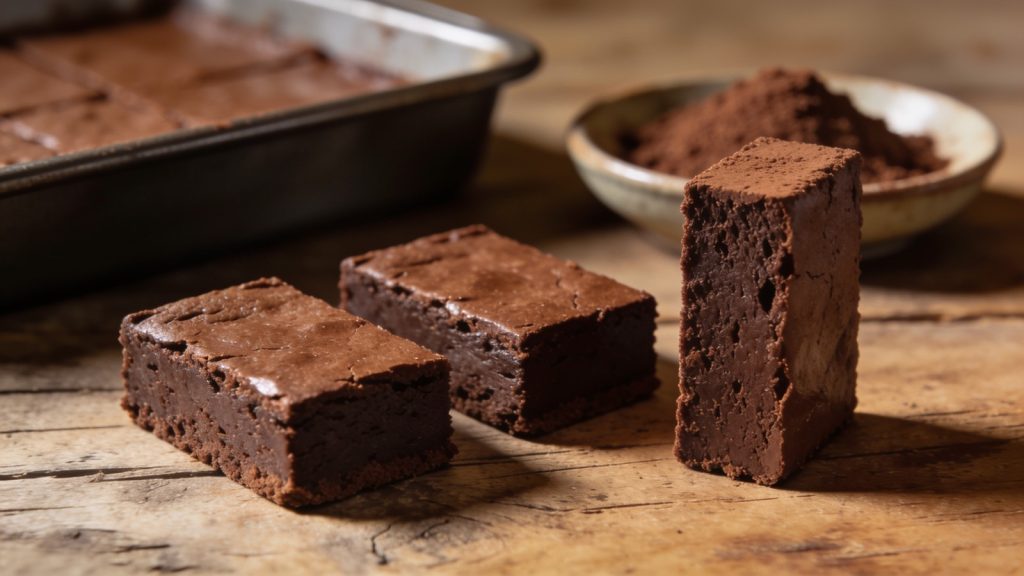
Sixteen fudgy cocoa powder brownies, mixed in the same saucepan the butter melted in — no melted chocolate, no chocolate chips, and about one tablespoon of cocoa in every square. Which tin you reach for decides more than the flavor: a survey of commercial cocoa powders put natural cocoa at 34.6 mg of flavanols per gram and heavily alkalized (Dutch process) cocoa at 3.9 mg. There is no baking soda in this batter, so either one works here — the difference is what you get for the same square.
Ingredients
For the cocoa base
To finish the batter
Instructions
Make the cocoa base
-
Heat the oven
Set a rack in the center and heat the oven to 180°C (350°F). Line a 23 x 23 cm (9 x 9-inch) metal baking pan (tin) with parchment paper (baking parchment), leaving a 5 cm (2-inch) overhang on two opposite sides to lift the slab out later.
-
Melt the butter
Melt the 170 g (3/4 cup) butter in a medium saucepan over low heat, then take the pan off the heat. Everything else gets mixed in this same pan.
-
Whisk in the sugar, cocoa, and salt while the butter is hot
Whisk the 300 g (1 1/2 cups) sugar, 86 g (1 cup) cocoa powder, and 3/4 teaspoon fine sea salt into the hot butter until you have a thick, grainy paste. Let it stand about 5 minutes — it should be warm to the touch, not hot, before the eggs go in.
Beat in the eggs, then the flour
-
Add the eggs one at a time
Stir in the 2 teaspoons (10 ml) vanilla extract, then add the 3 eggs one at a time, beating hard with a wooden spoon or a stiff spatula for about 30 seconds after each. The paste turns from grainy and dull into a thick, smooth batter. That beating is what builds the thin crackly top, so do not shortcut it.
-
Fold in the flour, then stop
Add the 85 g (2/3 cup) flour and stir until no dry streaks are left, then give the batter about 40 more strokes. Stop there — past that point you are only working the flour.
Bake, then wait
-
Bake
Scrape the batter into the lined pan, push it into the corners, and level the top. Bake at 180°C (350°F) for 30 to 35 minutes, until a toothpick pushed in 5 cm (2 inches) from the edge comes out with moist crumbs clinging to it. Start checking at 28 minutes; the very center stays soft and firms up as it cools.
-
Cool completely before you cut
Leave the pan on a rack for at least 2 hours. Lift the slab out by the parchment overhang and cut it into 16 squares with a long knife, wiping the blade clean between cuts. Warm brownies smear; cooled ones cut into clean squares.
Nutrition Facts
Servings 16
Serving Size 1 of 16 squares
- Amount Per Serving
- Calories 195kcal
- % Daily Value *
- Total Fat 10g13%
- Saturated Fat 6g30%
- Cholesterol 58mg20%
- Sodium 125mg6%
- Potassium 104mg3%
- Total Carbohydrate 26g10%
- Dietary Fiber 2g8%
- Sugars 19g
- Protein 3g6%
- Vitamin A 79 mcg RAE
- Calcium 16 mg
- Iron 1 mg
* Percent Daily Values are based on a 2,000 calorie diet. Your daily value may be higher or lower depending on your calorie needs.
Note
- Natural or Dutch process — the number, and where it comes from. A survey of commercial cocoa powders (Miller KB, Hurst WJ, Payne MJ, Stuart DA, Apgar J, Sweigart DS, Ou B; Journal of Agricultural and Food Chemistry, 2008; PMID 18710243) measured average total flavanols at 34.6 ± 6.8 mg/g for natural cocoas (extractable pH 5.3–5.8), 13.8 ± 7.3 mg/g for lightly alkalized (pH 6.50–7.20), 7.8 ± 4.0 mg/g for medium (pH 7.21–7.60), and 3.9 ± 1.8 mg/g for heavily alkalized powders (pH 7.61 and up), with the decline linear as pH rose. The “nearly nine times” in the title is natural against heavily alkalized cocoa (34.6 : 3.9); against a lightly treated tin the gap is closer to two and a half times. Read it with its limits: the work was done at the Hershey Center for Health and Nutrition, The Hershey Company — an industry laboratory — the standard deviations overlap a good deal, and no label tells you how heavily a Dutch-process cocoa was treated. On the tin it reads “processed with alkali”, “Dutch process”, or “Dutched”; natural cocoa usually says nothing at all.
- There is no baking soda in this batter, and that matters twice. First, for the rise: baking soda needs an acid to work, natural cocoa is that acid, and Dutch-process cocoa has had the acid neutralized. Nothing here rises chemically, so the two cocoas are interchangeable cup for cup without touching the texture. Second, for the flavanols: the only study that has measured what home baking does to them (Stahl L, Miller KB, Apgar J, Sweigart DS, Stuart DA, McHale N, Ou B, Kondo M, Hurst WJ; Journal of Food Science, 2009; PMID 19723182) found recoveries of 86 percent to over 100 percent in chocolate frosting, a hot cocoa drink, and chocolate cookies, while chocolate cake lost the most — 5 percent recovery for epicatechin and 54 percent for antioxidant activity. The losses tracked the pH: cakes leavened with baking soda went alkaline and lost the flavanols, cakes leavened with baking powder finished at pH 6.2 with essentially complete retention, and commercial cake mixes came out above pH 8.3 with no detectable monomeric flavanols at all. The limits are real: it is the same Hershey laboratory as the 2008 survey, and nobody measured a brownie. An unleavened batter sits closer to the cookie than to the cake, but that is reasoning from the study, not a measurement of this recipe.
- What one square carries on paper — and what the big trial actually found. One cup of cocoa is 86 g (USDA FDC 169593); divided by 16 squares that is about 5.4 g each, which is exactly USDA’s own tablespoon. At natural cocoa’s 34.6 mg/g, a square carries roughly 186 mg of flavanols before it goes in the oven; made with heavily alkalized cocoa, the same square carries about 21 mg. For scale: COSMOS (Sesso HD, Manson JE, Aragaki AK, Rist PM, Johnson LG, Friedenberg G, Copeland T, Clar A, Mora S, Moorthy MV, Sarkissian A, Carrick WR, Anderson GL; COSMOS Research Group; American Journal of Clinical Nutrition, 2022; PMID 35294962; NCT02422745) gave 21,442 older US adults 500 mg of cocoa flavanols a day, including 80 mg of (−)-epicatechin, as a capsule extract, with a median follow-up of 3.6 years. The primary endpoint did not reach significance — total cardiovascular events HR 0.90 (95% CI 0.78–1.02; P = 0.11). Cardiovascular death, a secondary endpoint, was lower (HR 0.73; 95% CI 0.54–0.98), and secondary endpoints are a lead, not a verdict. Matching that daily dose would take about three of these brownies a day, which is not a health plan — and a capsule of extract is not a tray bake that also carries 300 g of sugar.
- The caffeine is not the same either. USDA lists natural unsweetened cocoa at 230 mg of caffeine per 100 g (FDC 169593) and the alkali-processed powder at 78 mg (FDC 169594). At about 5.4 g of cocoa per square that works out to roughly 12 mg of caffeine in a natural-cocoa brownie and about 4 mg in a Dutch-process one — against about 95 mg in an 8 fl oz (237 ml) cup of brewed coffee (USDA FDC 171890, 40 mg per 100 g). Theobromine runs the other way: 2,057 mg per 100 g natural against 2,634 mg alkalized, so about 111 mg and 142 mg per square. None of that is a problem for most adults, but it is worth knowing if these are going out after dinner or to children.
- The crackly top comes from beating, and the wait is not optional. Beating each egg in hard dissolves the sugar and carries it up with the egg, and it sets into the thin papery sheet on top; a dull, matte top almost always means the eggs went in gently. On doneness: pull the pan when a toothpick 5 cm (2 inches) in from the edge comes out with moist crumbs, not clean — clean means cakey. A light-colored metal pan is what these quantities were written for; glass and dark metal both run hotter at the edges, so start checking at 28 minutes. Then leave it alone for 2 hours. Fudgy brownies set as they cool, and a warm slab cut early gives you smears instead of squares.
- Swaps. Oil for butter: 150 ml (2/3 cup) of a neutral oil carries about the same fat as the butter here — USDA puts butter at 81.11 g of fat per 100 g (FDC 173430), so 170 g of butter is roughly 138 g of fat. Oil brings no water and no milk solids, so the flavor is plainer and the square a little denser; everything else, including the oven at 180°C (350°F), stays put. Gluten-free: a 1:1 gluten-free baking blend swaps in for the 85 g of flour by weight; there is so little flour here that brownies forgive it better than most bakes. Salt: the brands are not interchangeable by volume — weigh 4.5 g, whatever is in the cupboard. Bigger pan: a 23 x 33 cm (9 x 13-inch) pan spreads this batter thin and it will be done several minutes sooner; the squares come out flatter and drier, so this is written for the 23 x 23 cm (9 x 9-inch).
- How the nutrition was calculated. From USDA FoodData Central SR Legacy records for the raw ingredients — butter 173430, granulated sugar 169655, cocoa powder 169593, egg 171287, vanilla extract 173471, all-purpose flour 168894, table salt 173468 — added up for the whole batch and divided by 16 squares. USDA’s Table of Nutrient Retention Factors (Release 6) has no row for baked goods, so the nearest documented row, flour/meal, baked, was applied to the batter; it changes one figure here, vitamin A, which drops about a tenth. Everything else stays where the raw records put it: the retention table carries no factors for calories, fat, protein, carbohydrate, fiber or cholesterol, nothing in this recipe is boiled or drained so none of the minerals go down the sink, and there is no vitamin C in any of these ingredients to lose. All 4.5 g of salt is counted. The figures are for the recipe as written, with natural cocoa; a Dutch-process tin changes the fiber (USDA gives 37.0 g per 100 g natural against 29.8 g alkalized) and the potassium (1,524 mg against 2,509 mg), because the alkali left behind in the powder is itself a potassium salt. The branded Diamond Crystal record (FDC 2571981) was used only to turn teaspoons into grams. One thing the records cannot tell you: the USDA record for unsalted butter carries no entry for trans fat at all, so the 0 g on the card is a rounding floor, not a measurement.