


Pumpkin Cinnamon Rolls, No Yeast: One Roll Is About a Third of a Day’s Coumarin
Description
Twelve rolls out of one pan with no yeast and no rising time — a tablespoon of baking powder does the lifting, so the dough is in the oven about twenty-five minutes after the flour comes out of the bag. One tablespoon of ground cinnamon seasons the whole pan, which is what makes this recipe countable: if that spoonful is cassia, our arithmetic from BfR’s average figure puts roughly 1.95 mg of coumarin in each roll, about a third of the 6 mg daily intake BfR and EFSA consider tolerable for a 60 kg (132 lb) adult.
Ingredients
For the dough
For the cinnamon filling
For the cream cheese glaze
Instructions
Make the dough
-
Heat the oven and butter the pan
Set a rack in the center and heat the oven to 190°C (375°F). Butter a 23 x 33 cm (9 x 13-inch) baking pan, or line it with parchment paper. Get this done first: once the dough is wet, the clock is running.
-
Cut the cold butter into the dry mix
Whisk the flour (375 g / 3 cups), 1 tablespoon baking powder, 25 g (2 tablespoons) granulated sugar and 3/4 teaspoon salt in a large bowl. Add the 85 g (6 tablespoons) of cold cubed butter and work it in with your fingertips or a pastry cutter until the largest pieces are the size of peas. Those pieces are the whole point — they turn to steam in the oven and give a yeast-free dough its layers.
-
Stir in the pumpkin and the milk
Add the pumpkin puree (183 g / 3/4 cup) and 60 ml (1/4 cup) cold milk and stir with a fork just until a shaggy dough pulls together. If dry flour is still loose in the bottom of the bowl, add milk one tablespoon at a time, up to two. Stop the moment it holds — every extra turn of the fork builds gluten, and there is no rise here to soften it again.
Fill, roll and cut
-
Roll out a rectangle
Turn the dough onto a floured surface and knead it four or five times, no more. Roll or pat it into a rectangle about 25 x 35 cm (10 x 14 inches) and 1 cm (3/8 inch) thick, with a long side facing you.
-
Spread the filling
Spread the 57 g (4 tablespoons) of soft butter across the dough, leaving a bare strip about 1 cm (1/2 inch) wide along the far long edge so the roll can seal. Stir the brown sugar (110 g / 1/2 cup packed) with the 1 tablespoon (7.8 g) of ground cinnamon in a small bowl and scatter it over the butter, right out to both short edges.
-
Roll it up and cut twelve
Roll the dough up from the long edge nearest you into a log about 35 cm (14 inches) long and set it seam side down. Cut it into 12 rolls of about 3 cm (1 1/4 inches) — a length of unflavored dental floss slid under the log and crossed over the top gives a cleaner cut than a knife. Set them cut side up in the pan in three rows of four, with a little space around each; they spread and meet as they bake.
Bake and glaze
-
Bake 25 to 28 minutes
Get the pan into the oven as soon as the rolls are cut and bake at 190°C (375°F) for 25 to 28 minutes, until the tops are golden and an instant-read thermometer pushed into the center roll reads about 96°C (205°F). Baking powder starts working the moment it meets the wet pumpkin, so a pan left standing on the counter goes in flat.
-
Beat the glaze while they bake
Beat the softened cream cheese (85 g / 3 oz) with the confectioners' sugar (60 g / 1/2 cup), 30 ml (2 tablespoons) milk and 1/2 teaspoon vanilla until it is smooth and just pourable — it should fall off the spoon in a ribbon rather than sit on it.
-
Rest ten minutes, then glaze
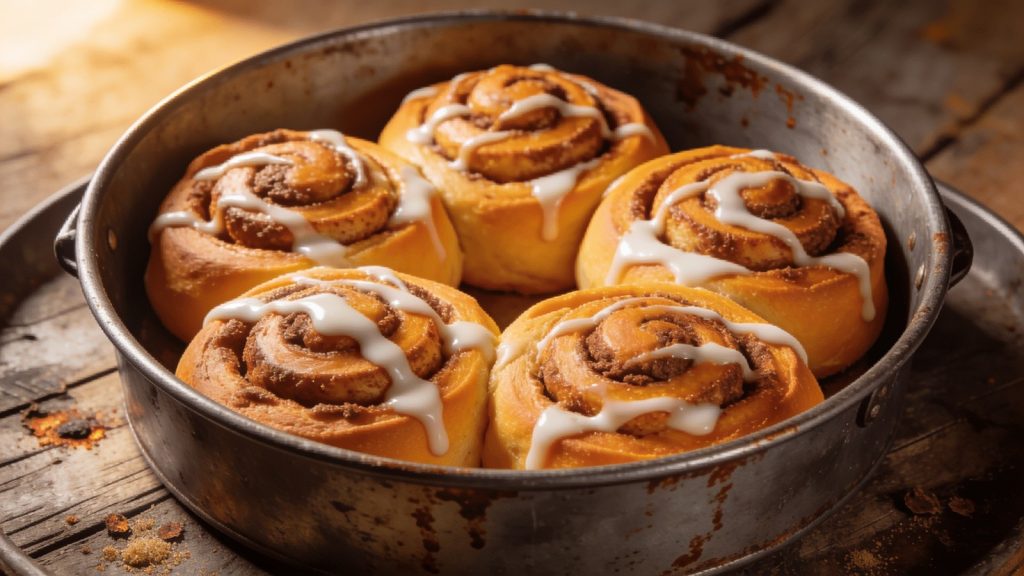
Let the pan stand for 10 minutes before you spoon the glaze over the rolls. On rolls straight from the oven it slides off the tops and collects in the pan; after ten minutes it stays where you put it and soaks only into the seams. Serve them warm, straight from the pan.
Nutrition Facts
Servings 12
Serving Size 1 of 12 rolls
- Amount Per Serving
- Calories 298kcal
- % Daily Value *
- Total Fat 12.6g17%
- Saturated Fat 7.6g38%
- Trans Fat 0.08g
- Cholesterol 33mg11%
- Sodium 298mg13%
- Potassium 103mg3%
- Total Carbohydrate 42.8g16%
- Dietary Fiber 1.6g6%
- Sugars 17.1g
- Protein 4.2g9%
- Vitamin A 219 mcg RAE
- Vitamin C 0.57 mg
- Calcium 109 mg
- Iron 1.9 mg
* Percent Daily Values are based on a 2,000 calorie diet. Your daily value may be higher or lower depending on your calorie needs.
Note
- The jar decides the number, not the recipe. Every coumarin figure here rests on one assumption: that the tablespoon in the filling is cassia, which is what a jar labeled only “ground cinnamon” almost always holds. Germany’s Federal Institute for Risk Assessment (BfR) puts cassia at an average of 3,000 mg of coumarin per kg of spice, with the highest measured samples at 10,000 mg/kg; Austria’s AGES measured 1,880–3,260 mg/kg in cassia and a highest value of 185 mg/kg in Ceylon. Swap the jar for Ceylon and the same spoonful takes this pan from about 23 mg of coumarin down to about 1.4 mg — roughly sixteen times less, and that is Ceylon measured at the highest AGES has ever recorded, not at its typical level. Our arithmetic, from their published figures.
- No legal limit applies to a home kitchen, and that cuts both ways. Annex III of Regulation (EC) No 1334/2008 has capped coumarin in shop-bought food since January 2011 — 50 mg/kg for traditional and seasonal bakery ware that names cinnamon on the label, 20 mg/kg for breakfast cereals, 15 mg/kg for other fine bakery ware, 5 mg/kg for desserts — and both BfR and AGES state plainly that there is no limit value for cinnamon as a spice or for what you bake at home. This pan works out at about 21 mg per kg of its 1,099 g raw batch: under the bakery ceiling, over the other three, and bound by none. The commercial limits are not theoretical either: in a 2025 campaign AGES analyzed 151 samples of cinnamon baked goods and cereals and found four over the limit.
- Losing the yeast costs you sodium. The tablespoon of baking powder that does the lifting carries about 1,463 mg of sodium — USDA lists 10,600 mg per 100 g for double-acting baking powder (FDC 172803) — which is roughly 122 mg a roll, close to what the 3/4 teaspoon of salt contributes. Yeast brings none of it. That is the honest trade for skipping the rise, and it is worth knowing if sodium is something you watch.
- Weigh the flour if you can. USDA puts a cup of all-purpose flour (plain flour) at 125 g (FDC 168894), so 3 cups is 375 g, and that is what the card was calculated from. A cup scooped straight out of the bag runs heavier; three of those turn a soft, rollable dough into one that splits along the edges the moment you roll it up.
- This dough will not wait overnight. Double-acting baking powder gives up part of its gas as soon as it meets the wet pumpkin and the rest in the oven heat, so rolls cut and refrigerated overnight bake flat — that is the one thing yeast dough does better. What you can do the night before is whisk the dry mix, cut in the cold butter and keep that bowl covered in the refrigerator; the rest takes fifteen minutes in the morning. The glaze is dairy, so refrigerate the glazed rolls and eat them within five days; unglazed rolls keep three days covered at room temperature. Either comes back with 10 seconds in the microwave or 8 minutes at 150°C (300°F).
- For UK kitchens. Tinned 100% pumpkin is an everyday US pantry item and a specialty buy on a British shelf. Roast butternut squash until soft, mash it and drain it well, then use it 1:1. USDA’s record for baked butternut squash (FDC 169296) gives 558 µg RAE of vitamin A per 100 g against 778 µg RAE for canned pumpkin (FDC 168450) — about 72 percent as much — and it holds slightly less water (87.8 g against 89.97 g per 100 g), so hold back one of the two spare tablespoons of milk and add it only if the dough stays dry.
- How the nutrition was calculated. From USDA FoodData Central SR Legacy records for each ingredient as it goes into the bowl — all-purpose flour 168894, baking powder 172803, granulated sugar 169655, table salt 173468, butter 173430, canned pumpkin 168450, whole milk 172217, brown sugar 168833, ground cinnamon 171320, cream cheese 173418, confectioners’ sugar 169656, vanilla extract 173471 — added up, then adjusted with USDA Release 6 retention factors: row 0301 (flour and meal, baked) for the flour, the baking powder, the sugar and the salt, row 3771 (other vegetables, baked) for the pumpkin and the cinnamon, and row 0001 (cheese, baked — food group 01, dairy and egg products) for the butter and for the milk in the dough. The glaze is spooned on ten minutes after the pan leaves the oven, so it carries no retention factor at all. The total was then divided by twelve. Nothing is drained or discarded, and all 4.5 g of the salt is counted. Raw batch weight 1,099 g, or about 92 g per roll before the water that leaves in the oven. One caveat we would rather state than leave out: USDA’s record for butter carries no figure for trans fat, so the 0.08 g on the card comes from the cream cheese alone and the real number is a little higher.