


Homemade Goat Cheese (Chèvre): One Pot, Four Ingredients, and a Thermometer
Description
Fresh homemade goat cheese — chèvre — from one pot, four everyday ingredients, and a thermometer: goat milk heated to 85°C (185°F), curdled with lemon juice, drained to the texture you like. About 225 g (8 oz) of creamy, tangy spread, no rennet needed.
Ingredients
For the cheese
For flavoring (optional, not in the nutrition card)
Instructions
Heat and curdle
-
Heat the milk to 85°C (185°F)
Pour 1 liter of goat milk into a heavy saucepan and set it over medium heat. Stir gently and often, and clip on a thermometer: you're going to 85°C (185°F) — hot enough to curdle cleanly, below a boil. This takes about 10 to 12 minutes; don't rush it.
-
Add the lemon juice off the heat
Take the pan off the heat and pour in the lemon juice (60 ml / 1/4 cup). Give it two or three slow stirs — no more — and watch the milk separate into white curds and thin, yellowish whey. If nothing happens within a minute, stir in the vinegar a teaspoon at a time until it does.
-
Let the curds settle
Cover the pan with a clean towel and leave it completely undisturbed for 10 minutes. The curds will finish forming and sink into a soft raft.
Drain, season, shape
-
Drain to the texture you like
Line a colander with fine cheesecloth (or a clean, thin tea towel) set over a bowl, and pour in the curds and whey. Let it drain 30 minutes for a spreadable cheese, 60 to 90 for a firmer one you can shape. Keep the whey — see Note.
-
Season and shape
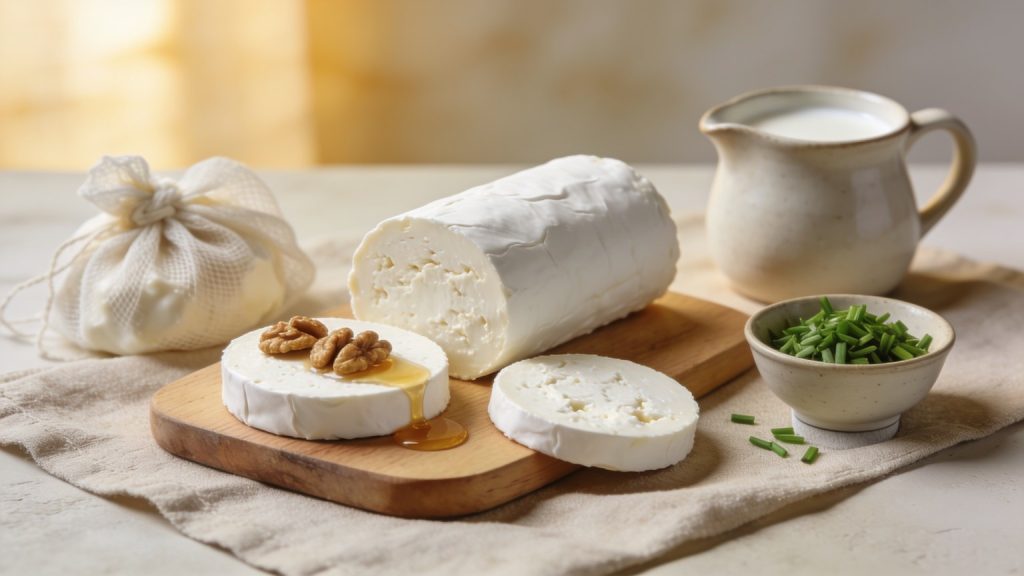
Turn the drained curds into a bowl, add 1/2 teaspoon of fine salt, and stir gently. Fold in herbs if you're using them. Shape into a log on parchment or press into a small ramekin.
-
Chill to set
Wrap and refrigerate at least 1 hour before serving — the texture settles and the tang rounds out. Keeps 5 to 7 days in an airtight container.
Nutrition Facts
Servings 8
Serving Size 1 of 8 servings
- Amount Per Serving
- Calories 74kcal
- % Daily Value *
- Total Fat 5.9g8%
- Saturated Fat 4.1g21%
- Cholesterol 13mg5%
- Sodium 129mg6%
- Potassium 7mg1%
- Protein 5.2g11%
- Vitamin A 81 mcg RAE
- Calcium 39 mg
- Iron 0.5 mg
* Percent Daily Values are based on a 2,000 calorie diet. Your daily value may be higher or lower depending on your calorie needs.
Note
- Pasteurized yes, ultra-pasteurized no: UHT milk's proteins are altered by the high-heat process and curdle poorly — the number-one reason this recipe "doesn't work." The carton will say.
- Skip raw milk. The FDA advises against raw (unpasteurized) milk — it can carry Listeria, Salmonella, and E. coli, and fresh soft cheese is exactly where that risk lives.
- The thermometer is the recipe: 85°C (185°F) sets the curd cleanly. Boiled milk turns grainy; underheated milk gives a weak, milky curdle.
- Drain time is your texture dial: 30 minutes = spreadable, 90 = sliceable log. There's no wrong answer, only preference.
- Don't pour out the whey: it's mildly tangy and protein-flecked — use it in smoothies, bread dough, or to water acid-loving plants.
- Flavor directions: chives and cracked pepper; herbes de Provence rolled on the log; or the sweet route — a drizzle of honey and walnuts over a slice.
- Nutrition method: fresh acid-set cheese splits its milk's nutrients between curd and whey, so the card uses USDA FoodData Central's record for soft goat cheese (FDC 173435) per 28 g (1 oz) serving — the closest complete match for the finished chèvre. The listed salt lands in the same range as that record's sodium; the acids mostly drain off with the whey.