


, whatever the clock says.)
How long to bake cod at 400 comes down to one measurement you can take with a ruler: a 2.5 cm (1-inch) fillet gets its first check at 10 minutes, and it is done at 63°C (145°F), not at a time. Four lemon-garlic fillets, 25 minutes from fridge to table, about 30 grams of protein each — and, by the federal database average, well over a day’s iodine.
Recipe Card
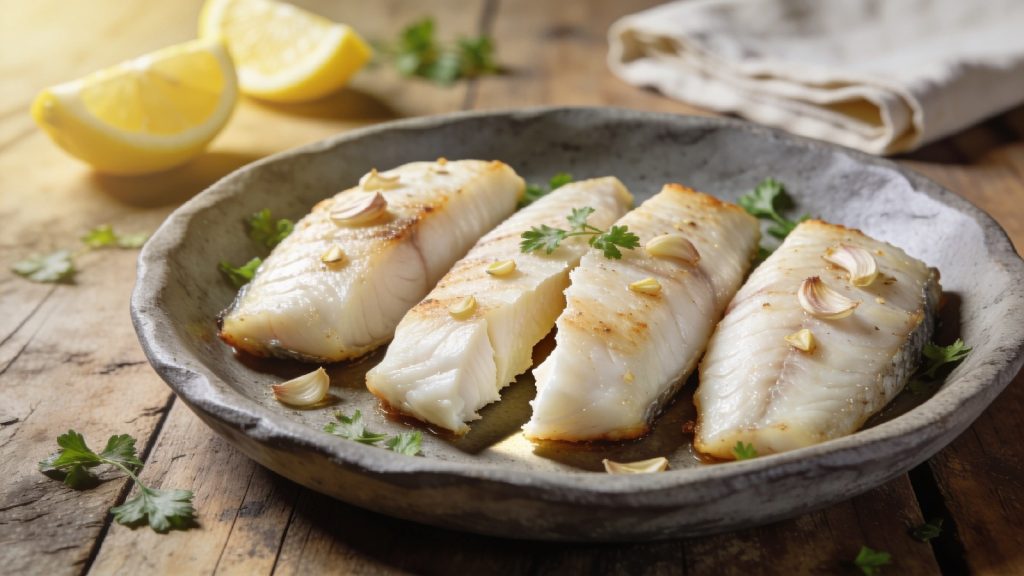

How Long to Bake Cod at 400 (200°C)? Measure the Fillet, Then Trust 145°F
Description
Four thick cod fillets baked uncovered under olive oil, garlic, and lemon zest — about 25 minutes from fridge to table, gluten-free and dairy-free. The timer only tells you when to start looking: a 2.5 cm (1-inch) fillet gets its first check at 10 minutes, and it is done at 63°C (145°F), when the flesh is no longer translucent and separates easily with a fork.
Ingredients
For the cod
For the lemon-garlic oil
To finish
Instructions
Before the oven
-
Heat the oven
Set a rack in the center and heat the oven to 200°C (400°F), or 180°C in a fan oven. Brush a 23 x 33 cm (9 x 13-inch) baking dish with 5 ml (1 teaspoon) of the olive oil.
-
Measure the fillets
Pat the four cod fillets dry with paper towels (kitchen paper). Measure each one with a ruler at its thickest point. If a fillet has a thin tail, fold it under so the piece has an even thickness. The thickest measurement decides when you first check the fish (step 5).
-
Make the lemon-garlic oil
In a small bowl, stir together the remaining 25 ml (5 teaspoons) olive oil, the 3 minced garlic cloves, 1 teaspoon lemon zest, and 15 ml (1 tablespoon) lemon juice.
Bake to 145°F, not to the clock
-
Season the fillets
Season the fillets on both sides with 1/2 teaspoon (3 g) fine salt and 1/4 teaspoon pepper, and set them in the dish with about 2.5 cm (1 inch) between them. Spoon the lemon-garlic oil over the tops so the garlic sits on the fish.
-
Bake uncovered, then check
Bake uncovered. Take the first reading at 10 minutes for 2.5 cm (1-inch) fillets — at 5 minutes for 1.3 cm (1/2 inch) and at 15 minutes for 4 cm (1 1/2 inches). Push an instant-read thermometer in from the side of the fillet into its thickest part.
-
Take it out at 63°C (145°F)
The cod is done at 63°C (145°F), or when the flesh is no longer translucent and separates easily with a fork. If it is not there yet, return the dish to the oven for 2 minutes and check again.
Finish and serve
-
Finish and serve
Scatter the 2 tablespoons of chopped parsley over the fillets, spoon the lemon-garlic juices from the dish over the top, and serve right away with the lemon wedges.
Nutrition Facts
Servings 4
Serving Size 1 of 4 fillets
- Amount Per Serving
- Calories 205kcal
- % Daily Value *
- Total Fat 8g11%
- Saturated Fat 1g5%
- Cholesterol 73mg25%
- Sodium 384mg17%
- Potassium 728mg16%
- Total Carbohydrate 1g1%
- Protein 31g62%
- Vitamin A 26 mcg RAE
- Vitamin C 7 mg
- Calcium 36 mg
- Iron 1 mg
* Percent Daily Values are based on a 2,000 calorie diet. Your daily value may be higher or lower depending on your calorie needs.
Note
- Measure the fillet, not the clock. The first check is set by thickness: 5 minutes for 1.3 cm (1/2 inch), 10 minutes for 2.5 cm (1 inch), 15 minutes for 4 cm (1 1/2 inches), then every 2 minutes after that. It is the old rule of 10 minutes per inch, and both Clemson Cooperative Extension and NC Sea Grant give it for a 230°C (450°F) oven. At 200°C (400°F) the fish should not be done any sooner, so treat those minutes as the moment to start checking, not the moment to stop.
- The finish line is 63°C (145°F). FoodSafety.gov lists cod by name: 145°F (63°C), or cook until the flesh is no longer translucent and separates easily with a fork. Some chef guides pull cod at 54–57°C (130–135°F) for a softer center; that sits below the official target, and this recipe is written to 63°C (145°F).
- Cod loin or fillet: UK shops often sell cod as loin, the thick center cut, rather than as fillet. It bakes the same way — measure it, because a thicker piece gets its first check later.
- From frozen: the FDA’s advice is to thaw seafood in the refrigerator overnight, or sealed in a plastic bag in cold water when you are short on time. If you bake straight from frozen, Clemson Cooperative Extension doubles the time for unthawed fish (20 minutes per inch at 230°C / 450°F), so double your first check, pat off any surface ice before seasoning, and let the thermometer decide.
- Swaps: haddock, Pacific cod, and Alaska pollock bake the same way by thickness. They are not equal on iodine: per 4 oz (110 g) raw, the USDA, FDA and ODS-NIH iodine database lists haddock at 250 mcg, Pacific cod at 144 mcg, Atlantic cod at 125 mcg, and Alaska pollock at 48 mcg — each from only 3 to 8 samples, so read them as rough averages.
- Butter version: replace 15 ml (1 tablespoon) of the olive oil with 15 g (1 tablespoon) melted butter. The recipe is then no longer dairy-free, and the nutrition card, which is calculated with olive oil only, will run slightly different.
- How the nutrition was calculated: from one USDA FoodData Central SR Legacy record per ingredient — Atlantic cod, raw 171955, olive oil 171413, garlic 169230, lemon juice 167747, lemon peel 167749, parsley 170416, black pepper 170931 and table salt 173468 — adjusted with USDA Release 6 retention factors for baking (row 2302, lean fish baked with its juices, for the cod; 3771 for the garlic and pepper; 0270 for the lemon juice and zest; the parsley goes on raw), then divided by four servings. The lemon wedges served alongside are not counted. Iodine is not on the card because USDA’s standard records do not carry it; the iodine figures in the article come from the separate USDA, FDA and ODS-NIH Database for the Iodine Content of Common Foods (Release 4, 2024).
| Thickness at the thickest point | First check at 200°C (400°F) | If it isn’t there yet |
|---|---|---|
| 1.3 cm (1/2 inch), thin fillet or tail end | 5 minutes | check every 2 minutes |
| 2.5 cm (1 inch), this recipe | 10 minutes | check every 2 minutes |
| 4 cm (1 1/2 inches), thick fillet or cod loin | 15 minutes | check every 2 minutes |
| 2.5 cm (1 inch), baked from frozen | 20 minutes | check every 2 minutes |
| Any thickness, wrapped in foil or baked in a sauce | add 5 minutes | check every 2 minutes |
| Every size: done when | 63°C (145°F) in the thickest part, or the flesh is no longer translucent and separates easily with a fork | |
The first-check times are the rule of 10 minutes per inch of thickness, which Clemson Cooperative Extension and NC Sea Grant both publish for a 230°C (450°F) oven, with the time doubled for frozen fish and 5 minutes added for fish in foil or in a sauce. At 200°C (400°F) cod should not be done any sooner, so these are the minutes to start checking, not the minutes to stop. We found no institution that publishes a cooking time for fish at 400°F. The finish line is FoodSafety.gov’s, which names cod: 145°F (63°C), or cook until the flesh is no longer translucent and separates easily with a fork.
Ask the top of a search page how many minutes cod needs in a 200°C (400°F) oven and you get a spread, not a number. Reading seven of those pages on September 24, 2026, we counted six different ranges for the same job, and for the same 1-inch fillet the answers ran from 10–12 minutes to 15–20. None of them tied its minutes to a source we could open. The one figure that kept coming up was 145°F, and that is the figure this recipe is built around.
The dish itself is plain on purpose. Four skinless Atlantic cod fillets, 170 g (6 oz) each, go into an oiled baking dish under a spoonful of olive oil stirred with minced garlic, lemon zest and a little lemon juice. They bake uncovered, get a scatter of parsley at the end, and go to the table with lemon wedges. There is no crumb crust and no butter sauce to hide a dry fillet behind, which is exactly why the timing matters.
What changes the timing is thickness, and cod fillets vary a lot. A fillet cut from the tail can be half the depth of one from the shoulder, and UK shops often sell the thick center cut as cod loin. So the first step after heating the oven is a ruler, not a timer: measure each piece at its thickest point, fold any thin tail underneath, and let that number tell you when to open the oven door. In a fan oven, use 180°C.
It is a weeknight dish in every sense: 10 minutes of prep, about 15 in the oven for a 1-inch fillet, one dish to wash. Cod is also one of the fish on the FDA and EPA’s “Best Choices” list for lower mercury, and white fish like it turns out to be carrying a nutrient that none of the baking-time pages we read mentions. We’ll get to that below.
Why This Baked Cod Recipe Works
- A ruler before a timer. The thickest measurement sets the first check: 5, 10 or 15 minutes for 1/2, 1 or 1 1/2 inches. The thermometer makes the final call.
- Folded tails. Tucking the thin end under gives each fillet one even thickness, so the tail isn’t dry by the time the middle reaches 63°C (145°F).
- Uncovered, at a moderate heat. At 200°C (400°F) with nothing on top, the surface stays dry enough to take a little color from the garlic oil instead of steaming pale.
- The flavor goes on the fish, not around it. The garlic, zest and juice are stirred into the oil and spooned over the tops, and whatever runs into the dish is spooned back over at the table.
- 25 minutes, one dish. Ten minutes of prep while the oven heats, and the bake itself is shorter than most side dishes.
- Gluten-free and dairy-free as written. The butter version in the recipe notes is richer, and it is no longer dairy-free.
How Long to Bake Cod at 400, by Thickness?
Start checking a 2.5 cm (1-inch) fillet at 10 minutes, a 1.3 cm (1/2-inch) piece at 5 and a 4 cm (1 1/2-inch) loin at 15, then check every 2 minutes until the thickest part reads 63°C (145°F). Those first-check times are a floor, not a forecast. The finished time depends on the fish in front of you, and the thermometer is what ends the bake.
The minutes come from an old kitchen rule, and it is worth knowing what it was written for. Clemson Cooperative Extension’s guidance on cooking fish, a column by County Extension Agent Christine Patrick posted on June 28, 2021, puts it plainly: at 450°F, bake for 10 minutes per inch of thickness, measured at the thickest point. NC Sea Grant’s Mariner’s Menu, published by North Carolina State University, gives the same rule and the same oven: “If baking, cook at 450° F.” Both sources add 5 minutes for fish cooked in foil or in a sauce, and both double the time for frozen fish.
Moved to 400°F, the rule doesn’t break, but it changes meaning. An oven about 30°C (50°F) cooler than the one the rule assumes should not cook the center of a fillet any faster, so 10 minutes per inch becomes the earliest sensible moment to look rather than the moment to take the dish out. How much longer a given fillet needs beyond that is the part nobody can print in advance. Fillet shape, how cold it was going in, how full the dish is and how accurate your oven dial is all move it. We looked for an institution that publishes a cooking time for fish at 400°F and did not find one; every official source we could open measures doneness by temperature or by the look of the flesh.
One detail from the extension guidance is easy to miss: Clemson’s version turns the fish halfway through and skips the turn only for pieces under half an inch thick. In a baking dish with the garlic sitting on top, we leave the fillets where they are so the garlic stays on the fish, which is one more reason the thermometer in the thickest part, not the clock, decides when the center is done. Frozen fillets follow the doubled times in the table; pat off any surface ice first, or the oil and garlic slide into the dish.
Baked Cod Internal Temperature: Why 145°F and Not 130?
Because 145°F (63°C) is the federal food-safety target, and cod is on the list by name. FoodSafety.gov, the U.S. government’s food-safety site, lists fish “such as salmon, tuna, tilapia, pollock, bass, cod, catfish, trout” at 145°F (63°C), or cooked until the flesh is no longer translucent and separates easily with a fork. The FDA’s seafood-safety page gives the same 145°F for most seafood.
Some seafood sellers and chef guides aim lower, pulling cod at 54–57°C (130–135°F) for a softer, slightly translucent center. That is a texture preference, and it sits below the official target. This recipe is written to 63°C (145°F), and every time in the table above is aimed at it.
Where you put the thermometer matters as much as the number. Push an instant-read probe in from the side of the fillet, parallel to the dish, until the tip sits in the middle of the thickest part. Going in from the top on a 1-inch fillet, it is easy to pass through the center and read the hot dish underneath. If one fillet is thicker than the others, read that one; the rest will be there.
Without a thermometer, the second half of the FoodSafety.gov line is the test, and the FAQ below walks through it. NC Sea Grant is candid that a thermometer usually isn’t practical, and that fish cooked until opaque and flaking easily is done.
What a Serving of This Baked Cod Actually Contains
One fillet with a quarter of the oil and seasoning comes to 205 calories, 31 g of protein, 8 g of fat, 1 g of carbohydrate, 384 mg of sodium and 73 mg of cholesterol. The fish supplies nearly all the protein; the olive oil supplies most of the fat. Two nutrients that aren’t on the recipe card, iodine and selenium, are the ones this fish stands out for.
What the evidence says
Strongest · 145°F (63°C) is the finish line for cod. FoodSafety.gov names cod on its list of fish with that safe minimum internal temperature; the FDA’s seafood-safety page gives the same figure.
Solid · Baked cod is one of the richest common sources of iodine. 146 µg per 3 oz (85 g), the average of 28 FDA Total Diet Study samples in the USDA, FDA and ODS-NIH iodine database (Release 4, 2024) — against 11 µg for baked salmon and 1.0 µg for roasted chicken breast.
Limited · The minutes. The 10-minutes-per-inch rule comes from two extension sources, Clemson and NC Sea Grant, and both write it for a 450°F oven. We found no institution that publishes a cooking time for fish at 400°F.
The catch · The iodine figure is an average of samples that ran nearly fourfold apart, and cod is not an oily fish. Those 28 samples ranged from 75 to 281 µg per 3 oz, and the NIH Office of Dietary Supplements calls the values in its iodine table approximate. One fillet here carries about 0.31 g of EPA and DHA combined; the 150 g salmon fillet in our sheet-pan recipe carries about 2.95 g.
The protein arithmetic is short. USDA lists raw Atlantic cod at 17.81 g of protein per 100 g, so a 170 g (6 oz) fillet brings 30.3 g, and the garlic and parsley add a fraction of a gram more. That is well over half of the 50 g Daily Value the FDA uses on nutrition labels. Baking takes water out, not protein: USDA’s record for cod cooked by dry heat (FoodData Central 171956) lists 22.83 g per 100 g, which puts the baked fillet at about 133 g on the plate, and the protein count doesn’t change.
The fat on the plate is mostly the olive oil. Of the 8 g in a serving, about 6.75 g comes from the quarter-share of two tablespoons of oil and about 1.1 g from the fish itself. The oil is also 29 percent of the calories. Sodium follows the same pattern: of 384 mg, about three quarters is the half-teaspoon of salt, and the cod brings roughly 92 mg. That is about a sixth of the 2,300 mg daily limit, and halving the salt is the one change that moves it much. The 73 mg of cholesterol, all from the fish, is about a quarter of the 300 mg Daily Value.
Two numbers the card doesn’t print are worth adding. Vitamin B12 comes to about 1.5 µg a fillet, roughly 60 percent of the 2.4 µg Daily Value, calculated from the raw cod record with USDA’s retention factor for baked lean fish. Selenium comes to close to the full 55 µg Daily Value. Calculated from the raw record, a fillet slightly exceeds it; calculated from USDA’s cooked-cod record, it lands a little under. Either way, it’s roughly a day’s worth from one fillet.
The honest comparison runs the other way on omega-3 fats. Raw Atlantic cod carries 0.064 g of EPA and 0.12 g of DHA per 100 g, about 0.31 g combined in one fillet. The same weight of farmed Atlantic salmon (FoodData Central 175167) carries roughly ten times as much, which is why the salmon fillet in our sheet pan salmon and zucchini comes to about 2.95 g. Cod is a lean white fish. It doesn’t count toward the oily-fish servings that come up in our guide to anti-inflammatory foods for arthritis and joint pain, and a dinner like this one sits beside salmon in a week rather than replacing it.
Is Cod a Good Source of Iodine?
Yes, one of the best among everyday foods. Three ounces (85 g) of baked cod averages 146 µg of iodine, about 97 percent of the 150 µg Daily Value, according to the USDA, FDA and ODS-NIH Database for the Iodine Content of Common Foods (Release 4, October 2024). The figures come from samples the FDA analyzed in its Total Diet Study, and they are averages with a wide spread, not a guarantee for any one fillet.
| Food, as listed in the iodine database | Serving | Iodine, average | Samples | Lowest–highest sample |
|---|---|---|---|---|
| Fish, cod, baked | 3 oz (85 g) | 146 µg | 28 | 75–281 µg |
| Fish, haddock, raw | 4 oz (110 g) | 250 µg | 3 | 152–345 µg |
| Fish, cod, Atlantic, wild, raw | 4 oz (110 g) | 125 µg | 8 | 26–397 µg |
| Milk, whole, fluid | 1 cup (244 g) | 82 µg | 59 | 42–205 µg |
| Fish, pollock, Alaska, raw | 4 oz (110 g) | 48 µg | 3 | 41–59 µg |
| Fish, salmon, steaks/fillets, baked | 3 oz (85 g) | 11 µg | 35 | 0–25 µg |
| Fish, tilapia, baked | 3 oz (85 g) | 5.8 µg | 28 | 0–69 µg |
| Chicken breast, oven-roasted (skin removed) | 3 oz (85 g) | 1.0 µg | 35 | 0–6.9 µg |
Source: USDA, FDA and ODS-NIH Database for the Iodine Content of Common Foods per Serving, Release 4, October 2024 (baked foods and milk analyzed in the FDA Total Diet Study; raw fish from USDA sampling). Servings are the database’s own, so raw 4 oz rows and baked 3 oz rows are not directly comparable. The Daily Value for iodine on U.S. labels is 150 µg (FDA).
The spread in the last column is the part most summaries leave out. The 28 baked-cod samples behind that 146 µg average ran from 75 to 281 µg per serving, and the raw Atlantic cod samples, only eight of them, ran from 26 to 397. The NIH Office of Dietary Supplements reprints these figures in its iodine fact sheet and describes the values in that table as approximate. That is the fair way to read them: cod is reliably high in iodine, but no one can tell you what a particular fillet holds.
For this recipe, the 170 g raw fillet bakes down to about 133 g, a little over one and a half of the database’s 3-ounce servings. By the database average, that is well over the 150 µg Daily Value, roughly one and a half times it. By the lowest and highest samples, it could be anywhere from under the Daily Value to nearly three times it. Iodine isn’t on the recipe card because USDA’s standard FoodData Central records don’t carry it; the figures here come only from the separate iodine database.
The table also shows how uneven “fish” is. Baked salmon averages 11 µg per 3 oz and baked tilapia 5.8, so a salmon dinner and a cod dinner are close on protein and far apart on iodine. The chicken breast in a tray like our sheet pan chicken and broccoli averages 1.0 µg per 3 oz. Among the other everyday sources, milk stands out: a cup of whole cow’s milk averages 82 µg. The database has no row for goat milk, so our comparison of goat milk vs cow milk can’t settle that one either way.
Why it matters: the thyroid needs iodine to make its hormones, which steer growth and metabolism and, in pregnancy and infancy, the development of a baby’s brain, according to the British Dietetic Association’s food fact sheet on iodine. For UK readers the point is sharper. The BDA notes that iodized salt is not widely available in the UK, that milk and dairy are the main sources for most people there, and that white fish generally contains more iodine than oily fish; its own table puts a 120 g portion of cod at about 230 µg. The NHS sets the adult need at 140 µg a day, and the BDA cites the European Food Safety Authority’s 150 µg.
Two limits belong next to all of this. The iodine database measures what is in the food, not what any one person needs, and a single fish dinner is not a thyroid plan. If you are pregnant, have a thyroid condition or take thyroid medication, how much iodine you should get is a conversation for your doctor. For fish in pregnancy specifically, the FDA and EPA list cod among their “Best Choices” and suggest 2 to 3 servings a week from that list, with a serving of 4 ounces.
Baked Cod FAQ
How do you know when cod is done without a thermometer?
Push a fork into the thickest part of the fillet and twist it gently. FoodSafety.gov accepts this as the second test: cod is done when the flesh is no longer translucent and separates easily with a fork. The center should be opaque white all the way through; if it still looks glassy, give the dish 2 more minutes and look again. A thermometer reading of 63°C (145°F) remains the exact answer.
Should you bake cod covered or uncovered?
Uncovered, for this recipe. Clemson Cooperative Extension’s guidance bakes fish uncovered and adds 5 minutes to the total time when the fish is wrapped in aluminum foil (tin foil) or cooked in a sauce. Wrapped fish steams rather than bakes, so the top stays pale. Covering is fine if you want softer, poached-style cod; the finish line is still 63°C (145°F).
Do I need to thaw cod before baking?
No, but thawed cod is easier to season and to time. The FDA’s advice is to thaw seafood in the refrigerator overnight or, if you need it faster, sealed in a plastic bag in cold water. Baking from frozen works if you plan for it: Clemson Cooperative Extension doubles the time for unthawed fish (20 minutes per inch at 230°C / 450°F), so double the first check and let the thermometer decide.
Why is my baked cod rubbery?
Usually because it cooked past done. Cod is very lean — USDA lists 0.67 g of fat per 100 g of raw Atlantic cod (FDC 171955) — so there is little fat to hide a few extra minutes. Thin tail ends go first, which is why this recipe folds them under. Start checking at the time the thickness sets, and take the fish out at 63°C (145°F).
Serving and Storage
Serve the fillets straight from the dish with the lemon wedges and the garlicky juices spooned over the top. Something green that cooks in the same 15 minutes is the easy partner: broccoli steamed for 1 to 3 minutes while the fish bakes, the timing our look at does cooking broccoli destroy sulforaphane lands on, or boiled new potatoes with a little of the parsley. For a bigger autumn plate, a fall salad with roasted vegetables can share the oven if you roast it first and keep it warm while the cod bakes.
Cod is best eaten the day it is baked, because reheating firms the flesh further. Leftovers work better cold than hot: flaked into a salad with the lemon juices, or folded into mashed potato for fish cakes.
To store: refrigerate leftovers in a covered container at 4°C (40°F) or below and eat them within 3 to 4 days, the FDA’s storage time for cooked fish. To freeze: the FDA chart gives cooked fish 4 to 6 months in the freezer at −18°C (0°F), a limit for quality rather than safety; thaw it overnight in the refrigerator. To reheat: cover the dish and warm it in a 165°C (325°F) oven until the thickest piece reads 74°C (165°F), the USDA’s temperature for reheated leftovers, or eat it cold.
Sources
- FoodSafety.gov (U.S. Department of Health and Human Services), Cook to a Safe Minimum Internal Temperature, date last reviewed November 21, 2024: fish (whole or filet), “such as salmon, tuna, tilapia, pollock, bass, cod, catfish, trout, etc.” — 145°F (63°C) or cook until flesh is no longer translucent and separates easily with a fork — https://www.foodsafety.gov/food-safety-charts/safe-minimum-internal-temperatures
- U.S. Food and Drug Administration, Selecting and Serving Fresh and Frozen Seafood Safely, content current as of March 5, 2024: most seafood should be cooked to an internal temperature of 145°F; thaw frozen seafood in the refrigerator overnight, or sealed in a plastic bag in cold water — https://www.fda.gov/food/buy-store-serve-safe-food/selecting-and-serving-fresh-and-frozen-seafood-safely
- Clemson Cooperative Extension, Homemaker’s Column: Guidelines for Cooking Fish, by Christine Patrick, County Extension Agent, posted June 28, 2021: at 450°F bake for 10 minutes per inch of thickness; add 5 minutes in foil or in a sauce; double the time (20 minutes per inch) for frozen fish; bake uncovered — https://blogs.clemson.edu/savannahvalley/homemakers-column-guidelines-for-cooking-fish/
- NC Sea Grant, North Carolina State University, Mariner’s Menu: Cooking Methods: 10 minutes per inch of thickness measured at the thickest point; “If baking, cook at 450° F”; fish should reach an internal temperature of 145°F — https://ncseagrant.ncsu.edu/mariners-menu/cooking-methods/
- USDA Agricultural Research Service, FDA and NIH Office of Dietary Supplements, USDA, FDA and ODS-NIH Database for the Iodine Content of Common Foods per Serving, Release 4, October 2024: fish, cod, baked, 3 oz, 146 µg (n = 28, 75–281); fish, cod, Atlantic, wild, raw, 4 oz, 125 µg (n = 8, 26–397); haddock, pollock, salmon, tilapia, chicken breast and milk rows as shown in the table — https://www.ars.usda.gov/ARSUserFiles/80400535/Data/Iodine/IODINE_DATABASE_RELEASE_4_PER_SERVING.pdf
- NIH Office of Dietary Supplements, Iodine: Fact Sheet for Health Professionals, Table 2 (selected food sources of iodine; values described as approximate) — https://ods.od.nih.gov/factsheets/Iodine-HealthProfessional/
- USDA FoodData Central, SR Legacy: Fish, cod, Atlantic, raw 171955 (82 kcal, 17.81 g protein, 0.67 g fat, 33.1 µg selenium, 0.064 g EPA and 0.12 g DHA per 100 g); Fish, cod, Atlantic, cooked, dry heat 171956; Fish, salmon, Atlantic, farmed, raw 175167 (for the omega-3 comparison); and, for the recipe card, olive oil 171413, garlic 169230, lemon juice 167747, lemon peel 167749, parsley 170416, black pepper 170931 and table salt 173468 — https://fdc.nal.usda.gov/
- USDA Agricultural Research Service, USDA Table of Nutrient Retention Factors, Release 6 (2007): row 2302, finfish under 5% fat, baked with drippings — https://www.ars.usda.gov/ARSUserFiles/80400525/Data/retn/retn06.pdf
- U.S. Food and Drug Administration, Daily Value on the Nutrition and Supplement Facts Labels, content current as of March 5, 2024: iodine 150 mcg, selenium 55 mcg, vitamin B12 2.4 mcg, protein 50 g, sodium 2,300 mg, cholesterol 300 mg — https://www.fda.gov/food/nutrition-facts-label/daily-value-nutrition-and-supplement-facts-labels
- U.S. Food and Drug Administration and U.S. Environmental Protection Agency, Advice about Eating Fish, content current as of March 5, 2024: cod listed as a “Best Choice”; in pregnancy and breastfeeding, 2 to 3 servings a week from the Best Choices list, 1 serving = 4 ounces — https://www.fda.gov/food/consumers/advice-about-eating-fish
- British Dietetic Association, Iodine: Food Fact Sheet, November 2022 (review date November 2025, currently under review): iodine’s role in thyroid hormones; white fish generally contains more iodine than oily fish; iodized salt not widely available in the UK; cod, 120 g portion, about 230 mcg; adults 150 mcg a day (EFSA) — https://www.bda.uk.com/resource/iodine.html
- NHS, Vitamins and minerals: Iodine, page last reviewed August 3, 2020: adults need 140 micrograms of iodine a day — https://www.nhs.uk/conditions/vitamins-and-minerals/iodine/
- U.S. Food and Drug Administration, Refrigerator & Freezer Storage Chart: cooked fish 3–4 days refrigerated at 40°F (4°C), 4–6 months frozen; freezing at 0°F (−18°C) keeps food safe indefinitely, so freezer times are for quality only — https://www.fda.gov/media/74435/download
- Nebraska Extension, University of Nebraska–Lincoln, Leftover Food Safety, based on USDA Food Safety and Inspection Service guidance: reheat leftovers thoroughly to 165°F; when reheating meat and poultry in the oven, the temperature should be no lower than 325°F — https://food.unl.edu/article/leftover-food-safety/