



Sheet pan chicken and broccoli, 390 calories and 43 g of protein a plate, roasted at 220°C (425°F) in about 37 minutes from start to table. The one unusual step costs nothing and takes ten seconds: two teaspoons of mustard powder go into a lemon dressing that lands after the pan leaves the oven, never before.
Broccoli does not actually contain sulforaphane. It contains glucoraphanin, a precursor, and an enzyme called myrosinase that converts one into the other the moment the florets are chopped or chewed. Heat denatures that enzyme. Cut the broccoli, slide it into a hot oven, and the compound most people are eating broccoli for largely never forms.
Mustard seed carries its own myrosinase, in an isoform that holds up to more heat than broccoli’s does. That is why the dressing here — lemon juice, olive oil, a grated garlic clove and two teaspoons of ground mustard, sold as dry mustard in the US and as English mustard powder in the UK — goes on after the pan has stood five minutes on the counter. Dry powder scattered over florets before roasting is seasoning. Stirred into lemon juice and spooned over warm ones, it is doing something else.
Underneath that it is an ordinary one pan chicken and broccoli dinner — a chicken broccoli traybake, if you are reading from the UK side. Four 170 g (6 oz) breasts pounded even at the thick end, 600 g (1 lb 5 oz) of florets around them, 20 to 22 minutes, one baking tray to wash. USDA’s SNAP-Ed Seasonal Produce Guide lists broccoli as a spring and fall crop in the United States, which puts mid-September inside the fall window; UK growers are cutting calabrese over the same weeks, so the timing lands the same way for a healthy sheet pan chicken dinner on either side of the Atlantic.
Why This Sheet Pan Chicken and Broccoli Works
- The dressing waits for the oven to finish. Two teaspoons of mustard powder, about 1 g a serving, stirred into lemon juice while the tray roasts and spooned over afterward.
- The thermometer runs the clock. Chicken is done at 74°C (165°F) at the thickest part, whether that arrives at 18 minutes or 22.
- Six hundred grams of broccoli, one layer. Cut sides down, spaces cleared for the breasts, nothing stacked — stacked florets steam each other and come out olive instead of browned.
- The salt is yours to move. A serving sits under a quarter of the daily sodium limit, and roughly three quarters of that is salt you added, not salt the food brought.
- Gluten-free and dairy-free as written, and high in protein without a supplement in sight. Boneless thighs swap in at the same 220°C (425°F) and the same 74°C (165°F) target, a few minutes longer on the clock.
What Temp to Cook Chicken and Broccoli?
The oven goes to 220°C (425°F), and the chicken is done at 74°C (165°F) inside. Those are two different numbers doing two different jobs, and only the second one is a rule. The FDA’s Safe Minimum Internal Temperatures chart lists poultry — ground, parts, whole and stuffing — at 165°F with no rest time required, and FoodSafety.gov publishes the same figure.
The oven setting is a compromise between two ingredients with different ideas. At 190°C (375°F) the florets turn army green before their tips brown; at 230°C (450°F) the thin end of a breast is leather by the time the thick end is safe. At 220°C (425°F) a breast pounded to an even 2 cm (3/4 inch) and the floret tips land in the same 20-to-22-minute window. Check at 18 and let the probe decide.
Why This Chicken and Broccoli Dinner Is Good for You
One of four plates comes to 390 calories, 43 g of protein, 19 g of fat (3 g of it saturated), 13 g of carbohydrate, 4 g of fiber, 534 mg of sodium, 1,078 mg of potassium and 117 mg of vitamin C. The protein is a little over four fifths of the Daily Value, the sodium under a quarter of the daily limit, the fiber about a seventh, the potassium roughly a fifth. Every figure starts from USDA FoodData Central SR Legacy records divided by four, and what actually goes into the oven carries Release 6 retention factors. The minerals are the exception: they are held at 100 percent, because nothing here gets drained and the pan juices go to the table with the food. That is the one choice that flatters us — run the chicken’s minerals at the Release 6 numbers instead and a serving reads 965 mg of potassium rather than 1,078, and 519 mg of sodium rather than 534. Read the potassium as a range with 1,078 at the top of it.
What the evidence says
Strongest · The temperature that makes the chicken safe is not in dispute. The FDA’s Safe Minimum Internal Temperatures chart and FoodSafety.gov both put poultry — ground, parts, whole and stuffing — at 165°F (74°C), measured with a food thermometer, with no rest time required.
Solid · Mustard seed carries a myrosinase that survives heat better than broccoli’s own. Ghawi, Methven and Niranjan measured how fast heat knocks the enzyme out of each source and found that broccoli boiled in water yielded no sulforaphane worth counting, while powdered white mustard seed (Sinapis alba) stirred into the already-cooked broccoli brought the yield back (Food Chemistry, 2013; PMID 23411305). Bench chemistry, not people.
Single study · In the one human trial, 1 g of mustard powder moved a urinary marker more than fourfold. Okunade, Niranjan, Ghawi, Kuhnle and Methven ran a randomized crossover in 12 healthy adults, four of the five authors at the University of Reading’s Department of Food and Nutritional Sciences: 200 g of cooked broccoli alone gave a mean urinary SF-NAC of 9.8 ± 5.1 µmol per g creatinine over 24 hours, and the same broccoli with 1 g of powdered brown mustard gave 44.7 ± 33.9 (Molecular Nutrition & Food Research, 2018; PMID 29806738).
Solid · What a plate carries is arithmetic, not inference. Chicken breast at 22.5 g of protein per 100 g raw (FDC 171077) and broccoli at 89.2 mg of vitamin C, 101.6 µg of vitamin K and 2.6 g of fiber per 100 g raw (FDC 170379), run through Release 6 retention factors and divided by four servings.
The catch · Twelve people, a spread almost as wide as the effect, and a dinner that is not the trial. The gap between the two arms is 34.9 µmol, and the standard deviation around the mustard arm is ±33.9 — almost the whole of it, which means some of those 12 barely responded while others carried the average. SF-NAC in urine is a metabolite, not a health outcome, and the broccoli was boiled rather than roasted. A serving here carries about 1 g of mustard powder alongside 150 g of raw broccoli, close to the trial’s gram but not its 200 g of cooked florets. Nobody has tested this dish; what has been tested is the mechanism under it.
Sodium is the number you control, and the arithmetic says so plainly. Across the tray the dish carries 2,136 mg: 1,356 mg is the 1 1/4 teaspoons of kosher salt on the pan and 271 mg the 1/4 teaspoon in the dressing, while the chicken brings 306 mg and the broccoli 198 mg of their own. The ingredients account for about a quarter of it. Halve the pan salt and the plate drops by roughly 170 mg.
The vitamin A does not come from where you would guess. Broccoli supplies most of it, but the single teaspoon of sweet paprika ends up delivering more than all 680 g (1 lb 8 oz) of chicken breast — 53.8 µg RAE against 45.9 on the plate. Raw for raw the two are almost level, at 2,463 µg RAE per 100 g of paprika (FDC 171329) against 9 µg for raw breast; roasting simply costs the chicken a quarter of its vitamin A under retention code 0805 and the paprika almost none. And the rest of that family is where bell peppers carry their vitamin C.
Vitamin C lands at roughly a day’s worth per serving, and that phrasing is deliberate. The 117 mg figure rests on an 85 percent retention factor from a generic baked-vegetable row in Release 6, not on anyone measuring broccoli at 220°C; if real retention is nearer 60 percent, a serving is closer to 85 mg. Vitamin K comes to about 162 µg and selenium to about 45 µg, but Release 6 publishes no factor for either, so both are raw-basis figures — which is why the recipe card leaves those fields blank, as it does on every recipe here.
The mustard powder itself is nutritionally irrelevant, and it would be dishonest to sell it otherwise: 4 g across the whole tray is 20 calories and about a gram of protein. Its job is enzymatic. That is a different claim from the usual superfood arithmetic, and closer to what we found in tomatoes, where cooking moves lycopene the other way: what heat does to a food can be a bigger lever than which food you picked.
Is Roasted Broccoli Healthier Than Steamed?
For sulforaphane specifically, a short steam appears to come out ahead. Wang, Farnham and Jeffery steamed, boiled and microwaved four broccoli cultivars and reported that 1.0 to 3.0 minutes of steam left less sulforaphane nitrile and more sulforaphane in three of the four — Brigadier did not respond — which they call proof of concept rather than a settled result (Journal of Agricultural and Food Chemistry, 2012; PMID 22471240). Nobody has run that comparison against a 220°C (425°F) oven, so the roasting side of it is inference: heat denatures myrosinase, and an oven is hotter for longer than three minutes of steam. We went through the cooking-method evidence in detail in our piece on steaming broccoli for one to three minutes. For everything else — browning, texture, the fact that people actually finish roasted broccoli — the tray has the advantage, and dry heat does not leach water-soluble vitamins into cooking water that gets poured down the sink.
The mustard powder is how you stop choosing. It reintroduces the missing enzyme after the heat is gone, which is exactly what the 2018 trial set out to test.
| 12 healthy adults, 24 hours of urine | Cooked broccoli alone | Cooked broccoli plus mustard |
|---|---|---|
| Mean urinary SF-NAC | 9.8 µmol/g creatinine | 44.7 µmol/g creatinine |
| Standard deviation | ± 5.1 | ± 33.9 |
| Broccoli served | 200 g, cooked | 200 g, cooked |
| Powdered brown mustard | — | 1 g |
| Authors’ conclusion | reference | “over four times greater” |
Source: Okunade O., Niranjan K., Ghawi S.K., Kuhnle G., Methven L., Molecular Nutrition & Food Research, 2018;62(18):e1700980 (PMID 29806738). Randomized crossover design, the same 12 subjects in both arms, SF-NAC assayed by HPLC in all urine collected over 24 hours. A urinary metabolite is not a clinical outcome, and the broccoli was boiled rather than roasted.
Read the second column honestly: the standard deviation is nearly the size of the effect, so some of those 12 barely moved. Spoon the dressing on anyway, because it is lemon, oil, garlic and mustard on hot broccoli and worth eating whatever the enzyme does. Same bargain as the sheet pan salmon that finishes with burst tomatoes instead of a sauce — a technique earns its place at dinner before it earns one in a journal.
Chicken and Broccoli Traybake FAQ
Can you cook raw chicken and broccoli in the same pan?
Yes, and that is the point of the pan. Raw chicken breasts and raw broccoli go into a 220°C (425°F) oven at the same moment and come out together after 20 to 22 minutes; the juices the chicken gives off cook along with everything else. Keep the handling separate before the pan goes in — one board and one set of tongs for the raw chicken — and check the breasts at 74°C (165°F), the FDA’s safe minimum internal temperature for all poultry.
How long to bake chicken and broccoli?
Twenty to 22 minutes at 220°C (425°F) for 170 g (6 oz) boneless breasts pounded to an even 2 cm (3/4 inch), with the broccoli florets spread around them on the same pan. Thinner breasts can be done at 18 minutes, thick ones need the full 22. The thermometer decides, not the clock: 74°C (165°F) at the thickest part. The floret tips brown in about the same window.
Why is my roasted broccoli soggy?
Almost always crowding or water. Florets touching on all sides steam each other instead of roasting, and florets that went onto the pan still damp from washing do the same. Dry them well, cut them into 4 cm (1 1/2-inch) pieces and lay them cut side down, keep them in one layer with space between, and keep the oven at 220°C (425°F). If you double the recipe, use two pans.
Does roasting broccoli destroy nutrients?
Some of them, and not evenly. Heat denatures myrosinase, the enzyme broccoli needs to convert its glucoraphanin into sulforaphane — which is exactly why the mustard powder goes on after the oven rather than before it. Vitamin C is the other heat-sensitive one: USDA lists raw broccoli at 89.2 mg per 100 g (FDC 170379), and roasting costs some of that. Fiber (2.6 g per 100 g) and vitamin K (101.6 µg per 100 g) are far steadier in the oven.
Serving and Storage
Serve it straight from the tray, scraping up the browned bits under the florets, with lemon wedges for anyone who wants more edge. Rice, quinoa or bread to catch the dressing stretches it for bigger appetites. Treated as sheet pan chicken and vegetables rather than a fixed recipe, it takes cauliflower cut to the same 4 cm (1 1/2 inch) — check those florets when you check the chicken at 18 minutes.
To store: refrigerate within 2 hours; the FDA’s Refrigerator & Freezer Storage Chart gives cooked poultry dishes 3 to 4 days in the refrigerator. To freeze: the same chart allows cooked poultry dishes 4 to 6 months frozen, though the broccoli softens badly, so freeze the chicken alone if you freeze anything. To reheat: cover and warm in a 150°C (300°F) oven until the chicken reaches 74°C (165°F) again, the FDA’s figure for leftovers.
One thing follows from the method if you are boxing this for the week: reheating dressed leftovers heats the mustard’s enzyme too, so hold the dressing back for those portions and spoon it on at the last moment. For more of the same weeknight shape, there is the unstuffed cabbage roll soup and its vitamin K count, and what zucchini brings at 17 calories per 100 g (FDC 169291).
Sources
- Okunade O., Niranjan K., Ghawi S.K., Kuhnle G., Methven L., Supplementation of the Diet by Exogenous Myrosinase via Mustard Seeds to Increase the Bioavailability of Sulforaphane in Healthy Human Subjects after the Consumption of Cooked Broccoli, Molecular Nutrition & Food Research, 2018;62(18):e1700980 (randomized crossover, n = 12 healthy adults, 200 g cooked broccoli with and without 1 g powdered brown mustard, urinary SF-NAC by HPLC over 24 h; a urinary metabolite rather than a clinical outcome, and the broccoli was boiled) — https://pubmed.ncbi.nlm.nih.gov/29806738/
- Ghawi S.K., Methven L., Niranjan K., The potential to intensify sulforaphane formation in cooked broccoli (Brassica oleracea var. italica) using mustard seeds (Sinapis alba), Food Chemistry, 2013;138(2-3):1734–1741 (laboratory study of thermal inactivation of myrosinase from broccoli and from mustard seed; boiling prevented significant sulforaphane formation, powdered mustard seed added to heat-processed broccoli significantly increased it) — https://pubmed.ncbi.nlm.nih.gov/23411305/
- Wang G.C., Farnham M., Jeffery E.H., Impact of thermal processing on sulforaphane yield from broccoli (Brassica oleracea L. ssp. italica), Journal of Agricultural and Food Chemistry, 2012;60(27):6743–6748 (four cultivars microwaved, boiled or steamed for various times; steaming for 1.0–3.0 minutes raised sulforaphane yield and lowered sulforaphane nitrile in all cultivars but Brigadier; the authors describe the result as proof of concept, and roasting was not among the methods tested) — https://pubmed.ncbi.nlm.nih.gov/22471240/
- U.S. Food and Drug Administration, Safe Food Handling — Safe Minimum Internal Temperatures chart (poultry, ground, parts, whole and stuffing: 165°F; leftovers and casseroles: 165°F) — https://www.fda.gov/food/buy-store-serve-safe-food/safe-food-handling
- FoodSafety.gov (USDA, FDA and CDC), Safe Minimum Internal Temperatures — poultry 165°F (74°C); the same figure is confirmed above from the FDA chart, which is the source used for it here — https://www.foodsafety.gov/food-safety-charts/safe-minimum-internal-temperatures
- U.S. Food and Drug Administration, Refrigerator & Freezer Storage Chart (cooked poultry dishes: 3–4 days refrigerated, 4–6 months frozen) — https://www.fda.gov/media/74435/download
- USDA FoodData Central, SR Legacy records used for the nutrition figures: chicken breast, skinless, boneless, raw 171077; broccoli, raw 170379; olive oil 171413; ground mustard seed 170929; lemon juice 167747; honey 169640; garlic 169230; paprika 171329; black pepper 170931; salt 173468 — https://fdc.nal.usda.gov/
- USDA Agricultural Research Service, USDA Table of Nutrient Retention Factors, Release 6 (2007) — retention codes 0805 (chicken, roasted) and 3771 (vegetables, other, baked); no factor is published for vitamin K or selenium — https://www.ars.usda.gov/ARSUserFiles/80400525/Data/retn/retn06.pdf
- U.S. Food and Drug Administration, Daily Value on the Nutrition and Supplement Facts Labels (protein 50 g, sodium 2,300 mg, potassium 4,700 mg, dietary fiber 28 g, vitamin C 90 mg) — https://www.fda.gov/food/nutrition-facts-label/daily-value-nutrition-and-supplement-facts-labels
- USDA SNAP-Ed Seasonal Produce Guide, Broccoli (in season spring and fall) — https://snaped.fna.usda.gov/resources/nutrition-education-materials/seasonal-produce-guide/broccoli
Recipe Details
Recipe Card
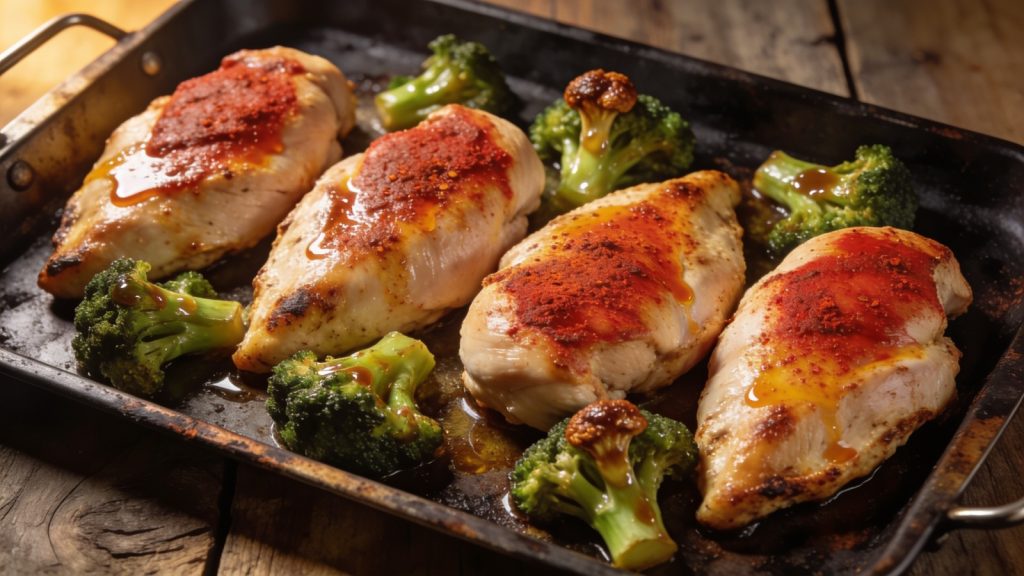

Sheet Pan Chicken and Broccoli: the Gram of Mustard Powder That Goes On After the Oven
Description
Four chicken breasts and a pan of broccoli roast together at 220°C (425°F), and the dressing — lemon juice, olive oil, and two teaspoons of mustard powder — goes on afterward, off the heat. That order is the whole point of this sheet pan chicken and broccoli: broccoli’s own myrosinase, the enzyme that turns glucoraphanin into sulforaphane, is denatured by cooking, and mustard seed carries a more heat-resilient form of the same enzyme. About 37 minutes, one pan, and naturally gluten-free.
Ingredients
For the pan
For the mustard dressing (it goes on after the oven)
Instructions
Roast the chicken and broccoli
-
Heat the oven
Set a rack in the center and heat the oven to 220°C (425°F). Line a large rimmed half-sheet pan, about 33 x 45 cm (13 x 18 inches), with parchment paper or brush it lightly with oil.
-
Season the chicken
Pat the four breasts dry and pound the thick end of each to an even 2 cm (3/4 inch). Rub them with about half of the 30 ml (2 tablespoons) pan oil, then with 1 teaspoon paprika, 3/4 teaspoon kosher salt, and half the pepper.
-
Toss the broccoli
Toss the broccoli florets (600 g / about 6 1/2 cups) with the rest of the pan oil, 1/2 teaspoon kosher salt, and the rest of the pepper. Spread them over the pan in a single layer, cut sides down, and push them aside to clear four spaces.
-
Roast, and go by the thermometer
Set the breasts into the cleared spaces and roast for 20 to 22 minutes, until an instant-read thermometer reads 74°C (165°F) at the thickest part of each breast and the floret tips have browned. Start checking at 18 minutes.
Mix the mustard dressing while the pan roasts
-
Wet the powder first
Stir the 2 teaspoons (4 g) mustard powder into the 30 ml (2 tablespoons) lemon juice in a small bowl and leave it to stand while the pan finishes. Dry mustard powder does nothing until it is wet.
-
Whisk in the rest
Whisk in 30 ml (2 tablespoons) olive oil, 1 teaspoon honey, the grated garlic clove, and 1/4 teaspoon kosher salt. It stays a loose, sharp dressing rather than a thick sauce.
Dress it off the heat
-
Let the pan stand five minutes
Pull the pan out and leave it on the counter for 5 minutes. The chicken finishes resting in that time, and the pan comes down off oven heat before the mustard goes anywhere near it.
-
Dress and serve
Spoon most of the dressing over the broccoli and turn the florets in it right on the pan, then spoon the rest over the chicken. Slice the breasts against the grain and serve from the pan, scraping up the browned bits underneath.
Nutrition Facts
Servings 4
Serving Size 1 of 4 portions
- Amount Per Serving
- Calories 390kcal
- % Daily Value *
- Total Fat 19g25%
- Saturated Fat 3g15%
- Cholesterol 124mg42%
- Sodium 534mg24%
- Potassium 1078mg23%
- Total Carbohydrate 13g5%
- Dietary Fiber 4g15%
- Sugars 4g
- Protein 43g86%
- Vitamin A 69 mcg RAE
- Vitamin C 117 mg
- Calcium 87 mg
- Iron 2 mg
* Percent Daily Values are based on a 2,000 calorie diet. Your daily value may be higher or lower depending on your calorie needs.
Note
- The dressing goes on after the oven — that is the whole method. Broccoli’s own myrosinase, the enzyme that converts glucoraphanin into sulforaphane, is denatured by cooking. In a randomized crossover trial in 12 healthy adults (Okunade O, Niranjan K, Ghawi SK, Kuhnle G, Methven L; Molecular Nutrition & Food Research, 2018; PMID 29806738), 200 g of cooked broccoli eaten alone produced a mean urinary sulforaphane metabolite (SF-NAC) of 9.8 ± 5.1 µmol per g creatinine; the same broccoli with 1 g of powdered brown mustard produced 44.7 ± 33.9 µmol per g creatinine, which the authors call over four times greater. Read it with its limits: 12 people, a spread (±33.9) wider than the difference itself, a urinary metabolite rather than a health outcome, and boiled broccoli rather than roasted. A serving here carries about 1 g of mustard powder with 150 g of raw broccoli, not the trial’s 200 g of cooked broccoli — close, not identical.
- Which mustard powder, and why it gets wet first. The 2018 trial used powdered brown mustard. The bench work behind it (Ghawi SK, Methven L, Niranjan K; Food Chemistry, 2013; PMID 23411305) used white mustard seed, Sinapis alba, and reported that mustard seed carries a more resilient isoform of myrosinase than broccoli does, and that adding powdered mustard seed to heat-processed broccoli significantly increased sulforaphane formation. English mustard powder is a brown-and-white blend; plain American ground mustard is white mustard alone. Whichever is in your cupboard, stir it into the lemon juice first — dry powder sprinkled over hot broccoli does nothing at all.
- Even thickness, and 74°C (165°F). The FDA’s chart Safe Minimum Internal Temperatures lists poultry — ground, parts, whole, and stuffing — at 165°F, with no rest time required, and FoodSafety.gov’s chart gives the same 165°F (74°C). A breast is thick at one end and thin at the other, so pounding the thick end to 2 cm (3/4 inch) is the difference between juicy at 20 minutes and dry at the tip. Start checking at 18.
- Don’t crowd the pan. Four breasts and 600 g of broccoli fill a 33 x 45 cm (13 x 18-inch) pan. Florets stacked on each other trap their own steam and come out limp and olive-colored instead of browned at the tips. Doubling? Use two pans and rotate them halfway.
- Which kosher salt. The brands are not interchangeable by volume. USDA’s branded records list Diamond Crystal kosher at 0.7 g per 1/4 teaspoon (FDC 2571981) and Morton coarse kosher at 1.2 g (FDC 2617978) — nearly twice the salt in the same spoon. This recipe was written and calculated with Diamond Crystal: 1 1/2 teaspoons in total, 4.2 g. With Morton, weigh the same 4.2 g, which is a scant 1 teaspoon.
- Swaps. Boneless skinless thighs work at the same 220°C (425°F) and the same 74°C (165°F) target; they take a few minutes longer, so check with the thermometer rather than the clock. Frozen florets go on the pan straight from frozen and spread wide — thawing them first leaves water behind, and water means steam instead of browned tips. Leave the honey out for a sharper dressing.
- How the nutrition was calculated. From USDA FoodData Central SR Legacy records for the raw ingredients — chicken breast 171077, broccoli 170379, olive oil 171413, ground mustard seed 170929, lemon juice 167747, honey 169640, garlic 169230, paprika 171329, black pepper 170931, salt 173468 — then divided by four servings. Only what actually goes into the oven carries USDA Release 6 retention factors: the chicken under Chicken, roasted (retention code 0805) and the broccoli, paprika and pepper under Vegetables, other, baked (3771). The dressing is mixed off the heat, so it is counted raw. Minerals are held at 100 percent because nothing is drained here — the pan juices go to the table with the food; using the 0805 mineral factors instead would put a serving at 965 mg of potassium rather than 1,078, and 519 mg of sodium rather than 534. Release 6 carries no factor for vitamin K or for selenium, so those two are raw-basis figures. The honey and all 4.2 g of salt are counted. The branded Diamond Crystal record (FDC 2571981) was used only to turn teaspoons into grams.