



How many blackberries a day? A cup or two is plenty — one cup brings 7.6 grams of fiber and a third of your daily vitamin C for 62 calories. The only controlled trial that moved metabolic numbers used far more: 600 grams a day. Here’s how strong the evidence is for each claim.
September is the tail of blackberry season in both the US and the UK, when brambles (as UK foragers call them) are cheapest and sweetest. A handful — roughly half a cup — costs 31 calories and delivers 3.8 grams of fiber. Here are four things blackberries actually do, with an honest read on each claim.
What the evidence says
Solid · A cup of blackberries carries 7.6 g of fiber — more than a quarter of the Daily Value — for 62 calories. USDA laboratory data, not a marketing claim (FDC 173946).
Single study · A week of blackberries lowered post-meal insulin by about a fifth and shifted fuel burning toward fat. 27 overweight men, randomized crossover — at 600 g a day; blood glucose itself didn’t change.
Strong, but observational · Diets rich in anthocyanins — the pigments that turn blackberries near-black — tracked with 32% fewer heart attacks in 93,600 women. Association, not causation, and measured across berries generally.
Lab and animal only · The anti-cancer story around ellagitannins and ellagic acid has not been tested in people eating blackberries. Promising mechanisms, no human trial.
The catch · The metabolic trial’s dose was 600 g a day — more than four cups — in men only, for seven days. Nobody has tested whether a normal cup does the same.
1. A Cup Delivers 7.6 Grams of Fiber for 62 Calories
Fiber is where blackberries beat nearly every fruit. One cup (144 g) provides 7.6 grams — more than a quarter of the 28-gram Daily Value, and more than most fruits manage per serving. Part of it is pectin, a soluble fiber that binds bile acids in the gut and can help lower LDL cholesterol; most of the rest is insoluble, the kind that works on regularity. Fresh berries win on fiber per calorie, but the dried end of the fruit bowl is where the trial data sits: we counted out how many prunes a day the bone studies actually used, and why the group told to eat twice that stopped turning up.
With about 7 grams of sugar per cup, blackberries sit near the bottom of the fruit-sugar scale, and all that fiber may blunt the rise in blood sugar after a meal. A cup of blackberries has a second job most people never give it: reduced to a syrup, it is the pink filling inside our lilac buttercream flower cake, where half a teaspoon of lemon juice is what keeps the color on the red side instead of letting it drift blue.
2. It May Shift Your Body Toward Burning More Fat
The strongest human evidence comes from a USDA feeding trial: 27 overweight or obese men ate a controlled high-fat diet for a week, twice — once with 600 g of blackberries a day (1,500 mg of flavonoids), once with a calorie-matched gelatin control — in randomized order.
After the blackberry week, the men burned measurably more fat over 24 hours in a whole-room calorimeter, and their insulin response to a test meal was about a fifth lower — 6,485 versus 8,245 µU·min/mL — with better insulin-resistance scores. Glucose itself didn’t change. The limitations matter: one week, men only, and 600 grams — a little over four cups a day (Nutrients, 2018).
3. It May Support Your Heart
The near-black skin comes from anthocyanins, the flavonoid family behind blueberries and red cabbage. In the Nurses’ Health Study II — 93,600 women followed for 18 years — the highest anthocyanin intake tracked with a 32% lower risk of heart attack (Circulation, 2013). It’s observational — association, not proof — covering anthocyanin-rich diets generally, mostly measured as blueberries and strawberries.
One correction from us: this article once ranked blackberries “ten times stronger than tomatoes or broccoli” on antioxidant tests. USDA withdrew that ORAC database in 2012 — a test-tube score says little about what happens inside a body — so the ranking is retired here.
4. Ellagitannins and Lutein: Where the Lab Story Ends
Blackberry seeds are rich in ellagic acid, an antioxidant with anti-inflammatory and anti-tumor effects in lab and animal work — heat-stable, so jams keep it. No human trial has tested it in blackberry form; it stays in the “promising” column.
The eye-health claim needs the same honesty: blackberries carry 118 µg of lutein and zeaxanthin per 100 g, but AREDS2, the big eye trial, used 10 mg of lutein a day — about 59 cups. For carotenoids by the milligram, try leafy greens or zucchini (courgette) instead.
How to Use Blackberries in Your Kitchen
Buy plump, deep-black berries and check the carton for juice stains — a stained bottom means crushed fruit. Keep them unwashed in the fridge in a single layer, rinse just before eating, and use them within two to three days.
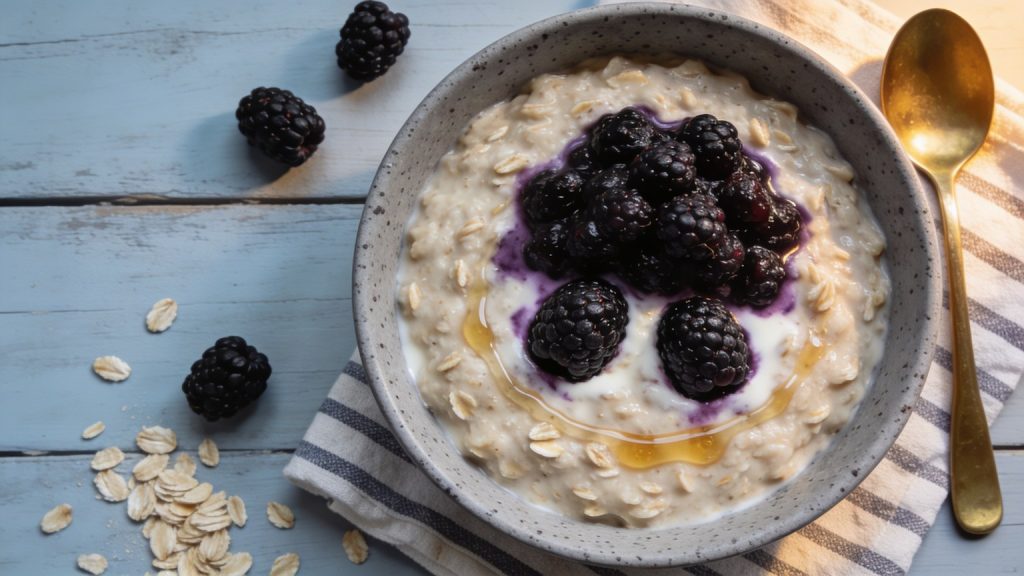
To freeze, spread them on a tray until solid, then bag them — frozen berries work in oatmeal, smoothies, and baking year-round. Fresh, they belong in green salads, over yogurt, or cooked into a quick sauce for pork or duck.
Blackberry Nutrition Facts
The numbers below are for 100 g of raw blackberries — about two-thirds of a cup.
Frequently Asked Questions
Are blackberry seeds safe to eat?
For most people, yes. The old advice to avoid seeds with diverticulosis has been retired: a study of 47,228 men over 18 years found no link between nuts, corn, or popcorn and diverticulitis (JAMA, 2008). During an active flare, doctors may briefly restrict fiber — seeds included.
Do blackberries have a lot of sugar?
No. A cup holds about 7 grams of sugar — half of what a medium banana carries — alongside 7.6 grams of fiber that slows its absorption. Among fruits, that’s one of the gentler sugar loads per serving.
Are blackberries good for weight loss?
No trial has measured blackberries against body weight — the seven-day USDA study shifted fuel use toward fat but was too short for weight to change. At 62 calories and 7.6 grams of filling fiber a cup, they’re an easy swap for desserts with five times the calories.
The Bottom Line: How Many Blackberries a Day?
A cup or two most days is a sound habit — fresh in season, frozen the rest of the year. That’s meaningful fiber, a third of your vitamin C, and two-fifths of your manganese for fewer calories than a granola bar. Just don’t expect one handful to replicate a 600-gram trial. If blueberries are your usual berry, see how a daily blueberry habit measures up.
Sources
- Nutrients, 2018 — Solverson PM, Rumpler WV, Leger JL, Redan BW, Ferruzzi MG, Baer DJ, Castonguay TW, Novotny JA. “Blackberry Feeding Increases Fat Oxidation and Improves Insulin Sensitivity in Overweight and Obese Males.” Nutrients. 2018;10(8):1048. PMID 30096878. https://pubmed.ncbi.nlm.nih.gov/30096878/
- Circulation, 2013 — Cassidy A, Mukamal KJ, Liu L, Franz M, Eliassen AH, Rimm EB. “High Anthocyanin Intake Is Associated With a Reduced Risk of Myocardial Infarction in Young and Middle-Aged Women.” Circulation. 2013;127(2):188-196. PMID 23319811. https://pubmed.ncbi.nlm.nih.gov/23319811/
- JAMA, 2008 — Strate LL, Liu YL, Syngal S, Aldoori WH, Giovannucci EL. “Nut, Corn, and Popcorn Consumption and the Incidence of Diverticular Disease.” JAMA. 2008;300(8):907-914. PMID 18728264. https://pubmed.ncbi.nlm.nih.gov/18728264/
- JAMA, 2013 — Age-Related Eye Disease Study 2 (AREDS2) Research Group. “Lutein + Zeaxanthin and Omega-3 Fatty Acids for Age-Related Macular Degeneration.” JAMA. 2013;309(19):2005-2015. PMID 23644932. https://pubmed.ncbi.nlm.nih.gov/23644932/
- USDA FoodData Central — “Blackberries, raw” (FDC ID 173946, SR Legacy) and “Bananas, raw” (FDC ID 173944, SR Legacy). https://fdc.nal.usda.gov/food-details/173946/nutrients
- US FDA — Daily Values for Nutrition and Supplement Facts Labels (21 CFR 101.9). https://www.fda.gov/food/nutrition-facts-label/daily-value-nutrition-and-supplement-facts-labels

I’m truly impressed with your website. So many great and useful insights about nutrition and healthy food. The recipes are a story of their own, with excellent photo illustrations and extremely clear, precise instructions. Hats off to you! I’ll definitely recommend you to others because you’re really something new, interesting, and valuable.
Thank You
I completely agree — Tasty Spot seems like something truly new and high-quality. When I say new, I mean that we really needed something fresh when it comes to food and recipes. Kudos for the idea, the design, and the content.
Thank You