



How many prunes a day? The dose in the trials is 50 g — five or six prunes, 120 calories. In a 12-month trial of 235 postmenopausal women, that arm held hip bone density nearly steady. Doubling the dose did not work better, and 41% of the women given 100 g quit.
“Prunes are one of the most effective fruits for preventing and reversing bone loss.” That sentence opens the 2026 meta-analysis on the subject, as the claim it set out to test. The first half of it has a trial behind it. The second half is the part the meta-analysis could not confirm.
Two numbers do almost all the work here: one for bone, a different one for the bowel. Here is each dose, what it moved, and where the evidence thins out.
What the evidence says
Moderate · 50 g a day preserved hip bone density for a year. 235 postmenopausal women, 12-month randomized controlled trial: total hip BMD fell 1.1 ± 0.2% in the control group against 0.3 ± 0.2% on 50 g (P < 0.05). One center — and the 2026 pooled analysis found no significant effect at the hip.
Single study · 50 g twice a day outperformed psyllium for constipation. 40 adults, one 8-week single-blind crossover, three weeks per arm, both arms matched at 6 g of fiber a day: more complete spontaneous bowel movements and better stool consistency (P < 0.05). No second trial has repeated it.
Limited · The pooled picture across every prune bone trial. 11 papers, 747 participants: lumbar spine borderline (SMD 1.30, 95% CI −0.03 to 2.63), I² = 98%, no significant difference at other sites or in bone markers.
The catch · More was not better, and people would not eat it. 41% of the 100 g group dropped out, against 15% on 50 g and 10% in the control arm (P < 0.001) — and the 100 g arm showed no significant hip effect.
1. How Many Prunes a Day for Bone Health? Fifty Grams May Hold the Line
Fifty grams (1.8 oz) — five or six prunes. That is the lower of the two doses both bone trials tested, and the one that held up. The two ways of counting agree: USDA FoodData Central weighs one pitted prune at 9.5 g (0.3 oz), so 50 g comes to 5.3 of them.
The big one is The Prune Study, run by De Souza and colleagues at Pennsylvania State University and published in the American Journal of Clinical Nutrition in October 2022 (NCT02822378). It randomized 235 women, average age 62.1 ± 5.0 years, to a control group (n = 78), 50 g of prunes a day (n = 79), or 100 g a day (n = 78), for 12 months. Total hip bone mineral density dropped 1.1 ± 0.2% in the control group; in the 50 g group it barely moved, −0.3 ± 0.2% (P < 0.05). Hip fracture risk scored by FRAX worsened in controls at six months (10.3 ± 0.5% against 9.8 ± 0.5% at baseline, P < 0.05) but held steady in the pooled prune groups.
The “five or six” phrasing comes from an earlier trial by Hooshmand and colleagues at San Diego State University, in Osteoporosis International in July 2016, which put it in the paper itself: “50 g of dried plum (equivalent to 5–6 dried plums).” It followed 48 osteopenic women aged 65 to 79 for six months; both 50 g and 100 g prevented the loss of total body BMD against control (P < 0.05), and TRAP-5b, a marker of bone breakdown, fell by three months and stayed down at six.
A 2024 follow-up by Koltun and colleagues, also in Osteoporosis International, put the same women through peripheral quantitative computed tomography (pQCT) and found preserved cortical density and estimated bone strength at the tibia in the pooled prune group.
The limits are worth stating plainly: two research groups, one population — postmenopausal women — and one verb. None of these trials reported bone density going up; they measured preservation, not rebuilding. A food that slows a loss is not a food that undoes one, which is the same reading we applied to every dose in our guide to anti-inflammatory foods for arthritis and joint pain.
2. Is More Better? 41% of the 100 g Group Dropped Out
No — and the reason is the most useful number in the whole literature. In The Prune Study, dropout overall was 22%, but it ran to 41% in the 100 g group against 15% on 50 g and 10% in the control arm (P < 0.001). Ten or eleven prunes a day, every day, for a year is more than most people will do.
Compliance followed: 90.2 ± 1.8% on 50 g against 87.1 ± 2.1% on 100 g. So did the hip result — the group × time interaction for total hip BMD appeared for 50 g against control, but not for 100 g (P > 0.05). The authors name the 50 g dose in their conclusion specifically because of “high compliance and retention.”
That is not the same as saying 100 g does nothing. Hooshmand’s six-month trial found both doses prevented total body bone loss, and the 2026 meta-analysis pooled studies using 50 to 100 g. Over six months, in 48 women, the larger dose worked. Over twelve, in 235, it mostly went uneaten.
3. How Many Prunes for Constipation? 50 g Twice a Day Beat Psyllium
Here the dose doubles and splits: 50 g in the morning and 50 g in the evening, roughly ten or eleven prunes across the day. That is what the one head-to-head trial used, and it came out ahead of a fiber supplement.
Attaluri and colleagues at the University of Iowa Carver College of Medicine ran an eight-week single-blind randomized crossover study in Alimentary Pharmacology & Therapeutics, April 2011: 40 adults with chronic constipation (3 men, 37 women, mean age 38), three weeks on each treatment with a one-week washout. Prunes went in at 50 g twice daily and psyllium at 11 g twice daily, deliberately matched at 6 g of fiber a day. Complete spontaneous bowel movements per week — the primary outcome — and stool consistency both improved significantly on prunes compared with psyllium (P < 0.05).
Two honest qualifications. Straining and overall relief of constipation did not differ between treatments, and the study ran three weeks per arm in 40 people, most of them women. The second is about mechanism: prunes are usually credited to their sorbitol, but the USDA record does not report sorbitol at all, so we are not putting a number on it. What the trial did control for was fiber, and prunes still came out ahead of an equal dose of it. The only other fruit on this site tested against constipation shows the same shape — a dose that worked and a dose that backfired, in how much mango a day.
4. Do Prunes Reverse Bone Loss? The 2026 Meta-Analysis Could Not Confirm It
Preserve, yes, in these trials. Reverse — no, that claim does not survive pooling. Yulia Treister-Goltzman and Roni Peleg, of Ben-Gurion University of the Negev and Clalit Health Services, screened 284 records in PubMed, Scopus and Web of Science and published the result in Nutrients on April 23, 2026.
Eleven papers and 747 participants made it in. Run through a three-level mixed-effects meta-analysis, the effect in postmenopausal women was borderline significant at the lumbar spine (SMD 1.30, 95% CI −0.03 to 2.63) — a confidence interval that crosses zero, which is the statistical way of saying “possibly nothing.” No significant differences appeared at any other BMD site. Markers of bone formation and bone resorption showed no significant difference either.
Then there is I² = 98%, a measure of how much the trials disagreed with each other; 98% is close to total disagreement, so the pooled estimate averages results that do not line up. The authors’ own summary is the sentence the health pages skipped: “preliminary evidence of modest skeletal benefits associated with consumption of 50–100 g of prunes, particularly at the lumbar spine, a trabecular-rich site. However, the overall body of research remains limited.” In their favor, risk of bias across the included trials was rated low on the RoB 2 tool.
5. Are Prunes High in Fiber? 7.1 g per 100 g, and 3.6 g in a Serving
By weight, yes: 7.1 g of fiber per 100 g (3.5 oz), a quarter of the 28 g FDA Daily Value. By serving, less so — the 50 g bone dose carries 3.6 g, closer to an eighth of a day’s fiber, for 120 calories and 19 g of sugars. All figures below are from USDA FoodData Central, “Plums, dried (prunes), uncooked,” FDC ID 168162.
- 50 g (five or six prunes, 1.8 oz): 120 calories, 3.6 g fiber, 19.1 g sugars, 366 mg potassium, 29.8 µg vitamin K
- 100 g (3.5 oz, about ten or eleven): 240 calories, 7.1 g fiber (25% DV), 38.1 g sugars, 732 mg potassium (16% DV), 59.5 µg vitamin K (50% DV), 0.281 mg copper (31% DV)
- 1 cup pitted (174 g, 6.1 oz): 418 calories, 12.4 g fiber — a serving almost nobody eats in one sitting
- 1 cup canned prune juice (256 g, 8 fl oz): 182 calories, 2.6 g fiber, 42.1 g sugars (USDA FDC ID 167753)
Two entries deserve a second look. Copper is the quiet one at 31% of the Daily Value per 100 g. Vitamin K is the loud one at 50% DV: useful, but a 2021 case-based review in Clinical Rheumatology by Rangecroft, Prabhu and Huang notes that for people on warfarin, keeping vitamin K intake consistent matters more than keeping it low — a swing in either direction is the problem. That is a conversation for your doctor, not a blog.
For comparison, a cup of blackberries (144 g, 5.1 oz) brings 7.6 g of fiber for 62 calories — the numbers are in how many blackberries a day. Fresh fruit wins on calories per gram of fiber; dried fruit wins on fitting in a coat pocket. Note too what prunes are not: 43 mg of calcium per 100 g is 3% of the Daily Value, so the bone effect here is not a calcium effect. Where calcium is concerned, absorption matters more than the label — we worked through that in how much spinach a day.
How to Use Prunes in Your Kitchen
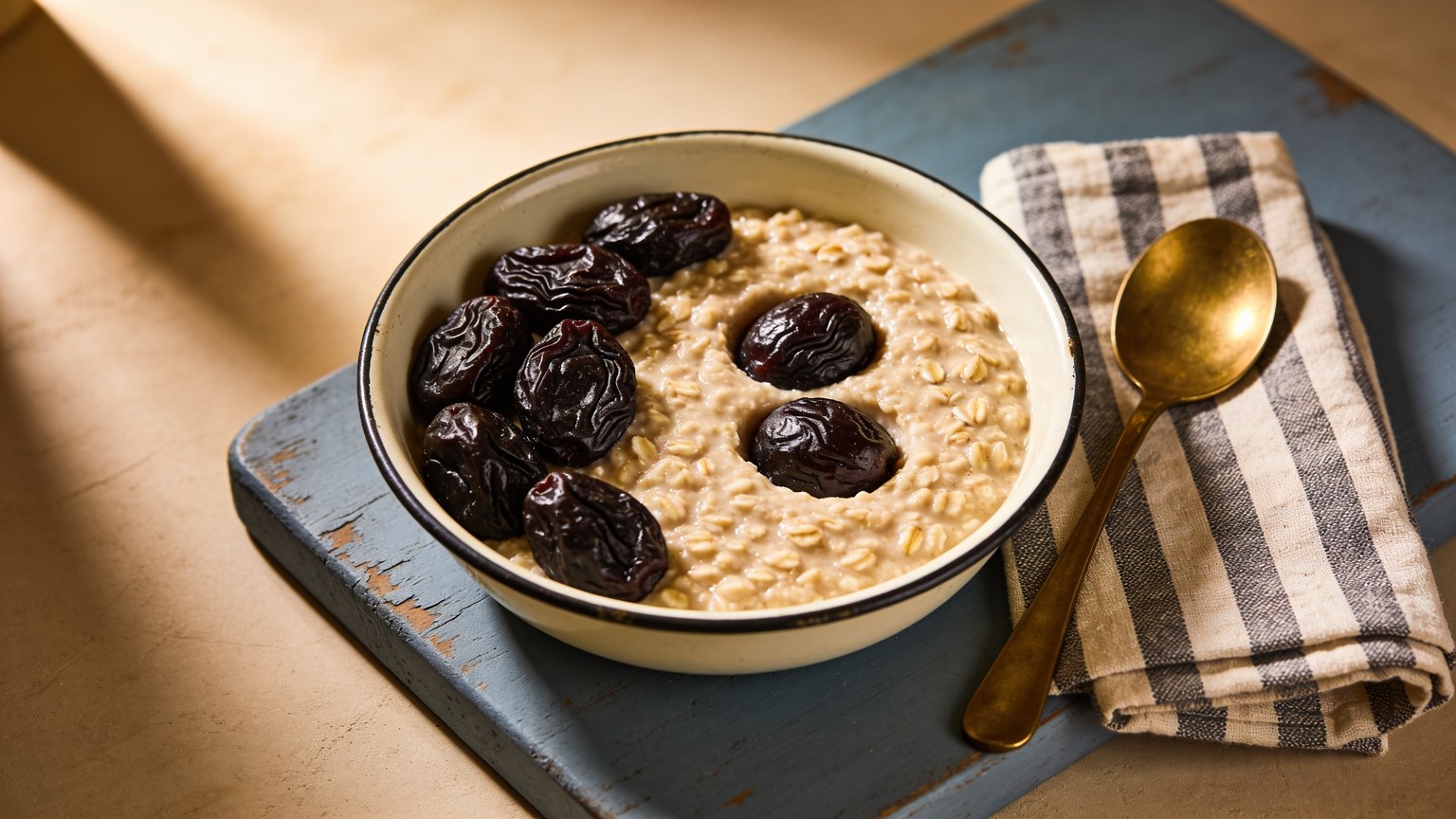
Buy them plump rather than hard, keep the bag sealed, and move it to the fridge once open — prunes stiffen in a warm cupboard. USDA’s 9.5 g weight is for a pitted prune, which is what most bags hold. A sweet snack is only ever as good as the serving it is measured on: 50 g is five or six prunes here, and 40 g is one of our pumpkin protein balls, where the same kind of arithmetic gives 10.37 g of protein and 2.18 g of fiber — strong on one, weak on the other.
Build up rather than jump: the dropout curve in The Prune Study is the clearest argument against starting at 100 g, and the constipation trial split its 100 g into two doses. Chopped into oatmeal (porridge) is the easiest daily habit — our guide to the benefits of eating oatmeal every day covers the fiber in the bowl underneath them. Simmered with a strip of orange peel, they keep a week in the fridge as compote. That compote is also the simplest way to serve them next to something baked rather than hidden inside it: spooned over a square of our fudgy cocoa powder brownies, the 50 g stays five or six prunes you can count on the plate.
Two habits decide the outcome: reach for the fruit rather than the juice, which the list above shows is the thinner product by a wide margin, and keep the amount fixed rather than occasional, because every trial here measured a dose taken daily for months, never a good week. We made the same point about eating blueberries every day.
Prune Nutrition Facts
Frequently Asked Questions
Are prunes and plums the same thing?
Same fruit, different water content. USDA files them under the title “Plums, dried (prunes), uncooked” — in that record, a prune is a dried plum, and the two words point at one entry, not two foods. Drying is what changes the numbers: water falls to 30.9 g per 100 g, so calories, fiber, sugars and potassium all concentrate by weight. That is why a handful of prunes and a handful of fresh plums read so differently on a label.
Are prunes good for diabetics?
That is a question for your doctor, and the small trials point both ways — neither of them in people with diabetes. In a crossover study in Appetite in 2010, Furchner-Evanson and colleagues gave 19 healthy women with a mean BMI of 26.1 a set of 238-calorie snacks on separate days; the dried plum trial produced a lower plasma glucose and insulin area under the curve than the low-fat cookie (P ≤ 0.05), with greater satiety. A 55-adult randomized crossover from Pennsylvania State University in the British Journal of Nutrition in 2020 went the other way, in adults with an elevated BMI and at least one other cardiometabolic risk factor: four weeks of three-quarters of a cup a day of mixed dried fruit — plums, figs, dates and raisins, not prunes alone — raised mean fasting glucose by 0.08 mmol/L, about 1.4 mg/dL, against a carbohydrate-matched snack (P = 0.038), and improved no cardiometabolic risk factor. We found no trial testing a set daily dose of prunes in people with diabetes. There is 38.1 g of sugar in 100 g of prunes, and drying does not remove it.
Prune juice or prunes — which is better for constipation?
The trial used whole fruit, not juice, so the evidence sits with the prunes. On paper the gap is wide: USDA lists 1.0 g of fiber per 100 g of canned prune juice against 7.1 g for the dried fruit, so a cup of juice (256 g, 8 fl oz) brings 2.6 g of fiber and 182 calories, while 50 g of prunes brings 3.6 g for 120. We found no trial pitting juice against whole prunes.
Can you eat too many prunes?
The 12-month trial answers this sideways: at 100 g a day, 41% of that group left the study, against 10% of controls. Yet in the three-week constipation trial the same 100 g, split into two 50 g doses, was in Attaluri’s words “safe and well tolerated,” and rated as palatable as psyllium by all 40 people in it. Tolerance looks like a question of pace and splitting as much as of amount. It helps to know which way the excess runs: 100 g a day is the dose a trial used to increase bowel movements, so the same amount in someone who is already regular is working in a direction they did not ask for. Start with two or three and work up.
The Bottom Line: Two Doses, Two Different Jobs
For bone, the measured dose is 50 g a day — five or six prunes. In a 12-month trial of 235 women, that arm held hip density nearly still while the control group lost 1.1%. For the bowel, it is 50 g twice a day for three weeks, which beat an equal dose of psyllium fiber in 40 adults. Doubling the bone dose bought nothing except a 41% dropout rate, and the pooled evidence across 11 trials and 747 people is still, in its authors’ word, preliminary. Eat them daily rather than occasionally, keep vitamin K steady if you are on an anticoagulant, and put them where you will actually eat them — chopped into a bowl of daily oatmeal is the version most people keep up.
Sources
- American Journal of Clinical Nutrition, October 2022 — De Souza MJ, Strock NCA, Williams NI, Lee H, Koltun KJ, Rogers C, Ferruzzi MG, Nakatsu CH, Weaver C. “Prunes preserve hip bone mineral density in a 12-month randomized controlled trial in postmenopausal women: the Prune Study.” 2022;116(4):897-910 (NCT02822378). https://pubmed.ncbi.nlm.nih.gov/35798020/
- Nutrients, April 23, 2026 — Treister-Goltzman Y, Peleg R. “Effects of Prunes on Bone Density in Humans: A Systematic Review and Meta-Analysis of Randomized Controlled Trials” (Ben-Gurion University of the Negev). 2026;18(9):1338. https://pubmed.ncbi.nlm.nih.gov/42123941/
- Osteoporosis International, July 2016 — Hooshmand S, Kern M, Metti D, Shamloufard P, Chai SC, Johnson SA, Payton ME, Arjmandi BH. “The effect of two doses of dried plum on bone density and bone biomarkers in osteopenic postmenopausal women: a randomized, controlled trial” (San Diego State University). 2016;27(7):2271-2279. https://pubmed.ncbi.nlm.nih.gov/26902092/
- Osteoporosis International, May 2024 — Koltun KJ, Strock NCA, Weaver C, Lee H, Williams NI, Rogers CJ, Damani J, Ferruzzi MG, Nakatsu CH, De Souza MJ. “Prunes preserve cortical density and estimated strength of the tibia in a 12-month randomized controlled trial in postmenopausal women: The Prune Study.” 2024;35(5):863-875. https://pubmed.ncbi.nlm.nih.gov/38349471/
- Alimentary Pharmacology & Therapeutics, April 2011 — Attaluri A, Donahoe R, Valestin J, Brown K, Rao SS. “Randomised clinical trial: dried plums (prunes) vs. psyllium for constipation” (University of Iowa Carver College of Medicine). 2011;33(7):822-8. https://pubmed.ncbi.nlm.nih.gov/21323688/
- Appetite, June 2010 — Furchner-Evanson A, Petrisko Y, Howarth L, Nemoseck T, Kern M. “Type of snack influences satiety responses in adult women” (San Diego State University). 2010;54(3):564-9. https://pubmed.ncbi.nlm.nih.gov/20206217/
- British Journal of Nutrition, November 2020 — Sullivan VK, Petersen KS, Kris-Etherton PM. “Dried fruit consumption and cardiometabolic health: a randomised crossover trial” (Pennsylvania State University). 2020;124(9):912-921. https://pubmed.ncbi.nlm.nih.gov/32513313/
- Clinical Rheumatology, April 2021 — Rangecroft A, Prabhu SS, Huang CC. “Pickles and warfarin interaction: a case-based review” (Wake Forest School of Medicine). 2021;40(4):1621-1624. https://pubmed.ncbi.nlm.nih.gov/32778973/
- USDA FoodData Central — “Plums, dried (prunes), uncooked” (SR Legacy, FDC ID 168162). https://fdc.nal.usda.gov/food-details/168162/nutrients
- USDA FoodData Central — “Prune juice, canned” (SR Legacy, FDC ID 167753). https://fdc.nal.usda.gov/food-details/167753/nutrients
- U.S. Food and Drug Administration — “Daily Value on the Nutrition and Supplement Facts Labels.” https://www.fda.gov/food/nutrition-facts-label/daily-value-nutrition-and-supplement-facts-labels