


. No pie filling.)
A chocolate cherry cake with fresh cherries that keeps the fruit out of the batter altogether: three chocolate layers under a dark chocolate buttercream, with whole cherries — stems on, pits in — piled into a well piped into the top. A cup of pitted sweet cherries is 97 calories (USDA FoodData Central 171719). A slice of the cake underneath them is 848, and both numbers are on this page.
Recipe Card
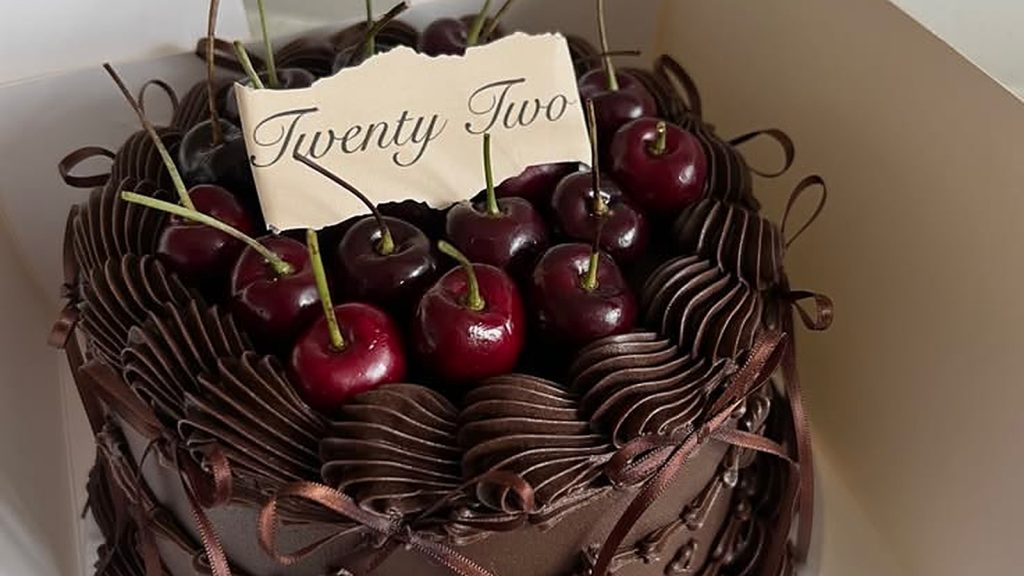

Chocolate Cherry Cake With Fresh Cherries — a Cup of Them Is 97 Calories, and They Go On Top
Description
Chocolate cherry cake with fresh cherries, built as three chocolate layers under a dark chocolate buttercream — and the fruit goes on whole, stems on, piled into a well in the piped ring on top. It never touches the batter, so it never sinks. A cup of pitted sweet cherries is 97 calories and 3.2 g of fiber (USDA FoodData Central 171719); out of season, thawed frozen dark sweet cherries take the same place.
Ingredients
For the chocolate layers
For the chocolate buttercream
For the cherries on top
Instructions
Bake the chocolate layers
-
Heat the oven and line the pans
Set a rack in the center and heat the oven to 175°C (350°F). Brush three 20 cm (8-inch) round cake pans (cake tins) lightly with oil, line the bottoms with parchment paper (baking paper), and dust the sides with a little of the cocoa powder.
-
Whisk the dry ingredients
In a large bowl, whisk together 250 g (2 cups) all-purpose flour (plain flour), 65 g (3/4 cup) natural unsweetened cocoa powder, 350 g (1 3/4 cups) granulated sugar, 1 1/2 teaspoons baking soda (bicarbonate of soda), 1 teaspoon baking powder, and 3/4 teaspoon fine sea salt. Break up any lumps of cocoa against the side of the bowl.
-
Beat in the wet ingredients
Add 2 large eggs, 240 ml (1 cup) buttermilk, 120 ml (1/2 cup) canola oil, and 2 teaspoons vanilla extract. Beat on medium for 1 minute, until the batter is smooth and glossy.
-
Stir in the hot coffee
Pour in 180 ml (3/4 cup) hot brewed coffee and stir on low just until it disappears. The batter goes thin and pourable at this point — that is what keeps the crumb soft, so resist the urge to add flour.
-
Bake and cool completely
Divide the batter among the three pans, about 440 g each if you weigh them. Bake for 30 to 34 minutes, until a skewer pushed into the center comes out with a few moist crumbs on it. Cool in the pans for 10 minutes, then turn the layers out onto a rack and leave them until they are cold all the way through, about 2 hours. Buttercream slides off a warm layer.
Make the chocolate buttercream
-
Melt the dark chocolate
Melt 170 g (6 oz) chopped dark chocolate, 60 to 70% cacao, over a pan of barely simmering water or in short bursts in the microwave. Set it aside until it is barely warm to the touch, about 15 minutes. Hot chocolate poured into butter will split the buttercream.
-
Beat the butter pale
Beat 400 g (1 3/4 cups) softened unsalted butter on medium-high for 3 minutes, scraping the bowl twice, until it is pale and holds a soft peak on the beater.
-
Work in the sugar and cocoa
Sift 540 g (4 1/2 cups) confectioners’ sugar (icing sugar) together with 43 g (1/2 cup) natural unsweetened cocoa powder and add it in three additions on low speed. Add 90 ml (6 tablespoons) heavy cream (double cream), 1 teaspoon vanilla extract, and 1/4 teaspoon fine sea salt.
-
Fold in the melted chocolate
Pour in the cooled melted chocolate and beat on medium for 1 minute, until the buttercream turns a shade darker and pulls away from the side of the bowl in one mass. You will have about 1,250 g — enough to fill, coat, and pipe the whole cake. If it feels stiff for piping, beat in cream 1 teaspoon at a time.
Fill, coat, and pipe
-
Stack the three layers
Slice the domes off the layers with a serrated knife so they sit flat. Set the first layer on a cake board or plate, spread about 150 g buttercream over it to the edge, add the second layer, spread another 150 g, and top with the third layer cut side down.
-
Crumb coat and chill
Spread a thin, see-through coat of buttercream over the top and sides to trap the crumbs. Chill for 30 minutes, until that coat is firm to a fingertip.
-
Coat and pipe the sides
Spread a thicker coat over the chilled cake and smooth it with a palette knife. Fit a piping bag with a ridged basketweave tip (Wilton 47 or 48), serrated side facing out, and pipe short strokes up the lower third of the side, each one touching the last. Leave a smooth band of buttercream above them and run a piped rope along its lower edge, then pipe a second band of the same strokes above that, up to the top edge.
-
Pipe the ring on top
With the same tip, pipe a ring of overlapping curved swirls around the top edge, working in one direction and letting each swirl cover the tail of the one before. Leave a clear well about 13 cm (5 inches) across in the middle — that is where the cherries go, and the ring is what holds them in.
Top with the cherries
-
Rinse the cherries and dry them
Rinse 250 g (9 oz) fresh dark sweet cherries under cold water with the stems still on, then dry every one with a towel. Damp fruit slides on buttercream and leaves red streaks behind it.
-
Pile them into the well
Pile the cherries into the well inside the piped ring, stems up, in one close layer with a few resting on top of it, until the well is full to the ring. Do this within 2 hours of serving so the fruit stays firm. The cherries go on whole: the pits and the stems are still in them, so say so before anyone takes a bite, and lift them off the slices you cut for small children. Out of season, use 250 g frozen dark sweet cherries, thawed, drained, and patted dry — they come pitted and stemless, so they sit lower in the well.
Nutrition Facts
Servings 12
Serving Size 1 of 12 slices
- Amount Per Serving
- Calories 848kcal
- % Daily Value *
- Total Fat 47g61%
- Saturated Fat 24g120%
- Trans Fat 1g
- Cholesterol 113mg38%
- Sodium 445mg20%
- Potassium 354mg8%
- Total Carbohydrate 107g39%
- Dietary Fiber 5g18%
- Sugars 83g
- Protein 7g15%
- Vitamin A 274 mcg RAE
- Vitamin C 2 mg
- Calcium 91 mg
- Iron 3 mg
* Percent Daily Values are based on a 2,000 calorie diet. Your daily value may be higher or lower depending on your calorie needs.
Note
- The cherries never go into the batter, so they never sink. Fresh sweet cherries are 82.25% water (USDA FoodData Central 171719) and far denser than this thin, coffee-loosened batter, which is why the usual advice is to toss fruit in flour to hold it up. Here the question never comes up: the fruit sits on set buttercream, above the crumb, and the ring piped around the top edge is what keeps it from rolling off.
- Pits and stems stay in. The cherries are whole, exactly as they came off the tree. Tell people before they bite, and lift the cherries off any slice going to a small child.
- Out of season, frozen is the honest route. The US sweet cherry harvest runs from early June through early August (Northwest Horticultural Council), UK punnets show up from mid-July to the end of August (BBC Food), and USDA’s SNAP-Ed produce guide files cherries under summer. The rest of the year, thaw 250 g (9 oz) frozen dark sweet cherries in a sieve set over a bowl for about an hour, drain them, and pat them dry. They arrive pitted and stemless, so they sit lower and look darker than the photo; if you want them glossy, simmer the drained juice with 1 teaspoon cornstarch (cornflour) until it coats a spoon, cool it, and brush it over. When they are in season, BBC Food’s buyer’s guide gives the test: the best cherries are “plump, firm, glossy and free of blemishes; the stems should be fresh and green.” On a cake where the stems are the decoration, that last half of the sentence is the whole test.
- Natural or Dutch-process cocoa. This batter is built on natural cocoa, which is acidic, together with buttermilk, baking soda, and a teaspoon of baking powder. Dutch-process cocoa is treated with alkali and USDA keeps it as a separate record (FDC 169594); swap it in one for one and the cake still rises on the buttermilk and the baking powder, but the crumb comes out darker and milder. It is the same choice that decides the texture of a pan of cocoa brownies.
- Ribbon and paper are decoration, not ingredients. If you tie a satin ribbon around the cake or push a paper tag into the cherries, both come off before the knife goes in. Nothing in this recipe is a chocolate band, and nothing on the outside of the cake is meant to be eaten except the buttercream and the fruit.
- Make-ahead and storage. The layers can be baked a day ahead, cooled, wrapped, and left at room temperature. The buttercream keeps 3 days in the fridge and needs a full re-beat before it will pipe. Frost the cake up to a day ahead, keep it covered at cool room temperature, and add the cherries within 2 hours of serving. Leftovers keep 3 days covered; take them out of the fridge an hour before serving or the buttercream tastes of nothing.
- How the nutrition was calculated, and what a slice actually is. The headline number is the fruit: a cup of pitted sweet cherries is 97 calories. A slice of this cake is 848, and the two are not the same claim. The card comes from USDA FoodData Central SR Legacy records for the raw ingredients — flour 168894, cocoa 169593, granulated sugar 169655, baking soda 175040, baking powder 172803, salt 173468, eggs 171287, buttermilk 170874, canola oil 172336, vanilla 173471, brewed coffee 171890, butter 173430, confectioners’ sugar 169656, dark chocolate 170272, heavy cream 170859, and sweet cherries 171719 — added up for the whole cake and divided by twelve. USDA’s Table of Nutrient Retention Factors (Release 6) has no row for cake, so the nearest documented row, flour/meal, baked, was applied to the whole batter; the buttercream is never heated and the cherries go on raw, so neither gets a factor. That row keeps all eight minerals at 100 percent, so it moves only two numbers here, vitamin C and vitamin A, and only slightly. One gap the records cannot close on their own: the USDA record for unsalted butter carries no entry for trans fat at all, so that figure comes from USDA’s sister record for salted butter (173410, 3.278 g per 100 g, salting does not change the fatty acids) — 400 g of butter puts about a gram of it in a slice, and it is the trans fat that occurs naturally in dairy, not the hydrogenated kind. Nothing is deducted: not the domes trimmed off the layers, not the buttercream left in the bag, not the film of oil and cocoa on the pans. A real slice therefore runs a little under what the card says, never over. The cherries are counted as flesh; their pits and stems are not.
Type this cake into a search box and the first page hands you a can. Box mix plus canned cherry pie filling is the dominant version of it on the internet, and it is genuinely fast. It is also a different food from the one in the photograph, where the fruit is raw, whole and sitting on top of the frosting rather than stirred into anything.
The cake this recipe was built to match is a tall single-tier round in a full coat of dark chocolate buttercream: two bands of close piped ribs with a smooth band between them, a ring of overlapping swirls around the top edge, and dark sweet cherries with their stems still attached packed into the middle, shoulder to shoulder. The cake in the photograph at the top of this page is one of ours; it lives as a pin on our own board, under the account we keep for cake work, Cake Theory. The paper flag reading Twenty Two came off before the knife went in.
The method is three 20 cm (8-inch) layers of an oil-and-buttermilk chocolate batter loosened with hot coffee, about 1,250 g of chocolate buttercream to fill, coat and pipe, and 250 g (9 oz) of cherries that go on within two hours of serving. It is the same kind of American buttercream, beaten and bagged the same way, as the lilac buttercream flower cake — only here it carries 170 g of melted dark chocolate and 43 g of cocoa, and a ribbed basketweave tip does the work the petal tips did there.
One thing to settle before you shop. The season for fresh sweet cherries is closed in both of our markets: the Northwest Horticultural Council puts the US harvest at “early June through early August,” BBC Food tells British shoppers to look for punnets “from mid-July to the end of August,” and USDA’s SNAP-Ed Seasonal Produce Guide files cherries under summer, full stop. From September through May, frozen dark sweet cherries — thawed in a sieve, drained, patted dry — are the honest route, and the recipe is written for both.
Why This Chocolate Cherry Cake With Fresh Cherries Works
- The fruit goes on last, onto set frosting. Nothing is folded into the batter, so nothing can sink, bleed pink streaks through the crumb, or turn a slice wet by the second day.
- Three layers, not one. Two bands of piped ribs need roughly 9 to 10 cm of cake side to stack one above the other; three 20 cm rounds give you that, and they give you twelve slices instead of eight.
- Hot coffee in the batter. 180 ml (3/4 cup) of it goes in last and takes the batter thin and pourable, which is what keeps the crumb soft. The cake does not taste of coffee; hot water behaves the same way if you would rather skip it.
- Weigh the confectioners’ sugar (icing sugar) before you sift it. USDA’s record for powdered sugar (169656) lists a cup at 120 g unsifted and 100 g sifted. Measure 4 1/2 cups after sifting and you have put 450 g in the bowl instead of 540 g, and the buttercream comes out slack. Scoop it, weigh it, then sift it with the cocoa.
- Lacto-ovo vegetarian, and alcohol-free as written. The cherries are raw fruit rather than a soaked or cooked filling, so nothing here needs kirsch, syrup or a bottle of anything.
Can You Put Fresh Cherries in a Cake?
You can, and on this one they go on rather than in — which sidesteps the problem entirely. Fresh sweet cherries (Prunus avium) are 82.25% water, so anything you bury in a batter arrives as a pocket of juice in a baked crumb. Left whole on set buttercream they stay firm, glossy and separate, and the ring piped around the top edge is what keeps them from rolling off. The near-black color of the dark sweet varieties is anthocyanin pigment, the same family that colors blackberries and red cabbage, and it stays where it is as long as the skin does.
The swap worth looking at is not fresh against baked, but fresh against the can that most recipes for this cake reach for. Both foods have a USDA record, and the two records do not say the same thing.
| 100 g of fruit, two ways | Raw sweet cherries (FDC 171719) | Canned cherry pie filling (FDC 168824) |
|---|---|---|
| Calories | 63 kcal | 115 kcal |
| Carbohydrate | 16.01 g | 28.0 g |
| Total sugars | 12.82 g | not listed in the record |
| Fiber | 2.1 g | 0.6 g |
| Potassium | 222 mg | 105 mg |
| Vitamin C | 7.0 mg | 3.6 mg |
| Sodium | 0 mg | 18 mg |
Both records are USDA FoodData Central SR Legacy, published April 1, 2019, and both are read at the same reference weight of 100 g. The total sugars row is a gap rather than a zero: the pie-filling record carries no total sugars entry at all, so no sugar comparison can honestly be drawn from it.
Read it in both directions. The can wins on the things a can is for — it keeps twelve months, costs the same in February as in July, holds its shape under heat, and comes pitted. What it does not do is stand in nutritionally: 52 more calories and nearly 12 g more carbohydrate per 100 g, against roughly three and a half times the fiber and more than twice the potassium in the raw fruit. If you want the fruit to be fruit, the version on top of this cake is the one that is.
Why Do Cherries Sink to the Bottom of Cake?
Because they are heavier than the batter around them and the batter is not stiff enough to hold them. A sweet cherry is 82.25% water by weight and weighs about 8.2 g whole (USDA FoodData Central 171719) — a small dense object in a batter this recipe deliberately keeps thin, since 180 ml of hot coffee goes in at the end. Anything that does not float drifts down while the oven sets the crumb from the outside in.
The standard fix — tossing the fruit in a spoonful of flour before folding it in — is baking-book practice rather than something anyone has measured, and it is worth calling it that. The flour is meant to thicken the film of juice at the fruit’s surface so the batter grips it. It helps at the margins; it does not repeal anything.
Which is the quiet argument for this design. Put the cherries on the finished cake and the failure mode disappears along with the workaround: no flouring, no halving, no pitting, no purple streaks, and the fruit still looks like fruit when the cake reaches the table. The cost is that it has to be done late — within two hours of serving, and never the night before.
What a Slice Actually Contains
One of twelve slices comes to 848 calories, 47 g of fat with 24 g of it saturated, 107 g of carbohydrate including 83 g of sugars, 7 g of protein, 113 mg of cholesterol and 445 mg of sodium. The saturated fat is the first figure to look at: more than a full day’s worth in one slice, out of 400 g of butter in the frosting. The cholesterol is over a third of a day’s, the carbohydrate close to two fifths, the sodium about a fifth. The cherries on top are worth about 20 g and 13 calories per slice — two and a half of them, at USDA’s 8.2 g apiece. They are the decoration, not the arithmetic.
What the evidence says
Solid · What a slice carries is arithmetic, not inference. Sixteen USDA FoodData Central SR Legacy records summed for the whole cake and divided by twelve: 848 calories, 24 g of saturated fat, 83 g of total sugars, 274 µg RAE of vitamin A. USDA’s Table of Nutrient Retention Factors (Release 6) has no row for cake, so the nearest documented row, flour/meal baked, was applied to the batter; it moves vitamin A and vitamin C and nothing else.
Solid · Cherries have not been shown to lower blood pressure — and that has been tested on the sweet ones too. A systematic review and meta-analysis of seven randomized controlled trials in 201 participants, set up to assess “the effect of tart and sweet cherries on systolic and diastolic blood pressure,” concluded that “incorporating cherries into the diet has no significant effect on blood pressure” (Eslami O, Khorramrouz F, Ghavami A, Hajebi Khaniki S, Shidfar F, Diabetes & Metabolic Syndrome, 2022; PMID 35108661). Two hundred and one people pooled across seven trials is a small total, and the literature search stopped at December 2020, so nothing published since is in it.
Single study · Thirty days of dark sweet cherry powder moved two memory scores and left the rest alone. A single-blind randomized trial at Texas A&M University gave obese adults 200 mL of a drink carrying 3 g of cherry powder (n = 19) or an isocaloric placebo (n = 21) twice daily for 30 days. Digit span forward improved (p = 0.006) and backward (p = 0.01); processing speed, sustained attention and visual-spatial performance did not differ, and melatonin rose significantly only in the placebo group (p = 0.02). The authors write that the findings “suggest DSC supplementation may enhance specific cognitive functions in obese adults” and that further trials are needed (Arbizu S, Mertens-Talcott SU, Talcott S, Riviere A, Riechman SE, Noratto GD, Nutrients, 2025; PMID 40077655). Forty people, one month, powder rather than fruit, and one population.
Limited · The sleep study everyone quotes was a different fruit in a different form. Twenty volunteers drank tart Montmorency cherry juice concentrate (Prunus cerasus) or placebo for seven days in a crossover trial at Northumbria University; total urinary melatonin, time in bed, total sleep time and sleep efficiency all rose (Howatson G, Bell PG, Tallent J, Middleton B, McHugh MP, Ellis J, European Journal of Nutrition, 2012; PMID 22038497). Nothing in it was tested on sweet cherries, and nothing in it was tested on whole fruit — so it says nothing about what is on this cake.
The catch · The fruit on top does not change what is under it. 350 g of granulated sugar and 540 g of confectioners’ sugar, plus the sugar in 170 g of dark chocolate, put about 78 g of added sugar in a slice — more than half again the FDA’s entire 50 g Daily Value for added sugars, and roughly two and a half days’ worth of the NHS limit of 30 g of free sugars a day for an adult. That is an argument for cutting twelve slices rather than eight, not an argument against cake.
Three figures on the card need a sentence rather than a nod, because each one is easy to credit to the wrong ingredient. The vitamin A comes to 274 µg RAE, not quite a third of a day’s — and it is the butter, 228 µg of it, while the cherries contribute well under a single microgram. The fiber, about a sixth of a day’s, is cocoa and dark chocolate rather than fruit: unsweetened cocoa powder is 37 g of fiber per 100 g, and the 108 g of it in this cake does most of the work. And the single largest source of the sodium is not the salt jar: 157 of the 445 mg come from a teaspoon and a half of baking soda (bicarbonate of soda), against 145 mg from the salt in the batter and another 49 mg from the salt in the buttercream.
The 1 g of trans fat on the card deserves the same treatment, because it looks alarming and is not what it looks like. USDA’s record for unsalted butter (173430) carries no entry for trans fat at all — the field is missing, not measured at zero — so the figure is taken from the sister record for salted butter (173410, 3.278 g per 100 g; salting does not change the fatty acids). It is the trans fat that occurs naturally in dairy rather than the hydrogenated kind, and 400 g of butter puts it above the 0.5 g per serving a label may round to zero. It is reported rather than rounded away.
Two more things about that column. Nothing is deducted from it — not the domes trimmed off the layers, not the buttercream left in the piping bag, not the film of oil and cocoa on three pans — so a real slice runs a little under the card and never over. And the cocoa you buy changes the crumb but not the numbers: natural cocoa is what this batter is built on, while Dutch-process is alkalized and has its own USDA record (169594), which is the same fork in the road we followed through a tray of fudgy cocoa powder brownies. If you came here for what the cocoa itself might do, that case is made on cocoa flavanols and the 21,442-person COSMOS trial and on what randomized trials actually changed for dark chocolate — and it is made at doses a slice of birthday cake was never meant to deliver. The same holds for the blood pressure question above, which we followed through 25 years of data on sugary drinks and blood pressure.
Chocolate Cherry Cake FAQ
Can I use frozen cherries instead of fresh?
Yes, and from September through May that is the sensible choice. Thaw 250 g (9 oz) frozen dark sweet cherries in a sieve set over a bowl for about an hour, drain them, and pat them dry before they go anywhere near the buttercream. Two things change: they come pitted and stemless, so the mound sits lower and loses the stems that make the top of this cake, and they are softer, so pile them on within an hour of serving. The drained juice is worth keeping — simmer it with 1 teaspoon cornstarch (cornflour) until it coats a spoon, cool it, and brush it over the fruit for the shine the fresh ones have on their own.
Can I substitute sweet cherries for sour cherries?
On top of this cake, sweet is the one you want. USDA puts raw sour red cherries at 50 calories and 8.49 g of total sugars per 100 g against 63 calories and 12.82 g in sweet cherries (FDC 173954 and 171719), and the gap tastes bigger than it reads — raw sour cherries are sharp and soft enough to slump against buttercream. Sour cherries belong in a cake where they are cooked or soaked first, which is exactly what the German cake with kirsch and whipped cream does.
How do you pit cherries without a pitter?
Stand a cherry on the neck of an empty bottle, stem end up, and push the pit straight through with a chopstick or a sturdy metal straw; the pit drops into the bottle and the fruit stays nearly whole. A piping tip works the same way, and so does a paper clip bent into a hook and twisted around the stone. For this cake you will not need any of it — the cherries on top stay whole, stems and pits in. Pit them only if you are cutting slices for small children.
What is chocolate cherry cake called?
In the US and the UK it usually goes by exactly that, chocolate cherry cake, with no older name behind it — most versions on the internet are a box mix stirred together with canned cherry pie filling. The named cake people are often thinking of is the German Schwarzwälder Kirschtorte, which is a different recipe on every count: sour cherries rather than sweet, kirsch rather than none, whipped cream rather than buttercream. We have written that one up on its own.
Serving and Storage
Say the obvious thing before anyone bites: the cherries are whole, and the pits and stems are still in them. Lift them off any slice going to a small child. Cut the cake with a long thin knife wiped between slices, twelve rather than eight, and let the pieces stand an hour if they have come out of the fridge — cold buttercream tastes of very little. An extra bowl of cherries alongside is the cheapest thing on the table that cuts the sugar, at 97 calories and 3.2 g of fiber per 154 g cup.
To make ahead: bake the layers a day early, cool, wrap and hold them at room temperature; the buttercream keeps 3 days in the fridge and needs a full re-beat before it will pipe. To store: frost up to a day ahead, keep the cake covered at cool room temperature, and add the fruit within 2 hours of serving; leftovers keep 3 days covered. To serve from cold: an hour out of the fridge, which is also about how long the frosting needs to stop tasting of nothing.
Sources
- USDA FoodData Central, SR Legacy record 171719, Cherries, sweet, raw (published April 1, 2019: 63 kcal, 82.25 g water, 16.01 g carbohydrate, 12.82 g total sugars, 2.1 g fiber, 222 mg potassium, 0 mg sodium and 7.0 mg vitamin C per 100 g; portions listed in the record include 1 cup without pits = 154 g and 1 cherry = 8.2 g, which is where the 97 calories a cup comes from) — https://fdc.nal.usda.gov/food-search/?query=Cherries%2C%20sweet%2C%20raw
- USDA FoodData Central, SR Legacy record 168824, Pie fillings, canned, cherry (published April 1, 2019: 115 kcal, 28.0 g carbohydrate, 0.6 g fiber, 105 mg potassium, 18 mg sodium and 3.6 mg vitamin C per 100 g; the record carries no total sugars entry, checked again on September 18, 2026) — https://fdc.nal.usda.gov/food-search/?query=Pie%20fillings%2C%20canned%2C%20cherry
- USDA FoodData Central, SR Legacy record 173954, Cherries, sour, red, raw (50 kcal and 8.49 g total sugars per 100 g), record 169656, Sugars, powdered (1 cup unsifted = 120 g, 1 cup sifted = 100 g), record 169593, Cocoa, dry powder, unsweetened (37 g fiber per 100 g), record 169594 for the alkalized Dutch-process cocoa, and records 173430 and 173410 for unsalted and salted butter — https://fdc.nal.usda.gov/
- Eslami O., Khorramrouz F., Ghavami A., Hajebi Khaniki S., Shidfar F., Effect of cherry consumption on blood pressure: a systematic review and meta-analysis of randomized controlled trials, Diabetes & Metabolic Syndrome, 2022;16(2):102409 (seven RCTs, 201 participants, tart and sweet cherries; “cherry supplementation does not lead to a significant decrease in SBP or DBP”) — https://pubmed.ncbi.nlm.nih.gov/35108661/
- Arbizu S., Mertens-Talcott S.U., Talcott S., Riviere A., Riechman S.E., Noratto G.D., Assessing the Role of Dark Sweet Cherry (Prunus avium L.) Consumption on Cognitive Function, Neuropeptides, and Circadian Rhythm in Obesity: Results from a Randomized Controlled Trial, Nutrients, 2025;17(5):784, Texas A&M University (n = 19 against 21, 200 mL twice daily with 3 g cherry powder, 30 days; digit span forward p = 0.006 and backward p = 0.01, no difference in processing speed, sustained attention or visual-spatial performance, melatonin significant only in the placebo group at p = 0.02) — https://pubmed.ncbi.nlm.nih.gov/40077655/
- Howatson G., Bell P.G., Tallent J., Middleton B., McHugh M.P., Ellis J., Effect of tart cherry juice (Prunus cerasus) on melatonin levels and enhanced sleep quality, European Journal of Nutrition, 2012;51(8):909–16, Northumbria University (20 volunteers, 7 days, randomized double-blind placebo-controlled crossover, tart Montmorency cherry juice concentrate) — https://pubmed.ncbi.nlm.nih.gov/22038497/
- Northwest Horticultural Council, Cherry Fact Sheet (“Cherry harvest season generally runs from early June through early August”; 2025 Pacific Northwest sweet cherry production 23,617,800 twenty-pound cartons) — https://nwhort.org/industry-facts/cherry-fact-sheet/
- BBC Food, Cherry — buyer’s guide (“Look out for telltale punnets of deep red cherries in markets from mid-July to the end of August”; “The best cherries are plump, firm, glossy and free of blemishes; the stems should be fresh and green”) — https://www.bbc.co.uk/food/cherry
- USDA SNAP-Ed Seasonal Produce Guide, Cherries (“When are Cherries in Season? Summer”) — https://snaped.fna.usda.gov/resources/nutrition-education-materials/seasonal-produce-guide/cherries
- U.S. Food and Drug Administration, Daily Value on the Nutrition and Supplement Facts Labels (added sugars 50 g, saturated fat 20 g, total fat 78 g, cholesterol 300 mg, sodium 2,300 mg, total carbohydrate 275 g, dietary fiber 28 g, vitamin A 900 mcg RAE) — https://www.fda.gov/food/nutrition-facts-label/daily-value-nutrition-and-supplement-facts-labels
- NHS, Sugar: the facts (adults no more than 30 g of free sugars a day; children aged 7 to 10 no more than 24 g, 4 to 6 no more than 19 g, 2 to 3 no more than 14 g) — https://www.nhs.uk/live-well/eat-well/food-types/how-does-sugar-in-our-diet-affect-our-health/
- USDA Agricultural Research Service, USDA Table of Nutrient Retention Factors, Release 6 (2007) — no row exists for cake, so the nearest documented row, flour/meal baked, was applied to the whole batter; the buttercream is never heated and the cherries go on raw, so neither carries a factor — https://www.ars.usda.gov/ARSUserFiles/80400525/Data/retn/retn06.pdf