


 or less lowered systolic pressure 6 mmHg, but that glass has about 40 g of sugar.)
How much pomegranate juice per day? In a 2023 review of 14 trials and 573 people, systolic blood pressure fell 5 mmHg, and the fall was significant only at 300 mL (10 fl oz) a day or less. That glass holds about 40 g of sugar. Here’s how strong each piece of evidence is.
Pomegranate juice puts this site in an awkward spot. Our look at 25 years of data on sugary drinks and blood pressure found daily fruit juice linked to a higher risk of hypertension. Here, a stack of short trials finds one particular fruit juice nudging blood pressure down. Both can be true at once, and the dose is where they meet.
Below: what four meta-analyses found, why the 300 mL line is a subgroup rather than a rule, what that glass costs in sugar, and how it compares with eating the fruit.
What the evidence says
Moderate · Pomegranate juice may lower systolic blood pressure by about 5 mmHg. Two juice-only meta-analyses agree: 14 trials and 573 people (−5.02 mmHg), and 8 randomized trials (−4.96 mmHg). The trials were small and short.
Limited · The 300 mL (10 fl oz) line. A subgroup result: −6.11 mmHg at 300 mL a day or less; above that, −3.28 mmHg (p = 0.07). The abstract reports no test showing the two groups really differ.
Limited · Whether the effect lasts. The 2023 review says the benefit was lost after two months; the 2017 review still found −4.36 mmHg in trials longer than 12 weeks.
Moderate · Fruit juice as a daily habit. One cohort of 25,749 people followed for up to 25 years: 1.5 or more servings a day linked to 35% higher hypertension risk. Association, not cause.
The catch · 300 mL of bottled pomegranate juice carries about 40 g of sugars and 0.3 g of fiber. USDA FDC 167787. The WHO puts a can of soda (a fizzy drink, in the UK) at “up to 40 grams” of free sugars.
1. How Much Pomegranate Juice per Day to Lower Blood Pressure? The Signal Appears at 300 mL (10 fl oz) or Less
Up to 300 mL (10 fl oz) a day is the range where the pooled trials found a clear systolic drop. Trials using 300 mL or less lowered systolic pressure (the top number) by 6.11 mmHg, with a 95% confidence interval of −9.22 to −3.00. Trials using more saw a 3.28 mmHg fall that missed statistical significance (p = 0.07).
Those figures come from a meta-analysis by Ghaemi and colleagues at Mashhad University of Medical Sciences, with co-authors at RCSI Medical University of Bahrain, published in Phytotherapy Research in October 2023. They searched PubMed, Scopus, ISI Web of Science and the Cochrane Library and kept only studies of pomegranate juice alone. Across 14 clinical trials and 573 people, systolic pressure fell 5.02 mmHg.
Three details keep the 300 mL figure from being a rule. The authors themselves called the result above 300 mL “counterintuitive.” In that same higher-dose group, diastolic pressure (the bottom number) did fall significantly, by 3.10 mmHg (p = 0.02). And the review’s meta-regression tied the systolic effect to dose (p < 0.001) without the abstract saying which way the line runs; its conclusion calls the effect “dose-dependent.” What the subgroup supports is narrow: in these trials, 300 mL or less was enough for a significant systolic drop. Whether more juice adds anything, the abstract doesn’t settle.
An earlier review (Pharmacological Research, 2017), with Amirhossein Sahebkar among the authors of both, drew its line at 240 mL (8 fl oz): systolic pressure fell 11.01 mmHg below it and 3.62 mmHg above it, both significant, with overlapping intervals. Same direction, different cut-off, and again no reported test showing the smaller glass beat the larger one.
For scale, the Blood Pressure Lowering Treatment Trialists’ Collaboration pooled 48 randomized drug trials and 344,716 people (The Lancet, 2021): each 5 mmHg cut in systolic pressure lowered the risk of major cardiovascular events by about 10% over a median of four years. That was medication taken for years; the juice trials ran for weeks, so the comparison sizes the number without transferring the benefit.
2. Does Pomegranate Juice Lower Blood Pressure? Four Meta-Analyses Suggest It May Trim 3.5 to 7.9 mmHg
It may, a little. Four meta-analyses agree on the direction and disagree on the size, with pooled systolic drops ranging from 3.52 to 7.87 mmHg:
- Pharmacological Research, 2017 (juice only): 8 randomized trials; systolic −4.96 mmHg, diastolic −2.01 mmHg
- Phytotherapy Research, 2023 (juice only): 14 trials, 573 people; systolic −5.02 mmHg
- Phytotherapy Research, 2024 (pomegranate in different forms): 22 randomized trials; systolic −7.87 mmHg, diastolic −3.23 mmHg
- Human Nutrition & Metabolism, 2026 (pomegranate supplementation): 33 studies; systolic −3.52 mmHg, diastolic −1.50 mmHg
The spread is itself a finding. Bahari and colleagues, in the 2024 review, measured heterogeneity (I², how much the trials disagree with one another) at 90% for systolic pressure, and found a larger drop in people who started above 130 mmHg. When trials differ that much, a single pooled number is soft.
The two newer reviews were not limited to juice: the 2024 review pooled pomegranate “in different forms,” and the 2026 abstract describes “pomegranate supplementation” without listing the forms, so only the first two speak for the glass. That gap between a supplement and an everyday food is the same one we ran into with cocoa flavanols in the COSMOS trial, and dark chocolate has its own short blood pressure trials to read the same way. The U.S. National Center for Complementary and Integrative Health (NCCIH), part of NIH, lands in the same place: pomegranate juice or extract “may be helpful in reducing blood pressure, but additional research is needed.”
3. Does the Effect Last Past Two Months? The Two Juice Reviews Disagree
Nobody can say yet. In the 2023 review, trials of two months or less lowered systolic pressure by 4.59 mmHg and diastolic by 2.94 mmHg, and the authors write that “the benefit was lost after 2 months.” The 2017 review found the opposite for longer trials: beyond 12 weeks, systolic pressure was still 4.36 mmHg lower (95% CI −7.89 to −0.82).
That disagreement is why this row sits at “limited” in the box above. If the effect fades, a daily glass kept up for a year may deliver more sugar than blood pressure benefit; settling it would take longer trials than either review had to pool.
4. How Much Pomegranate Juice Is Too Much? Above 300 mL, the Sugar Outruns the Evidence
For most people the practical ceiling is sugar, not safety. By USDA figures for bottled juice (FoodData Central, FDC 167787), 300 mL (10 fl oz) carries about 40 g of sugars and 172 calories, and 150 mL (5 fl oz) carries about 20 g and 86 calories. The NCCIH describes the juice as “believed to be safe,” while noting that some people get digestive symptoms and that allergic reactions have been reported.
The NHS caps fruit juice and smoothies at 150 mL a day combined. It also counts the sugar in unsweetened juice as free sugars, and sets a limit of 30 g of free sugars a day for adults. A 150 mL glass of pomegranate juice uses about two-thirds of that; 300 mL goes past it. The World Health Organization likewise counts sugars in fruit juice as free sugars, and notes that a can of sugar-sweetened soda holds “up to 40 grams.” At 300 mL, pomegranate juice lands right there.
So the two numbers pull in different directions: the trials found a systolic effect at up to 300 mL, and the sugar argues for staying nearer 150 mL. Whether 150 mL does as much, the 2023 abstract can’t say; it reports the subgroup, not each trial’s dose.
5. Is Pomegranate Juice Just Another Sugary Drink? Polyphenols vs. Sugar
For blood sugar, it behaved like one. In a randomized crossover trial published September 5, 2026, in The Journal of Nutrition, 42 adults drank 8 fl oz (about 240 mL) of pomegranate juice, a calorie-matched glass of sugar water, and plain water on separate days. Glucose responses to the juice and to the sugar water did not differ on any standard measure. The juice did produce a lower response of GIP, one of the incretin hormones the gut releases after eating. The trial, run at UCLA’s Center for Human Nutrition (NCT04591782), was open to healthy adults and to adults with prediabetes aged 20 to 50, excluded people with diabetes on medication, and reports no conflicts of interest; the abstract doesn’t say how many of the 42 had prediabetes.
That result is what squares this article with our sugary drinks and blood pressure analysis. There, in the Growing Up Today Study (Circulation, August 18, 2026), 1.5 or more servings of fruit juice a day was linked to 35% higher risk of hypertension (HR 1.35), while total fructose showed no link. Pomegranate juice is fruit juice, and nothing in the trials exempts it.
The two bodies of evidence measure different things. The cohort followed habits for up to 25 years and counted self-reported diagnoses; the juice trials ran for weeks and read a blood pressure cuff. One shows association, not cause; the other, a small short-term change that may not last. The ellagitannins and anthocyanins in pomegranate are why researchers keep testing it, and the Journal of Nutrition trial suggests they don’t cancel the sugar that arrives with them.
6. Is It Better to Eat Pomegranate or Drink the Juice?
On fiber and vitamin C the whole fruit comes out well ahead; the juice keeps its potassium and the blood pressure trials. A whole pomegranate (282 g, about 10 oz, 4 inches (10 cm) across) carries about the same sugar as 300 mL of juice, 38.5 g against 40.3 g, but 11.3 g of fiber against 0.3 g, and 28.8 mg of vitamin C against 0.3 mg. All figures are from USDA FoodData Central (fruit FDC 169134, bottled juice FDC 167787):
- 1 whole pomegranate (282 g): 234 calories, 38.5 g sugars, 11.3 g fiber (40% DV), 28.8 mg vitamin C (32% DV), 666 mg potassium
- ½ cup arils (87 g): 72 calories, 11.9 g sugars, 3.5 g fiber, 8.9 mg vitamin C
- 150 mL juice (5 fl oz): 86 calories, 20.1 g sugars, 0.2 g fiber, 341 mg potassium
- 300 mL juice (10 fl oz): 172 calories, 40.3 g sugars, 0.3 g fiber, 0.3 mg vitamin C, 682 mg potassium
The juice keeps its side of the ledger. It holds on to potassium, 214 mg per 100 g against 236 mg in the fruit, and the blood pressure trials tested juice, not arils (the ruby seed sacs you eat), so that evidence belongs to the glass. The cohort behind our sugary-drinks piece put a number on the other side: replacing a daily serving of fruit juice with whole fruit was associated with 19% lower hypertension risk.
Other fruit shows the same pattern. USDA lists 1.0 g of fiber per 100 g of canned prune juice against 7.1 g in prunes, and the trials in how many prunes a day used the dried fruit. Our sugary-drinks piece offered a cup of mango as the swap for the morning glass (see how much mango a day), and blackberries carry more fiber than pomegranate with about a third of the sugar per 100 g, as how many blackberries a day lays out.
How to Use Pomegranate Juice in Your Kitchen
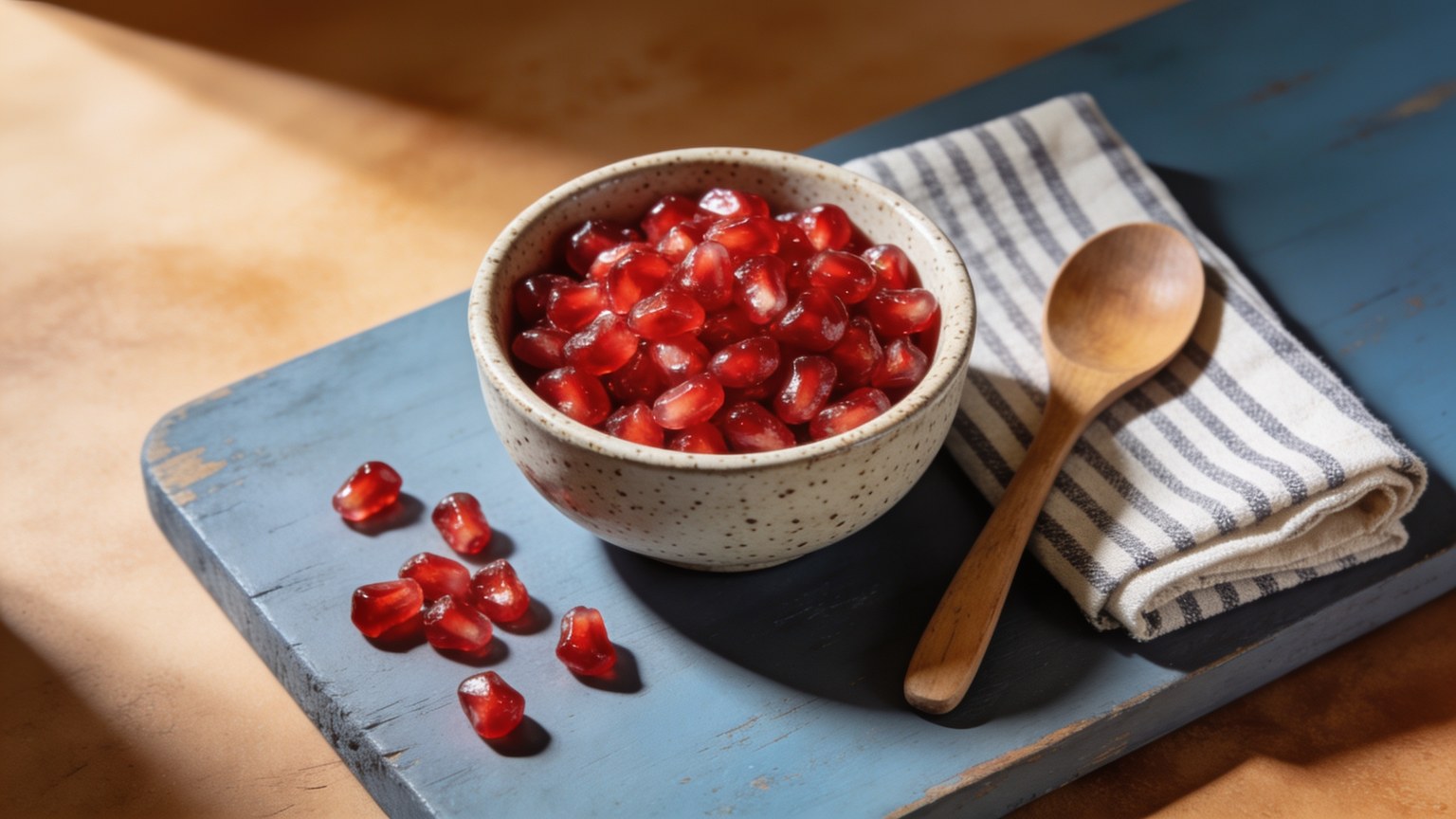
Read the label before the price. The USDA figures here are for plain bottled pomegranate juice; bottles sold as a juice drink or blend can carry other juices or added sugar, which the ingredient list will show.
Measure the glass once. 150 mL (5 fl oz) is a little under two-thirds of a US cup, smaller than most people pour by eye. The NHS advises keeping juice to mealtimes to limit the effect on teeth, and topping a measured pour with sparkling water makes a longer drink without adding sugar.
For the whole fruit, score the skin, break the pomegranate apart in a bowl of cold water, and loosen the arils with your thumbs: the arils sink and the pale pith floats. Scatter them over yogurt, oatmeal (porridge) or a salad, where they add crunch and color along with the fiber the juice leaves behind.
Pomegranate Juice Nutrition Facts
Frequently Asked Questions
Can you drink pomegranate juice with blood pressure medication?
Ask your pharmacist or doctor; the research can’t answer it for you. We found no study in people measuring whether the juice changes how a blood pressure drug works. The only blood pressure drug we found with an interaction signal, nitrendipine, comes from animal studies in rats (Phytotherapy Research, 2012) and rabbits (European Journal of Drug Metabolism and Pharmacokinetics, 2012). In healthy volunteers, the juice did not meaningfully change how the body handled midazolam (Clinical Therapeutics, 2011), simvastatin (European Journal of Drug Metabolism and Pharmacokinetics, 2016) or flurbiprofen (Clinical Pharmacology & Therapeutics, 2012), test drugs for the drug-processing enzymes CYP3A4 and CYP2C9. Against that stand case reports: rhabdomyolysis (muscle breakdown) in a man on rosuvastatin (American Journal of Cardiology, 2006) and unstable warfarin control in two patients (Pharmacotherapy, 2009; Emergency Medicine Journal, 2010), none of which proves the juice was the cause.
Does pomegranate juice lower blood sugar?
Not in the short trial that tested it most directly. In the 2026 Journal of Nutrition crossover, 8 fl oz of pomegranate juice produced the same glucose response as calorie-matched sugar water in 42 adults, in a trial open to people with prediabetes that excluded people with diabetes on medication. Across 34 randomized trials of pomegranate in any form (BMC Nutrition, 2025; 1,500 participants), fasting glucose was 3.04 mg/dL (about 0.17 mmol/L) lower, but HbA1c, the three-month average, did not change, and the authors found no significant non-linear link between juice dose and fasting glucose. If you have diabetes, count the juice as sugar and ask your care team how it fits.
Does pomegranate juice have vitamin C?
Very little in the bottled version. USDA lists 0.1 mg per 100 g of bottled pomegranate juice (FDC 167787), against 10.2 mg per 100 g of the raw fruit (FDC 169134). Half a cup of arils (87 g) gives 8.9 mg, about a tenth of the 90 mg Daily Value; a 300 mL glass of juice gives 0.3 mg.
The Bottom Line: A Small Glass, Counted as Sugar
Pomegranate juice may lower systolic pressure by about 5 mmHg over weeks, on moderate evidence; the drop was significant at up to 300 mL (10 fl oz) a day, a subgroup result, and it may not hold past two months. The same glass carries about 40 g of sugars, roughly the most a can of soda holds by the WHO’s count, so 150 mL with a meal, about 20 g of sugars, stays inside the 300 mL line and matches the NHS’s 150 mL daily cap. If you want one daily change for blood pressure, the swap our analysis of 25 years of sugary-drink data points to is whole fruit in place of juice, and a whole pomegranate brings 11.3 g of fiber the juice leaves behind.
Sources
- Phytotherapy Research, October 2023 — Ghaemi F, Emadzadeh M, Atkin SL, Jamialahmadi T, Zengin G, Sahebkar A. “Impact of pomegranate juice on blood pressure: A systematic review and meta-analysis.” 2023;37(10):4429-4441. https://pubmed.ncbi.nlm.nih.gov/37461211/
- Pharmacological Research, January 2017 — Sahebkar A, Ferri C, Giorgini P, Bo S, Nachtigal P, Grassi D. “Effects of pomegranate juice on blood pressure: A systematic review and meta-analysis of randomized controlled trials.” 2017;115:149-161. https://pubmed.ncbi.nlm.nih.gov/27888156/
- Phytotherapy Research, May 2024 — Bahari H, Omidian K, Goudarzi K, Rafiei H, Asbaghi O, Hosseini Kolbadi KS, Naderian M, Hosseini A. “The effects of pomegranate consumption on blood pressure in adults: A systematic review and meta-analysis.” 2024;38(5):2234-2248. https://pubmed.ncbi.nlm.nih.gov/38410857/
- Human Nutrition & Metabolism, 2026 — Sanei M, Bonyadian A, Maroofi M, Nikrad N, Noshadi N, Darzi M, Hadipour A, Askari G, Vajdi M. “Effects of pomegranate on blood pressure and endothelial function: A systematic review and meta-analysis of clinical trials.” 2026;44:200363. https://doi.org/10.1016/j.hnm.2026.200363
- The Lancet, May 2021 — Blood Pressure Lowering Treatment Trialists’ Collaboration. “Pharmacological blood pressure lowering for primary and secondary prevention of cardiovascular disease across different levels of blood pressure: an individual participant-level data meta-analysis.” 2021;397(10285):1625-1636. https://pubmed.ncbi.nlm.nih.gov/33933205/
- The Journal of Nutrition, September 5, 2026 (online ahead of print) — Zelicha H, Yang J, Diacova T, Wang J, Pan Y, Wang S, Heber D, Li Z. “Pomegranate Juice Induces Similar Glycemic but Distinct Incretin Responses Compared with Sugar Water: A Randomized Crossover Trial.” doi:10.1016/j.tjnut.2026.101821. https://pubmed.ncbi.nlm.nih.gov/42700818/ — registry: NCT04591782
- Circulation, August 18, 2026 — Nguyen M, AlEssa HB, Glenn AJ, Tobias DK, Chavarro JE, Willett WC, Hu FB, Hanley AJ, Birken CS, Sievenpiper JL, Malik VS. “Consumption of Fructose-Containing Food and Beverage Sources in Childhood Through to Adulthood and Risk of Hypertension: A Prospective Cohort Study.” 2026;154(7):612-623. https://pubmed.ncbi.nlm.nih.gov/42324999/
- BMC Nutrition, August 2025 — Mohammadzaheri F, Sheikhhossein F, Hemmati A, Ghoreishy SM, Mohammadi-Sartang M, Shiraseb F, Keshavarz SA. “The effect of pomegranate products on glycemic profile in adults: a GRADE-assessed systematic review and dose-response meta-analysis of randomized controlled trials.” 2025;11(1):168. https://pubmed.ncbi.nlm.nih.gov/40847381/
- Phytotherapy Research, August 2012 — Voruganti S, Yamsani SK, Ravula SK, Gannu R, Yamsani MR. “Effect of pomegranate juice on intestinal transport and pharmacokinetics of nitrendipine in rats.” 2012;26(8):1240-5. https://pubmed.ncbi.nlm.nih.gov/22275232/
- European Journal of Drug Metabolism and Pharmacokinetics, June 2012 — Voruganti S, Rapolu K, Tota S, Yamsani SK, Yamsani MR. “Effect of pomegranate juice on the pharmacokinetics of nitrendipine in rabbits.” 2012;37(2):77-81. https://pubmed.ncbi.nlm.nih.gov/22101410/
- Clinical Therapeutics, February 2011 — Misaka S, Nakamura R, Uchida S, Takeuchi K, Takahashi N, Inui N, Kosuge K, Yamada S, Watanabe H. “Effect of 2 weeks’ consumption of pomegranate juice on the pharmacokinetics of a single dose of midazolam.” 2011;33(2):246-52. https://pubmed.ncbi.nlm.nih.gov/21497708/
- European Journal of Drug Metabolism and Pharmacokinetics, August 2016 — Park SJ, Yeo CW, Shim EJ, Kim H, Liu KH, Shin JG, Shon JH. “Pomegranate juice does not affect the disposition of simvastatin in healthy subjects.” 2016;41(4):339-44. https://pubmed.ncbi.nlm.nih.gov/25720525/
- Clinical Pharmacology & Therapeutics, November 2012 — Hanley MJ, Masse G, Harmatz JS, Court MH, Greenblatt DJ. “Pomegranate juice and pomegranate extract do not impair oral clearance of flurbiprofen in human volunteers: divergence from in vitro results.” 2012;92(5):651-7. https://pubmed.ncbi.nlm.nih.gov/23047652/
- American Journal of Cardiology, September 2006 — Sorokin AV, Duncan B, Panetta R, Thompson PD. “Rhabdomyolysis associated with pomegranate juice consumption.” 2006;98(5):705-6. https://pubmed.ncbi.nlm.nih.gov/16923466/
- Pharmacotherapy, August 2009 — Komperda KE. “Potential interaction between pomegranate juice and warfarin.” 2009;29(8):1002-6. https://pubmed.ncbi.nlm.nih.gov/19637955/
- Emergency Medicine Journal, January 2010 — Jarvis S, Li C, Bogle RG. “Possible interaction between pomegranate juice and warfarin.” 2010;27(1):74-5. https://pubmed.ncbi.nlm.nih.gov/20029019/
- National Center for Complementary and Integrative Health (NIH) — “Pomegranate.” https://www.nccih.nih.gov/health/pomegranate
- NHS — “5 A Day: what counts?” https://www.nhs.uk/live-well/eat-well/5-a-day/5-a-day-what-counts/
- NHS — “Sugar: the facts.” https://www.nhs.uk/live-well/eat-well/food-types/how-does-sugar-in-our-diet-affect-our-health/
- World Health Organization, March 4, 2015 — “WHO calls on countries to reduce sugars intake among adults and children.” https://www.who.int/news/item/04-03-2015-who-calls-on-countries-to-reduce-sugars-intake-among-adults-and-children
- USDA FoodData Central — “Pomegranate juice, bottled” (SR Legacy, FDC ID 167787). https://fdc.nal.usda.gov/food-details/167787/nutrients
- USDA FoodData Central — “Pomegranates, raw” (SR Legacy, FDC ID 169134). https://fdc.nal.usda.gov/food-details/169134/nutrients
- USDA FoodData Central — “Prune juice, canned” (FDC ID 167753), “Plums, dried (prunes), uncooked” (FDC ID 168162) and “Blackberries, raw” (FDC ID 173946), all SR Legacy. https://fdc.nal.usda.gov/food-details/173946/nutrients
- U.S. Food and Drug Administration — “Daily Value on the Nutrition and Supplement Facts Labels.” https://www.fda.gov/food/nutrition-facts-label/daily-value-nutrition-and-supplement-facts-labels